- 10
- 1
- 0
- 1
- 0


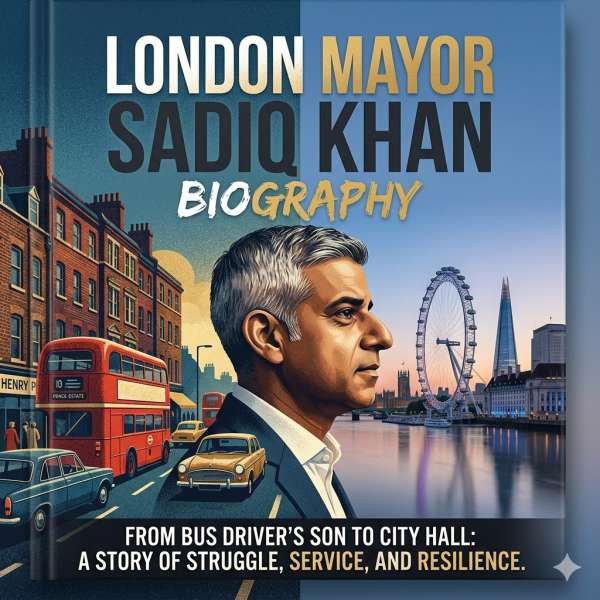
London Mayor Sadiq Khan Biography
The Henry Prince Estate in Earlsfield, South London, in the 1970s was not merely a cluster of concrete buildings; it was a microcosm of a changing Britain. For the young Sadiq Khan, it was the only world he knew, a vertical village where the sounds of different languages, the smell of diverse cuisines, and the shared struggle of working-class life blurred the lines between disparate cultures.
The Henry Prince Estate in Earlsfield, South London, in the 1970s was not merely a cluster of concrete buildings; it was a microcosm of a changing Britain. For the young Sadiq Khan, it was the only world he knew, a vertical village where the sounds of different languages, the smell of diverse cuisines, and the shared struggle of working-class life blurred the lines between disparate cultures.
London Mayor Sadiq Khan Biography
Chapter 1: The South London Landscape
The Henry Prince Estate in Earlsfield, South London, in the 1970s was not merely a cluster of concrete buildings; it was a microcosm of a changing Britain. For the young Sadiq Khan, it was the only world he knew, a vertical village where the sounds of different languages, the smell of diverse cuisines, and the shared struggle of working-class life blurred the lines between disparate cultures.
The estate, characterized by its stark, post-war architecture, stood as a testament to the era’s urban planning. But beneath the gray facade, there was a vibrant, pulsating energy. Sadiq was one of eight children, the son of Pakistani immigrants who had arrived in the United Kingdom in search of stability and opportunity. His father, Amanullah, was a man of quiet fortitude—a bus driver who navigated the sprawling, labyrinthine streets of London, and his mother, Sehrun, managed the logistical feat of keeping a large, boisterous household fed, clothed, and grounded in faith and tradition.
For Sadiq, childhood was defined by the density of his environment. With seven siblings, personal space was a luxury that simply did not exist. Life happened in the shared rooms, around the cramped kitchen table, and in the communal spaces of the estate. It was a chaotic, often noisy environment, but it was also a fortress of support. In the 1970s, the economic climate of the UK was volatile. There were strikes, industrial unrest, and a palpable sense of tension in the air. Yet, within the Khan household, the focus remained on the virtues of education, hard work, and the importance of community.
The South London of Sadiq’s youth was a place where identity was fluid. He navigated the complexities of being a first-generation British Pakistani in a neighborhood that was rapidly diversifying. He wasn’t just a child of the estate; he was a child of the city. The bus routes his father navigated became the arteries of Sadiq’s own world. As he played in the courtyards and walked to the nearby Fircroft Primary School, he began to observe the stark inequalities of the city. He noticed how the quality of public facilities, the frequency of bus services, and the general standard of living seemed to fluctuate depending on which side of the tracks you lived on.
These early observations were formative. They planted the seeds of a political consciousness that would take decades to fully bloom. He did not grow up thinking of himself as a future leader; he grew up simply trying to survive the pressures of a large family and make sense of his place in a country that often seemed ambivalent about his presence.
In the hallways of the Henry Prince Estate, Sadiq learned the most important lesson of his life: the power of proximity. By living in such close quarters with families from all walks of life—Caribbean, Irish, Indian, and English—he developed an innate ability to empathize with different perspectives. He learned that behind every closed door on the estate was a story of struggle, hope, and resilience.
As he stepped out of his front door each morning, he wasn't just walking into an estate in Earlsfield; he was walking into a laboratory of modern Britain. The lessons he learned in those early, formative years—the value of a well-funded bus service, the necessity of safe housing, and the fundamental dignity of every human being—would eventually become the bedrock of his career in public service. He was, in every sense, a product of the city he would one day go on to lead.
Chapter 2: The Bus Driver’s Legacy
If the Henry Prince Estate was the stage upon which Sadiq Khan’s early life played out, the iconic red London bus was the heartbeat that kept the rhythm of that stage. Amanullah Khan, Sadiq’s father, was a man of the road. For over twenty-five years, he sat in the driver’s seat of the city’s buses, navigating the complex arteries of London’s traffic, rain or shine.
In the 1970s and 80s, the role of a London bus driver was more than just a job; it was an essential function of the city's civic life. It was a role that required an immense amount of patience, a cool head, and a deep, almost encyclopedic knowledge of the city’s geography. Sadiq grew up watching his father head off to work in his uniform, an image that instilled in him a profound respect for the dignity of labor. He saw his father not as a cog in a machine, but as a facilitator of the city’s movement—a man who helped the nurse get to the hospital, the student to school, and the shopkeeper to their livelihood.
The bus, however, represented more than just his father’s profession; it was a tangible link to the city’s interconnectedness. While other children might have viewed the bus as just a mode of transport, to Sadiq, it was a social space. He saw the way his father treated his passengers—with respect, regardless of their background, their destination, or their status in life. Amanullah was a quiet, steady presence, a man who believed in the inherent value of public service and the responsibility one has toward the collective good.
These long shifts, often involving unsociable hours, meant that Amanullah was frequently away from home. Yet, his influence permeated the household. The financial stability that his job provided was the fragile platform upon which the family’s aspirations were built. Sadiq understood early on that this stability was hard-won. He watched his father return home exhausted, his back aching from hours behind the wheel, yet never complaining. The lesson was silent but profound: you work for the community, and in doing so, you serve your family.
This childhood perspective also provided Sadiq with a unique understanding of how London functioned—and how it failed. He would occasionally travel on his father’s bus, observing the diverse stream of humanity that boarded and exited. He saw the city as a living, breathing entity that relied on reliable, affordable infrastructure to thrive. When the service was slow, or the routes were poorly planned, he saw the frustration of the people who depended on it. He saw the way bad policy directly impacted the lives of working families.
The "bus driver’s son" identity would eventually become a powerful, recurring theme in Sadiq’s political life. It wasn't just a biographical detail; it was a symbol of his commitment to the "ordinary" Londoner. It grounded him, reminding him that the decisions made in the marbled halls of Westminster or the glass-walled offices of City Hall have immediate, real-world consequences for the person sitting in the passenger seat of a number 44 bus.
As he grew older, Sadiq realized that his father’s life was a masterclass in civic duty. Amanullah didn't have a title or a high-ranking position, but he moved the city. He ensured that the city didn't grind to a halt. In the years to come, as Sadiq navigated the complexities of political office, he would often find himself drawing on the quiet endurance and the service-oriented philosophy that he had observed in his father’s cab. The bus driver’s son had learned that the most important quality of a leader is not the ability to command, but the ability to keep things moving for the sake of everyone else.
Chapter 3: The Boys from Bevin
The transition from the intimacy of primary school to the sprawling, institutional environment of Ernest Bevin School was a definitive rite of passage for Sadiq. Located in Tooting, a stone’s throw from the neighborhoods he had always known, the school was to become the crucible where his identity as a South Londoner was forged in fire. Named after the legendary trade unionist and politician, the school carried a weight of working-class history, and its ethos felt like a natural extension of the values taught at the kitchen table on the Henry Prince Estate.
Ernest Bevin was not a place for the faint of heart. It was a boisterous, multicultural, and deeply competitive environment. For a young boy from a large, close-knit, and faith-observant family, navigating the social hierarchies of an all-boys comprehensive school required a delicate balance. Sadiq was small for his age, an observant figure among a sea of loud, energetic adolescents who were all busy asserting their own versions of masculinity.
This was the 1980s, a decade of profound social and political friction in Britain. The school corridors were a mirror of the society outside—vibrant, occasionally volatile, and deeply divided. Sadiq quickly learned that to thrive, one had to be articulate, quick-witted, and, above all, resilient. He wasn't the star athlete or the loudest boy in the class, but he possessed a sharp intellect and an innate ability to connect with people from vastly different backgrounds. He found himself moving effortlessly between groups—bridging the gaps between the academic strivers, the sports enthusiasts, and the boys who, like him, were navigating the complexities of their immigrant roots.
It was here that Sadiq began to shed his early shyness. The classroom became his domain. He discovered a genuine passion for debate, finding that he could hold his own in arguments, dismantle an opponent's logic, and persuade others to see his point of view. His teachers noticed this burgeoning ability. They encouraged him to speak up, to question, and to engage with the world beyond the school gate. The teachers at Bevin were instrumental in this shift; they recognized that Sadiq had a spark that, if nurtured, could lead him far beyond the boundaries of Tooting.
But the school was also where he encountered the harsher realities of life. He witnessed firsthand the impact of racism, of socio-economic disparity, and of the casual cruelties that teenagers can inflict upon one another. He saw boys with immense potential lose their way, derailed by the pressures of home life or the lack of opportunities that seemed to shadow their futures. These observations turned the school into a second, more complicated classroom. He began to internalize the idea that systemic inequality was not just an abstract concept; it was a force that decided which of his peers would succeed and which would be left behind.
Friendships made at Ernest Bevin were not superficial; they were forged in the daily grind of exams, sports matches, and the shared struggle to make sense of a world that was changing rapidly around them. These boys—his peers, his rivals, and his friends—were the ones who helped him understand the true meaning of the word "community." He learned that you could be a proud Muslim, a proud son of immigrants, and a proud Londoner all at the same time.
By the time he approached his final years at the school, Sadiq was no longer just a boy from the Henry Prince Estate. He was a burgeoning leader, someone who understood that the future was not something that simply happened to you—it was something you had to actively shape. The lessons of Ernest Bevin were clear: if you wanted a seat at the table, you had to earn it, and if you wanted to change the rules of the game, you had to be the one to master them.
Chapter 4: The Boxing Ring
If Ernest Bevin School taught Sadiq how to debate, the boxing ring taught him how to survive. In the mid-1980s, amidst the backdrop of a tough South London environment, boxing offered more than just physical fitness; it provided a sanctuary for discipline and a masterclass in emotional control. It was at a local gym that Sadiq first wrapped his hands and stepped into the ring, an experience that would leave an indelible mark on his character.
The sport of boxing is often misunderstood as merely about aggression, but for Sadiq, it was the opposite. It was a practice of restraint. To be a good boxer, you cannot simply throw wild punches in frustration. You must maintain your composure while someone is trying to hit you. You have to keep your eyes open, your guard up, and your feet moving. You have to learn the rhythm of your opponent so you can anticipate their next move before they even make it.
In the gym, the hierarchy of the outside world—where class, religion, or background might define a person’s status—was stripped away. You were judged by your work ethic, your conditioning, and your discipline. Sadiq was never the biggest or the most physically imposing boy in the ring, but he was scrappy and incredibly determined. He learned that the hardest blows to take were not necessarily the ones that caused physical pain, but the ones that shook your confidence. He learned how to swallow his fear and stand his ground, a skill that would later prove invaluable in the brutal, high-stakes arena of national politics.
The boxing gym was also a masterclass in strategy. Sadiq watched as his coaches broke down fights, identifying patterns and vulnerabilities. He realized that every problem, no matter how intimidating, had a technical solution. Whether it was navigating a difficult school debate or maneuvering through the complex social dynamics of his neighborhood, he began to apply the "boxer’s mindset": observe the opponent, protect yourself at all times, and look for the opening to counter-punch.
Crucially, the ring taught him about the inevitability of losing and the importance of getting back up. There were days he would leave the gym feeling defeated, his confidence bruised. But his coaches preached consistency. You don't quit because you lost a round; you train harder for the next one. This grit became a defining trait of his personality. It prevented him from becoming cynical when faced with the inevitable setbacks of adult life, and it gave him the stamina to weather the political storms that would define his career.
Moreover, the boxing gym introduced him to a diverse cross-section of people he might otherwise never have encountered. It was a space of intense, shared human experience. He fought alongside boys from different estates, different ethnicities, and different walks of life. In that confined, sweat-soaked space, they were all simply boxers. They looked out for one another, shared rides home, and celebrated each other’s successes.
As Sadiq transitioned from his teenage years toward adulthood, the boxing ring remained a constant. It was the place where he burned off the anxieties of being a young, ambitious man in a city that didn't always make space for people like him. He walked out of the gym stronger, not just in his muscles, but in his resolve. He understood that life, like a fight, wasn't about avoiding conflict—it was about how you handled yourself when the pressure was at its absolute highest.
Chapter 5: Law and the Working Class
The leap from the boxing ring to the courtroom was less of a departure than it might seem; it was a transition from physical discipline to intellectual combat. As Sadiq began his studies at the University of North London, the ambition to become a dentist—a path once considered a stable, respectable career—faded. He found himself drawn instead to the law, captivated by the idea that it could be a tool for systemic change rather than just a way to earn a living.
University was an eye-opener. It was here that the abstract theories of justice he had heard about were tested against the grit of reality. He wasn't studying the law in a vacuum; he was studying it alongside peers who, like him, were the first in their families to attend higher education. They discussed the law not just as a set of rules, but as a framework that had historically either protected or oppressed people like their parents.
He excelled, not because he was the most naturally gifted theorist, but because he possessed a singular, driven work ethic. He viewed his education as a privilege, a hard-won opportunity made possible by his parents’ sacrifices. While others spent their student years in leisure, Sadiq was already looking for ways to apply his learning. He volunteered at local community law centers, where the law was not about high-stakes corporate disputes, but about the everyday struggles of ordinary people: eviction notices, unfair dismissals, and discriminatory treatment by public institutions.
It was in these clinics that he found his true calling. He saw that for the vulnerable, the legal system was often a terrifying, opaque labyrinth. He learned that the law was only as good as the person fighting for it. He became a human rights solicitor, joining the firm Christian Fisher in 1994, where he quickly moved from trainee to partner.
Working at the coalface of the law, Sadiq spent his days representing people who had been ignored or marginalized. He took on cases involving police misconduct, discrimination, and civil liberties. He was no longer the boy on the estate looking at the world; he was now the man in the suit standing between the vulnerable and the powerful. He learned that to be an effective lawyer, you didn't just need to know the statutes; you needed to be able to tell your client’s story in a way that compelled a judge to listen.
This period was foundational. It honed his ability to analyze complex evidence and maintain calm under the crushing pressure of a trial. But more importantly, it stripped away any lingering illusions he had about the fairness of society. He saw, in vivid detail, how the structures of the city could fail the very people who kept it running. He began to realize that while the law could provide a remedy for an individual, politics could change the system that allowed the injustice to happen in the first place.
He was a "lawyer’s lawyer," respected by his peers for his tenacity and his grasp of human rights legislation. But as he walked home through Tooting, watching the same buses his father had driven, he couldn't shake the feeling that he was only treating the symptoms of a much deeper, broader set of problems. The transition from the law to the political arena was becoming inevitable.
Chapter 6: The Local Councillor
In 1994, Sadiq stepped into the local government arena, joining the Wandsworth Council as a councillor. If the legal world had taught him how to fight for the individual, the Council taught him how to fight for the community. Wandsworth was a challenging environment for a young Labour councillor, as it had long been a stronghold for the opposition. This meant that every victory—every bit of funding for a local project, every improvement to a street, every housing repair—had to be hard-fought.
His time at Wandsworth was an apprenticeship in the reality of governance. He quickly learned that politics at the local level was rarely about grand ideological debates; it was about bin collections, school placements, and street lighting. He was often the bridge between the council’s bureaucratic machinery and the residents of his ward. He spent his evenings attending community meetings, listening to the frustrations of families who felt neglected, and his days navigating the council’s committee structures to get things done.
It was during these years that he truly came into his own as a public representative. He realized that the most powerful thing a politician could do was to be present. He was constantly out in the borough, walking the streets, talking to shopkeepers, and meeting parents at school gates. He proved that he was not an "absentee" politician; he was a neighbor who just happened to hold a position of responsibility.
He gained a reputation for being an effective operator—someone who knew how to pull the right levers, build coalitions, and endure the frustration of slow-moving institutional change. He learned that in local politics, you have to play the long game. You don't always win the vote, but you stay in the fight to ensure that the residents’ voices are heard.
By the time he decided to look toward the national stage, he had mastered the fundamental art of the politician: the ability to listen to a problem, synthesize a solution, and effectively communicate that plan to the people it would impact. He had served the borough of Wandsworth for over a decade, and he left with the title of Honorary Alderman—a nod to the respect he had earned from both colleagues and political rivals. He was ready for the next move, but he would carry the lessons of Wandsworth with him into the high-pressure environment of Westminster.
Chapter 7: The Road to Westminster The year 2005 marked a seismic shift in Sadiq’s trajectory. After a decade of dedicated service to the Wandsworth Council, the opportunity arose to run for the Parliamentary seat of Tooting—the very neighborhood where he had grown up, attended school, and established his life. For Sadiq, this was not just a political vacancy; it was a rare, once-in-a-lifetime chance to represent the people who had shaped his identity. The selection process was grueling. In the hyper-competitive world of Labour party politics, being a "local boy" was an asset, but it was not enough. He had to prove he had the vision to navigate the national stage. He spent months campaigning, knocking on doors across the constituency, reminding residents that he was the person who knew their streets because he had walked them his entire life. He spoke of the need for better investment in public services and a more inclusive approach to politics that recognized the diversity of a changing London.His campaign was marked by the same discipline he had learned in the boxing ring. He didn't rely on grand rhetoric; he focused on the practical concerns of his neighbors. He talked about housing, education, and transport—the issues that actually moved the needle for families in South London. When he secured the nomination and subsequently won the seat in the 2005 General Election, it was a moment of profound personal validation. He had transitioned from the council estate to the halls of Westminster, yet he remained, in his own words, "the bus driver’s son from Tooting." Upon arriving in Parliament, the sheer scale of the institution was intimidating. The ornate, centuries-old traditions of the House of Commons were a far cry from the utilitarian atmosphere of City Hall or the courtroom. However, Sadiq quickly found his footing. He discovered that the skills he had honed as a human rights lawyer—the ability to analyze complex legislation, the tenacity to argue a point, and the composure to handle a hostile cross-examination—were exactly what he needed to stand out among the hundreds of other MPs. He began to make a name for himself as a sharp, principled, and occasionally contrarian voice, unafraid to challenge his own party leadership when he believed they were veering away from the values he had promised his constituents to uphold.
Chapter 8: Brown’s Cabinet By 2008, Sadiq’s reputation for efficiency and straight-talking had caught the attention of Prime Minister Gordon Brown. The political landscape was becoming increasingly turbulent, with the financial crisis looming and public trust in government beginning to fray. Brown needed ministers who could bridge the gap between Westminster and the public, and Sadiq, with his background in community legal work and local government, was seen as a key bridge-builder. When he was appointed Parliamentary Under-Secretary of State for Communities and Local Government, it was a historic moment. Sadiq became the first Muslim to serve as a Minister in the UK government to attend Cabinet. The appointment sent a powerful message about the changing face of modern Britain, but for Sadiq, the significance was not in the title; it was in the responsibility. He saw his role as an opportunity to ensure that the voices of underrepresented communities were heard at the highest level of government. His transition to Minister of State for Transport shortly thereafter was perhaps even more fitting. Having grown up watching his father navigate the city's bus network, he now found himself overseeing the very systems that kept London moving. He was, in effect, the "Minister for the Bus." It was a role he took immense pride in. He utilized the emerging power of social media—a novel tool at the time—to communicate directly with the public, breaking down the stiff, detached formality that often characterized ministerial communications. This period was a masterclass in executive governance. He learned how to manage vast budgets, navigate the Byzantine bureaucracy of Whitehall, and project a steady hand in the midst of a national crisis. He worked alongside some of the most powerful figures in the country, yet he maintained a focus on the minutiae of policy that would later become a hallmark of his mayoral administration. He was no longer just the MP for Tooting; he was a national figure, tasked with managing the infrastructure of a modern, global city. He was preparing for a much larger stage, even if he didn't yet know it.
Chapter 9: The Wilderness Years
The 2010 General Election was a watershed moment for the Labour Party. The transition from government to opposition was abrupt, and for Sadiq Khan, it marked the beginning of a period of deep introspection and strategic rebuilding. After five years of being in the engine room of government, he was suddenly on the sidelines, tasked with helping his party find its voice in a post-Brown, post-financial crisis era.
These were the "wilderness years." While the public often views opposition as a time of inaction, for a politician like Sadiq, it was a time of immense labor. He was appointed to the Shadow Cabinet, serving as Shadow Secretary of State for Justice. This role was a natural fit for a man who had spent his early career as a human rights lawyer. He stood across from the government benches, holding Ministers to account on legal aid cuts, prison reform, and the integrity of the judicial system.
In the face of the coalition government’s austerity measures, Sadiq’s work became increasingly focused on the human cost of policy. He saw how the legal aid changes were effectively shutting the doors of justice to the poorest in society—a direct reversal of the very principles he had fought for as a solicitor. His speeches during this time grew sharper, more focused on the intersections of inequality and the law.
But these years were also a test of political loyalty and endurance. The party was wrestling with its identity, moving through leadership changes and shifting priorities. Sadiq learned the importance of party management, often acting as a bridge between the party’s traditional base and its more metropolitan, progressive wings. He became a key figure in the party’s electoral machinery, serving as Ed Miliband’s campaign manager for the 2015 general election. The crushing defeat in that election was a personal and professional blow, a moment of profound disappointment that forced him to rethink his own political future. He had poured everything into the campaign, only to watch the party falter. It was in the quiet of that aftermath that the idea of the Mayoralty began to take hold.
Chapter 10: The Decision
The decision to run for Mayor of London did not happen overnight; it was the culmination of a decade of observing the city’s trajectory from the perspective of an MP, a Minister, and a local resident. In the months following the 2015 election, Sadiq spent time talking to Londoners—not just activists or party members, but people on the buses, in the markets, and in the community centers of Tooting. He asked them what they wanted from their city.
The answers were consistent: housing was becoming unaffordable, air quality was a silent crisis, and the transport network was struggling to keep pace with a growing population. There was a palpable sense that the city was becoming a playground for the wealthy, while the people who kept it running were being squeezed out. Sadiq saw a city in danger of losing its soul.
His internal debate was intense. A seat in Parliament is a place of influence, but the Mayoralty is a place of direct, executive power. To run for Mayor meant leaving the security of his Parliamentary seat and risking everything on a campaign that would be fought in the glare of a global spotlight. He knew that for a Muslim candidate in a city still grappling with complex issues of integration, the campaign would be vicious. He anticipated the dog-whistle politics and the personal attacks that would inevitably come his way.
His family’s support was the final, deciding factor. They discussed the toll a mayoral campaign would take on their private lives, understanding that their father’s face would be plastered on billboards and his character scrutinized by a hostile press. Yet, they agreed that the opportunity to shape the future of their home city was too important to ignore.
When Sadiq formally announced his candidacy, he framed his vision around the concept of "A Mayor for all Londoners." He wasn't just promising better policies; he was promising a return to the values of his childhood: opportunity, dignity, and fairness. He had the boxing gym’s grit, the solicitor’s forensic attention to detail, and the councillor’s deep understanding of local life. He wasn't just running for office; he was beginning a campaign to defend the city that had raised him.
Chapter 11: The 2016 Campaign
The 2016 Mayoral campaign was, by any historical measure, a watershed moment in British politics. It was not merely a contest over transport policy or housing numbers; it became a proxy war for the soul of London and, by extension, the nature of contemporary British identity. From the moment Sadiq secured the Labour nomination, the atmosphere turned toxic.
His opponent, Zac Goldsmith, backed by a significant campaign apparatus, opted for a strategy that many observers later labeled as "dog-whistle" politics. The discourse shifted from the bread-and-butter issues of city management to questions of background, faith, and perceived associations. Sadiq found himself in the crosshairs of a smear campaign designed to cast him as an "other"—a figure incompatible with the values of the city he sought to lead.
For Sadiq, the experience was a grueling test of the discipline he had honed as a boxer. In the ring, you do not retaliate with anger when hit; you maintain your composure and keep your eyes on the opponent’s next move. Throughout the debates and public appearances, he refused to take the bait. He stayed focused on his "London is Open" mantra, emphasizing his identity as the "bus driver’s son" and speaking directly to the aspirations of Londoners across every borough.
The climax of the campaign demonstrated the city's maturity. Despite the attempts to sow division, the electorate responded to his message of unity and practical progress. On May 5, 2016, Sadiq Khan was elected the Mayor of London with the largest personal mandate of any politician in the history of the United Kingdom. It was a historic victory—the first time a Muslim had been elected mayor of a major Western capital. As he walked into City Hall, the weight of the office was immense, but the victory had sent a clear message: London was not interested in the politics of fear.
Chapter 12: "London Is Open"
The morning after the election, the reality of the Mayoralty set in with a swiftness that left little time for celebration. The city was in a state of nervous anticipation. The UK was fast approaching the pivotal Brexit referendum, and the mood in London—a city that had voted overwhelmingly for remaining in the European Union—was anxious.
Sadiq’s first act as Mayor was to launch the "London Is Open" campaign. It was a simple, declarative statement, but in the context of the isolationist rhetoric growing elsewhere, it was a radical act of defiance. He traveled to European capitals, meeting with leaders and business executives to assure them that London remained a global, welcoming, and open city, regardless of the coming political upheavals.
Internally, he had to grapple with the massive, sprawling bureaucracy of the Greater London Authority and the myriad agencies under its purview. He moved quickly to assert control over Transport for London (TfL), the city’s lifeblood. He understood that while the "London Is Open" campaign was essential for the city’s international brand, his domestic reputation would be built on the quality of life for the people on the ground.
He began the process of assembling his team—a mix of policy wonks, seasoned political operators, and community advocates. He was a demanding boss, known for his forensic attention to detail and his insistence on clear, actionable data. He wanted to know the "why" behind every proposal and the "how" behind every budget line. The "bus driver’s son" had finally reached the helm, and he was determined to prove that a city could be both globally ambitious and locally focused. He was no longer reacting to the political climate; he was defining it.
Chapter 13: The Hopper and the Streets
Sadiq Khan arrived at City Hall with a clear understanding of the city's nervous system: the bus network. He knew that for millions of Londoners, the cost of transport was not just an economic statistic; it was the primary factor determining their quality of life, their job prospects, and the time they could spend with their families. The implementation of the "Hopper" fare—allowing passengers to take unlimited bus journeys within an hour for the price of a single ticket—was his first major political victory.
The policy was classic Sadiq: practical, impactful, and delivered with a focus on those who needed it most. It was designed to help the low-income worker, the student, and the parent juggling school runs and shifts. While critics initially questioned the fiscal sustainability of such a move, Sadiq leaned on his experience in Treasury-related roles during his time as a minister. He insisted on a disciplined approach to the budget, ensuring that the fare freeze and the Hopper fare did not collapse the transport finances.
Beyond the numbers, the Hopper was a symbolic statement. It signaled a shift from an era where transport was often viewed as a commodity for the elite, toward a model where it was treated as an essential public utility. He spent hours in meetings with TfL commissioners, pushing them to think about service reliability not just as an operational metric, but as a commitment to the citizen. He understood that when a bus didn't show up, it wasn't just a delay; it was a lost wage or a missed appointment.
The success of the Hopper bolstered his standing and gave him the political capital to push further. He began to look at the streets themselves, not as conduits for cars, but as public spaces. He championed the idea of "Healthy Streets," pushing for better cycling infrastructure and wider pavements. It was a vision that occasionally clashed with the habits of a car-dependent minority, but Sadiq remained steadfast. He viewed the city not as it was in the past, but as it needed to be for the future: a place where people could breathe, move, and thrive.
Chapter 14: The Climate Frontier
If transport was the lifeblood of London, the environment was its lungs, and Sadiq quickly identified that the city’s air quality was in a state of crisis. Growing up on a council estate in South London, he had seen the impact of pollution, but as Mayor, he saw the data—the stark, undeniable numbers showing thousands of premature deaths linked to toxic air. It was a public health emergency that demanded an urgent response, regardless of the political friction it would cause.
Sadiq became a global leader in the climate movement, leveraging his position as chair of the C40 Cities network to put London at the forefront of the green transition. He realized that city mayors had a unique capacity to act where national governments were often paralyzed by ideology or gridlock. He began the ambitious work of transforming London’s fleet of red buses into zero-emission vehicles, setting a goal that was initially considered wildly optimistic.
The climate agenda became the backbone of his long-term strategy for London. He wasn't just talking about abstract carbon reduction targets; he was talking about the health of the children breathing the air in classrooms near busy arterial roads. This focus provided him with a clear moral mandate. When he faced pushback from industries that relied on older, polluting models, he framed the conversation back to the well-being of the next generation.
His commitment to the environment was also a strategic play for the city’s economic future. He argued that a green London was a competitive London—a city that could attract the best talent and the most innovative companies because it was a pleasant, sustainable, and healthy place to live. He was positioning London to thrive in a low-carbon world, understanding that the cities that moved first would be the ones that led the century. He was no longer just the boy from the Henry Prince Estate; he was an architect of the modern, sustainable metropolis.
Chapter 15: The ULEZ StruggleIf the climate agenda was a vision of the future, the expansion of the Ultra Low Emission Zone (ULEZ) was the battleground where that future collided with the present. The policy—designed to charge the most polluting vehicles to discourage their use in the capital—had begun in the city center with relative calm. But as Sadiq announced the expansion to the rest of Greater London, the political temperature surged.The opposition was intense. For many residents in outer London, where public transport options were less dense than in the center, the car was not a luxury; it was a lifeline. Families who relied on older vehicles to get to work or the school run saw the charge as an unfair tax on the working class. The debate quickly became toxic, fueled by misinformation and the amplification of grievances through social media and parts of the press. Sadiq found himself at the center of a storm. He was accused of being "out of touch" and "anti-motorist." The conflict reached the halls of the London Assembly, where his political opponents levied formal complaints, alleging that the consultation process had been manipulated to favor the expansion. Through it all, Sadiq stuck to the data: the thousands of premature deaths linked to air pollution were a reality he could not ignore. He argued that the cost of inaction—the long-term health burdens on the city’s children—was far higher than the price of a daily charge.It was a test of his resolve. He wasn't just managing a city; he was navigating a fundamental shift in urban living. The High Court challenge to the expansion, which ultimately ruled in his favor, provided the legal vindication he needed, but the political scars remained. The struggle over ULEZ taught him that the most necessary policies are often the most politically perilous, and that leadership requires the fortitude to carry forward in the face of widespread, deeply felt opposition.Chapter 16: Testing TimesIn early 2020, the world changed. The COVID-19 pandemic descended upon London with a speed that left the city reeling. As the Mayor, Sadiq found himself managing the greatest crisis in the city’s post-war history. London became the epicenter of the UK’s outbreak, and the human cost was devastating.Sadiq’s leadership during this period was characterized by a constant push-and-pull with the central government. He became a vocal advocate for the city’s needs, calling for better testing, clearer public health guidance, and consistent financial support. He didn't shy away from confrontation when he believed the government’s lack of preparation was putting lives at risk.The economic fallout was equally dire. Transport for London (TfL), the backbone of the city, saw its revenue plummet overnight as the city went into lockdown. Sadiq had to negotiate a series of emergency bailouts with the government, each accompanied by stringent conditions, including forced fare hikes that he personally loathed but felt were necessary to keep the system running. Throughout the long, gray months of the pandemic, Sadiq’s presence was a daily constant. He held press conferences, spoke with grieving families, and communicated directly with Londoners, emphasizing the values of community and shared responsibility. He recognized early on that the pandemic was not an "equalizer"—it hit the poorest boroughs and minority communities the hardest. His calls for an inquiry into these inequalities were a reflection of his own roots; he saw that the crisis had simply exposed the structural flaws in the city he had always known.It was a period of profound exhaustion, both for the city and its leader. When the lockdowns finally lifted, the London that emerged was different. The office culture had shifted, the economy was fragile, and the social contract was under immense strain. But through it all, Sadiq had kept the city moving—literally and figuratively. He had proven that even in the face of an existential threat, the city could adapt, endure, and ultimately begin the long process of recovery.
Chapter 17: The Affordable Housing Crisis The housing crisis was not merely a problem of supply; it was, in Sadiq’s view, a moral failure of the highest order. When he took office in 2016, he inherited a landscape where the dream of owning a home in London had become a distant, almost impossible aspiration for the majority of the city's residents. He recognized early that the market, left to its own devices, would never provide for those on low and middle incomes. He took a two-pronged approach. First, he shifted the focus of City Hall toward "genuinely affordable" housing, redefining what that term meant to exclude the expensive "affordable" brackets favored by previous administrations. He pushed for social rent—the most affordable tier—which had seen near-zero delivery in the years preceding his tenure. By 2026, he could point to a turnaround: record-breaking council home starts that surpassed the levels of the 1970s. He backed boroughs with the funding and the institutional support to reclaim their role as homebuilders, transforming once-dormant planning departments into engines of construction. But the crisis required more than just building. Sadiq became the champion of the renter, a segment of the population that had long been ignored by a political system skewed toward homeowners. He launched initiatives like the "rogue landlord" checker, providing tenants with the tools to hold predatory landlords accountable. He fought for rent controls and better protections, often finding himself in direct opposition to powerful real estate interests. He understood that for a city to be truly "open," people had to be able to afford to live in it. His goal for his third term was even more ambitious: 40,000 new council homes by 2030 and the introduction of new "rent control" housing models. He viewed every new social rent home not just as a unit of construction, but as a victory for the "bus driver’s son" ethos—ensuring that the next generation of Londoners wouldn't be priced out of the city that raised them.
Chapter 18: Policing and Youth The relationship between the Mayor and the Metropolitan Police was perhaps the most complex and delicate thread of Sadiq’s entire administration. As the head of the Mayor’s Office for Policing and Crime (MOPAC), he walked a constant tightrope: holding the nation’s largest police force to account for its failures, while simultaneously ensuring it had the resources to keep a growing city safe. Following the devastating findings of the Casey Review, which exposed deep-seated cultural issues within the Met, Sadiq moved toward radical reform. He backed the Commissioner in a "clear-out" of rogue officers, overseeing the dismissal of nearly 1,500 individuals who failed to meet the standards required of the uniform. He invested millions into a new Leadership Academy, aiming to transform the culture from the top down. Yet, this was a friction-filled process. He faced criticism from the police hierarchy when he stood firm on procurement and process—such as his decision to block a high-profile AI contract that bypassed standard oversight—insisting that public money required total transparency. He navigated these disputes with the same composure he had learned in the boxing ring, refusing to allow the police force to become a "political football" while demanding that it remain responsive to the needs of the community. Central to his strategy was the Violence Reduction Unit (VRU), a pioneering public health approach that treated knife crime not just as a criminal issue, but as a symptom of deeper social neglect. He diverted funds into youth clubs, apprenticeships, and mental health services, believing that the way to prevent crime was to give young Londoners a viable, hopeful path forward. As he entered his third term, his mission remained steadfast: 1,300 more police on the streets, record funding for the protection of women and girls, and a relentless focus on making every neighborhood in the city feel safe. He was proving that you could be tough on crime and tough on the causes of crime at the same time.
Chapter 19: The Third Term The 2024 mayoral election was, in many ways, the definitive test of Sadiq Khan’s political endurance. With the electoral rules shifting to a "first-past-the-post" system—a change engineered by his political opponents in the hope of creating a more volatile landscape—the stakes had never been higher. Yet, on May 2, 2024, the result was a resounding confirmation of his mandate. With 43.8% of the vote, Sadiq secured a historic third term, defeating his Conservative challenger, Susan Hall, by a margin of over 275,000 votes. For Sadiq, this victory was not merely a repetition of the past; it was a solidification of a new era. During the campaign, he had faced intense pressure from multiple directions, ranging from the fallout of his environmental policies to the broader national discontent with the political establishment. Yet, the electorate’s decision to return him to City Hall signaled a desire for stability and a continuation of his core agenda: record-breaking house building, the expansion of free school meals, and the unrelenting pursuit of a safer, cleaner city. The victory speech at City Hall, though momentarily interrupted by a lone heckler, was a moment of quiet reflection. He thanked Londoners for their trust, framing the result as a mandate to keep pushing forward on the issues that mattered most to working families. Having won in nine of the fourteen assembly constituencies—including, for the first time, the historically challenging West Central area—he had moved beyond the traditional divides of the city’s political map. He was no longer just a representative of his base; he was the first citizen of a global metropolis that had clearly chosen his vision of progress over the politics of division.
Chapter 20: The Unfinished City As Sadiq Khan entered his third term in the summer of 2026, he found himself in a unique position in London’s history. He was the architect of a city currently undergoing a profound transformation. The "Unfinished City," as he often called it, was not a failing place, but a project in constant motion—always striving, always building, and always wrestling with the contradictions of its own success. His vision for the years ahead was focused on completion and consolidation. The climate agenda, once a radical outlier, had become the mainstream operating logic for the Greater London Authority. The infrastructure he had fought to protect during the pandemic was now serving as the foundation for a new, post-industrial economic strategy. Yet, he remained acutely aware of the challenges on the horizon: the ongoing housing crisis, the evolution of a policing model that still required deep trust-building, and the perennial need to ensure that London’s prosperity remained accessible to every resident, from the outer boroughs to the city center.Reflecting on his journey, the boy from the Henry Prince Estate, the human rights lawyer, and the three-term Mayor recognized that the work would never truly be "finished." A city, like the people who inhabit it, is a living thing. His role, as he saw it, had been to provide the scaffolding upon which the next generation could build. He had navigated the storms of Brexit, the darkness of a global pandemic, and the toxicity of modern political combat, emerging with his core values—dignity, fairness, and the importance of the common good—intact.Whether he would eventually step back into the private sphere or continue to influence the national discourse remained a question for the future. But for now, he was content to be exactly where he had always aspired to be: at the service of his city, working on the next bus route, the next home, and the next opportunity for a young Londoner who, like him, just needed a seat at the table to change the world.
Недавно прослушал


Комментариев не найдено
Больше треков