- 16
- 1
- 0
- 0
- 0


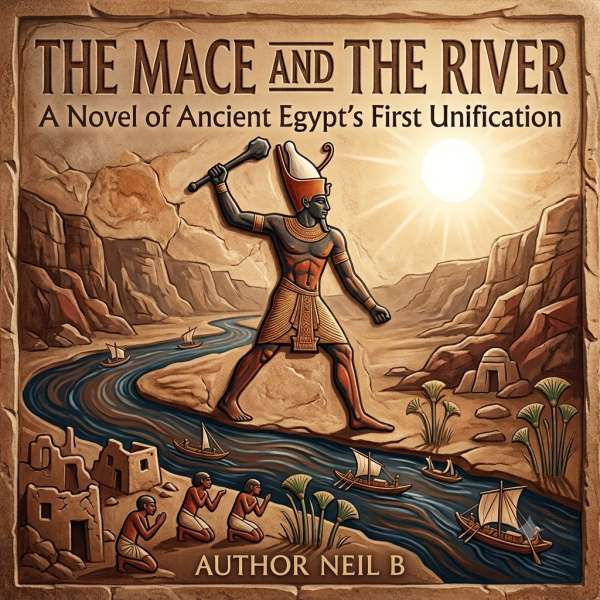
The Mace and the River
A Novel of Ancient Egypt's First Unification
Prologue: The Weight of the Sun
The morning sun over the Nile valley is white and unforgiving. It strikes the mud brick houses of the riverbanks, turning the air above the water into a shimmering blur. Men stand on the banks near Hierakonpolis, their feet buried in the dark, heavy silt left behind by the receding flood. They are laborers, carrying baskets of grain toward the granaries, their chests heaving with the rhythm of the work. Sweat beads on their shoulders, tracking lines through the dust. The river flows wide and sluggish, a deep brown vein that provides everything—and demands everything in return.
A Novel of Ancient Egypt's First Unification
Prologue: The Weight of the Sun
The morning sun over the Nile valley is white and unforgiving. It strikes the mud brick houses of the riverbanks, turning the air above the water into a shimmering blur. Men stand on the banks near Hierakonpolis, their feet buried in the dark, heavy silt left behind by the receding flood. They are laborers, carrying baskets of grain toward the granaries, their chests heaving with the rhythm of the work. Sweat beads on their shoulders, tracking lines through the dust. The river flows wide and sluggish, a deep brown vein that provides everything—and demands everything in return.
The Mace and the River
A Novel of Ancient Egypt's First Unification
Prologue: The Weight of the Sun
The morning sun over the Nile valley is white and unforgiving. It strikes the mud brick houses of the riverbanks, turning the air above the water into a shimmering blur. Men stand on the banks near Hierakonpolis, their feet buried in the dark, heavy silt left behind by the receding flood. They are laborers, carrying baskets of grain toward the granaries, their chests heaving with the rhythm of the work. Sweat beads on their shoulders, tracking lines through the dust. The river flows wide and sluggish, a deep brown vein that provides everything—and demands everything in return.
For generations, the people of the valley have lived in independent towns, each clustered around a local shrine. They have their own leaders, their own traditions, and their own small wars for grazing rights. A man living in the north knows the life of the delta, while a man in the south knows only the cataracts and the harsh, narrow strip of green between the desert cliffs. They have never known a single king who commands the length of the river.
But the pressure is building. The harvests are no longer sufficient to keep the local lords in luxury. There is a hunger for more land, more control, and more direct access to the trade routes that bring cedar from the north and gold from the south. The lords are arming their men, and the skirmishes at the borders of the districts are becoming more frequent.
Two men, one from the north and one from the south, are preparing for a confrontation that will dictate the fate of the entire river. The southern king, known to history as Narmer, watches his men sharpen their copper maces. He is a man who understands that survival depends on absolute control. He does not want a treaty. He wants the river.
The tension becomes an unbearable weight. The local leaders meet to debate terms, but their voices are lost in the sound of drums. In the south, the army is already on the move.
Part One: The Kingdoms Before
Chapter One: The Scribe of Hierakonpolis
Khenemet sat cross-legged in the shade of the granary wall, his reed brush hovering over a broken shard of pottery. The morning heat had already become oppressive, and the sweat dripped from his brow onto the clay surface, smearing the careful symbols he had just inscribed. He cursed softly under his breath and reached for a cloth to wipe the damage.
He was thirty-two years old, a scribe of the middle rank, and he had spent his entire life in the service of the temple of Horus at Hierakonpolis. His father had been a scribe before him, and his grandfather before that, their names recorded in the temple archives alongside the harvest tallies and the royal decrees. Khenemet had never questioned his path. He had been born with a brush in his hand, and he would die with one.
But lately, he had begun to question everything.
The granary was one of the largest structures in the city, its walls thick enough to withstand the heat and its roof high enough to hold the wealth of an entire district. Baskets of emmer wheat and barley were stacked in careful rows, each one marked with the symbol of its village of origin. Khenemet moved among them, checking his tallies against the day's deliveries, his sandals whispering against the packed earth floor.
"The northern villages are late again," said a voice behind him.
Khenemet turned. It was Menes, the chief overseer, a man whose belly had grown soft from years of directing others. His eyes were small and calculating, and he wore a pectoral of beaten copper that marked his status above the common laborers. His presence always made Khenemet uncomfortable. Menes had a way of speaking that suggested he knew secrets that others did not.
"The flood was low this year," Khenemet replied carefully. "The northern fields may have suffered."
Menes snorted. "The northern lords are hoarding their grain. They do not wish to share with the south." He stepped closer, his voice dropping to a conspiratorial murmur. "I have heard that the king of the north has fortified his border towns. He means to block our trade routes to the delta."
Khenemet felt a cold knot form in his stomach. He had heard similar whispers in the market, in the temples, in the quiet moments between prayers. The lords of the valley were arming their men, and the skirmishes at the borders of the districts were becoming more frequent.
"The harvests are no longer sufficient," Menes continued. "The local lords cannot maintain their luxury. There is a hunger for more land, more control, more direct access to the trade routes that bring cedar from the north and gold from the south. The hunger is growing, Khenemet. And hunger, as you know, leads to war."
Khenemet said nothing. He only bent lower over his tablet, his brush moving with practiced precision. But his mind was elsewhere—on the river, on the distant northern delta he had never seen, on the possibility of a world transformed by violence.
That evening, as he walked home through the dusty streets of Hierakonpolis, Khenemet noticed something different about the city. The usual sounds of domestic life—the laughter of children, the chatter of women at the well, the lowing of cattle—were muted, replaced by a tense, expectant silence. Men stood in small groups, their voices low, their eyes darting toward the palace on the hill.
At the center of the city, near the temple of Horus, a crowd had gathered. Khenemet pushed his way through, his heart pounding in his chest. On the stone platform before the temple stood the king's herald, a tall man with a voice like thunder.
"Hear me, people of Hierakonpolis!" the herald bellowed. "The king commands that all able-bodied men report to the training grounds at dawn. The army is being assembled. The northern delta must be brought to heel. The king demands your loyalty. The king demands your strength. The king demands your blood, if necessary."
A murmur rippled through the crowd. Khenemet saw fear in the eyes of the men around him, but also something else—a flicker of excitement, a hunger for adventure and glory. He himself felt nothing but dread.
He made his way home to his small mud-brick house, where his wife, Neferet, was waiting with their two children. Neferet was a weaver, her fingers nimble and quick, her eyes sharp. She took one look at his face and knew that something was wrong.
"What happened?" she asked.
Khenemet slumped onto a low stool, his head in his hands. "The king is raising an army. He means to march north."
Neferet's face went pale. "They will not take you. You are a scribe, not a soldier."
"Even scribes can be conscripted," Khenemet said. "Every man is needed. The king wants to unite the entire valley under his rule. He wants to be the lord of all Egypt."
"Egypt," Neferet repeated, the word strange on her tongue. "What is Egypt?"
Khenemet looked up at her, his eyes haunted. "I don't know yet. But I think we are about to find out."
Chapter Two: The King of the South
Narmer stood on the stone platform before his palace, his arms crossed over his chest, his eyes fixed on the horizon. The sun was setting behind the western cliffs, painting the sky in shades of gold and crimson. He was a man in his prime, his body hardened by years of military campaigns and his mind sharpened by the counsel of his priests. His crown was white, the crown of the south, and his kilt was fastened with a belt of gold and lapis lazuli. He was the king of Hierakonpolis, the most powerful ruler in the upper valley, and he was not satisfied.
Behind him, his vizier, a thin man named Shepses, recited the morning reports. "The grain reserves are at sixty percent capacity. The northern border has been breached twice in the past month by raiders from the delta. The copper mines have yielded less than expected."
Narmer did not turn. "The northern king," he said, his voice low and cold. "What does he want?"
"He wants to maintain his independence," Shepses replied. "He has refused all offers of federation. He believes that the northern delta can sustain itself without the south."
Narmer's jaw tightened. "He is a fool."
"He is a fool with an army, my lord. And the backing of the marsh lords."
Narmer finally turned, his eyes meeting those of his vizier. There was something in his gaze that made Shepses take a step backward—a hunger, a determination, a vision of absolute control.
"I do not want a treaty," Narmer said. "I do not want a federation. I want the river." He gestured broadly at the valley below, the green strip of farmland stretching between the desert cliffs. "All of it. From the first cataract to the sea. Every village, every shrine, every palm grove. I want the northern king to kneel, or I want him dead."
Shepses swallowed hard. "My lord, the northern army is formidable. The marshes are difficult to navigate. The delta lords have their own alliances, their own loyalties..."
"Then I will break their alliances," Narmer said. "I will drown their loyalties in the river." He stepped closer to his vizier, his voice dropping to a whisper. "Prepare the army. We march in seven days."
That night, Narmer did not sleep. He stood on the balcony of his palace, gazing out at the dark river below. The moon reflected off the water, creating a silver path that seemed to stretch to the horizon. He thought of his father, the previous king, who had ruled with wisdom and caution. He thought of his grandfather, who had expanded the southern borders through careful diplomacy. But Narmer was not his father or his grandfather. He was something new, something the valley had never seen.
He thought of the northern king, Iry-Hor. He had never met the man, but he had heard stories. Iry-Hor was old, cautious, wedded to the old ways. He believed in the independence of the districts, the autonomy of the local shrines. He was a man of the past. Narmer was a man of the future.
"The past is dead," Narmer whispered to the river. "And I will be the one to bury it."
Chapter Three: The Northern Court
In the northern delta, in the city of Pe, Iry-Hor sat in his audience chamber, surrounded by his advisors. The chamber was large and airy, its walls covered with painted scenes of marsh life and hunting expeditions. The air was thick with the scent of lotus blossoms and incense, and the sound of water lapping against the palace walls provided a constant, soothing background.
Iry-Hor was old, his hair streaked with gray, his body softened by years of feasting and diplomacy. But his eyes were sharp, and his mind was still quick. He had ruled the northern delta for thirty years, and he had seen enough challenges to know when a threat was real.
"He means to conquer us," said Bebi, his general, a scarred veteran with a voice like gravel. "Narmer has raised an army of ten thousand men. They are marching north even now."
Iry-Hor nodded slowly. "I expected as much. Narmer is not a man who shares power."
"We can fight them," Bebi said. "The marshes are our home. We know every channel, every sandbar, every patch of hidden ground. The southerners will be lost in the reeds."
"And if we win?" Iry-Hor asked. "If we drive them back? What then? They will return next year, and the year after that. Their hunger for our land will not end." He turned to his general, his expression weary. "There is no middle ground left. If I turn them away, I lose my status. If I welcome them, I lose my crown. And if I meet them on the battlefield..." He sighed. "The chance for a peaceful federation has evaporated."
One of his advisors, a priest of the temple of Wadjet, stepped forward. "My lord, the goddess has spoken. She says that the south will come like a flood, but the north will endure. The marshes are sacred. They cannot be conquered."
Iry-Hor smiled bitterly. "The goddess speaks in riddles, as always. The marshes can be conquered. All things can be conquered. The question is whether we will survive the conquest."
Another advisor, a merchant named Khenemet—no relation to the southern scribe—spoke up. "My lord, what of the trade routes? If the south controls the delta, they will control the cedar from Lebanon, the copper from Sinai, the gold from Nubia. Our wealth will flow south. We will become a province, nothing more."
Iry-Hor rose from his throne, his movements slow and deliberate. "I have heard enough," he said. "I have heard fear. I have heard despair. I have not heard courage." He turned to Bebi. "Prepare the army. We will meet them on the open plain. Let the gods decide who will rule the river."
Bebi bowed. "It will be done, my lord."
As the advisors filed out of the chamber, Iry-Hor remained behind, staring at the painted walls. He saw the huntsmen, the birds, the fish, the reeds. He saw the world he had known his entire life. And he knew, with a certainty that chilled him to the bone, that it was about to end.
Part Two: The March
Chapter Four: The Gathering
The training grounds outside Hierakonpolis were a chaos of activity. Thousands of men had gathered from the towns and villages of the south, their bodies painted with the symbols of their districts, their weapons clutched in trembling hands. Some were experienced soldiers, hardened by years of border skirmishes. Others were farmers, fishermen, potters, weavers—men who had never held a spear before.
Khenemet stood at the edge of the training grounds, his tablet tucked under his arm, his brush tucked behind his ear. He had been conscripted as a scribe, tasked with recording the names of the soldiers and the inventory of their weapons. It was a minor role, but it meant he would be traveling with the army. It meant he would see the war.
He watched as a young soldier named Nakhti practiced with his spear, thrusting and parrying at an imaginary opponent. Nakhti was barely eighteen, his body still lean and boyish, but there was a fierce determination in his eyes that made him look older.
"Have you ever killed a man?" Khenemet asked.
Nakhti paused, his spear lowered. "No," he admitted. "Have you?"
Khenemet shook his head. "I am a scribe. I record deaths. I do not cause them."
"Today, you are a soldier," Nakhti said. "We are all soldiers. The king commands it."
Khenemet looked at the thousands of men around them, their faces a mixture of fear and excitement. "The king commands a great deal," he said. "I wonder if he understands what he is asking."
"Does it matter?" Nakhti asked. "He is the king. He is the voice of Horus. We do not question the king."
Khenemet opened his mouth to reply, but he was interrupted by a blast of trumpets. The crowd fell silent as Narmer appeared on a raised platform, his white crown gleaming in the sun. He was dressed for war, his chest bare, his mace in his hand. He looked like a god.
"Men of the south!" Narmer shouted, his voice carrying across the training grounds. "Today, you are no longer farmers, no longer fishermen, no longer potters. Today, you are soldiers. Today, you are the children of Horus. Today, you will march north and claim what is rightfully ours!"
A cheer erupted from the crowd, a roar of approval that shook the ground. Khenemet found himself cheering too, even though his heart was not in it.
"The northern delta is rich," Narmer continued. "Its fields are fertile. Its marshes are filled with fish. Its cities are filled with gold. But the northern king, Iry-Hor, is weak. He clings to the old ways. He clings to a past that is dead. He does not deserve the wealth of the river. He does not deserve the loyalty of his people. I will take it from him. I will take it all!"
Another cheer, louder than before. Narmer raised his mace above his head, and the crowd fell silent.
"Men of the south," he said, his voice low and intense. "We march at dawn. Prepare yourselves. The river is ours."
He descended from the platform and walked through the crowd, his men parting before him like water. Khenemet caught a glimpse of his face as he passed—and what he saw chilled him. Narmer's eyes were not filled with the passion of a warrior. They were filled with the cold, calculating hunger of a man who would stop at nothing to achieve his goal.
Chapter Five: The Scribe's Dilemma
That night, Khenemet sat alone in his tent, his tablet balanced on his knees. The sounds of the camp drifted in from outside—the crackle of campfires, the murmur of voices, the occasional burst of laughter. He should have been recording the day's activities, but his mind was elsewhere.
He thought of Neferet, his wife, who was back home in Hierakonpolis with their children. He had told her not to worry, that he would return soon, that the campaign would be brief. But he had seen the fear in her eyes, and he knew that she did not believe him.
He thought of his father, who had died five years ago, his body worn out by a lifetime of bending over tablets. His father had been a good man, a patient man, a man who believed in the old ways. What would he think of his son, marching north with an army? What would he think of the unification?
Khenemet dipped his brush in ink and began to write. He wrote of the training grounds, the thousands of soldiers, the king's speech. He wrote of his own fear, his own doubts, his own hope that the campaign would be quick and bloodless. He wrote until his hand ached, until the ink ran dry, until he could write no more.
As he set down his brush, he heard footsteps outside his tent. A moment later, the flap was pushed aside, and Shepses, the vizier, stepped inside.
"Scribe," Shepses said, his voice cold and formal. "The king wishes to see you."
Khenemet's heart leaped into his throat. "Me? Why?"
"The king does not explain his wishes," Shepses said. "He simply gives orders. Come. He is waiting."
Khenemet followed the vizier through the camp, his mind racing. What could Narmer possibly want with a lowly scribe? Had he done something wrong? Was he being punished?
They reached the king's tent, a massive structure of linen and leather, guarded by two imposing soldiers. Shepses gestured for Khenemet to enter, and he stepped inside.
Narmer was seated on a low stool, his mace resting across his knees. He was not wearing his crown, and without it, he looked almost ordinary—a man, not a god. But his eyes were still cold, still hungry.
"Scribe," Narmer said. "You are Khenemet, son of Khenemet, servant of the temple of Horus."
"Yes, my lord," Khenemet said, bowing deeply.
"I have read your records," Narmer said. "Your work is meticulous. Your handwriting is precise. You are a man of detail, a man who notices things."
Khenemet did not know how to respond, so he remained silent.
"Tell me," Narmer continued. "What do you see in this camp? What do you notice about my soldiers?"
Khenemet hesitated. He did not know if this was a test, a trap, or a genuine request. But he answered honestly. "They are afraid, my lord. They are afraid of dying. They are afraid of the unknown. They are afraid of the north."
Narmer nodded slowly. "And what else?"
"They are also proud," Khenemet said. "They are proud to serve you. They believe in your vision. They believe that you are the future of the river."
A flicker of something—surprise? admiration?—crossed Narmer's face. "You are an observant man, Khenemet. That is why I need you."
"I do not understand, my lord."
"I need a record," Narmer said. "A record of everything that happens on this campaign. The battles, the victories, the deaths. I need someone who will tell the truth—not the truth of poets and priests, but the truth of a scribe. The truth of a man who sees things as they are."
Khenemet was stunned. "My lord, I am a lowly scribe. I am not worthy of such a task."
"You are exactly worthy," Narmer said. "Because you are afraid, and fear makes a man honest. You will record everything. You will leave nothing out. And when this is over, your tablet will be placed in the temple of Horus as a testament to what we have done."
Khenemet bowed again. "I will do as you command, my lord."
Narmer leaned forward, his eyes locking onto Khenemet's. "Do not disappoint me, scribe. I have a vision for this valley. I have a vision for the future. And I will not let anyone—not the northern king, not my own advisors, and certainly not a scribe with a trembling hand—stand in my way."
Chapter Six: The Long March
The army marched north for twelve days. The narrow valley stretched out before them, a ribbon of green between the desert cliffs. The river flowed beside them, wide and brown and patient, as if it had seen a thousand armies come and go.
Khenemet walked near the rear of the column, his tablet tucked under his arm. The heat was oppressive, and the dust from the thousands of feet was thick in the air. He was tired, his legs aching, his throat dry. But he kept walking, kept recording, kept watching.
He saw the soldiers march in formation, their leather sandals slapping against the baked earth, a sound that resonated through the cliffs and echoed across the water. He saw the supply wagons, heavy with grain and water and weapons. He saw the priests, chanting prayers to Horus and Seth and all the gods of the south.
He saw the villages they passed, small clusters of mud-brick houses surrounded by fields of wheat and barley. The villagers came out to watch the army pass, their faces a mixture of fear and awe. Some brought offerings—bread, beer, small trinkets—to appease the soldiers. Others simply stared, their eyes wide with the knowledge that their lives were about to change.
He wrote it all down—every detail, every face, every moment. His brush moved across the papyrus, creating a record of the march that would survive for thousands of years.
On the fifth day, they reached the border town of Nekhen. It was a small settlement, barely more than a village, but it was strategically important. It marked the boundary between the south and the north, the division that had existed for generations.
Narmer rode to the front of the column, his chariot drawn by two white oxen. He raised his mace above his head, and the army came to a halt.
"Men of the south!" he shouted. "Behind me is the north. Behind me is the delta, the marshes, the cities of our enemies. Behind me is everything we have been denied for generations. Today, we take it. Today, we make it ours!"
The soldiers cheered, their voices rising to the sky. Narmer turned his chariot north and led the army across the border.
Khenemet watched him go, his heart pounding. He thought of the northern king, Iry-Hor, waiting somewhere ahead. He thought of the battle that was coming. He thought of the river, flowing silently beside them, indifferent to the ambitions of men.
"The river has no memory," he murmured to himself. "It does not remember the battles fought on its banks. It does not remember the blood spilled into its waters. It only flows, always flows, carrying everything away."
Chapter Seven: The Northern Defenses
On the eighth day, they saw the northern army.
They were camped on a low rise, their tents arranged in neat rows, their banners fluttering in the wind. The northern soldiers stood in formation behind their wooden shields, their spears glinting in the afternoon sun. They were smaller than the southern army, but they were hardened by years of border skirmishes, and they fought on familiar ground.
Narmer ordered his army to halt. He climbed onto a rise near the river, his general Kaa at his side, and surveyed the northern positions.
"They are well defended," Kaa said. "The rise gives them a vantage point. The marshes on either side make it difficult to flank them."
Narmer nodded slowly. "They are clever. Iry-Hor may be old, but he is not a fool."
"Shall I give the order to attack?" Kaa asked.
Narmer shook his head. "Not yet. I want to see him first. I want to look into his eyes."
He stepped down from his chariot and walked forward, alone, across the open plain between the two armies. The heat was stifling. The air was so still that the sound of a hawk circling above seemed deafening.
On the northern side, Iry-Hor emerged from behind his lines. He walked forward to meet Narmer, his red crown gleaming on his head. The two kings stood face to face, separated by a few feet of baked earth.
"You have come far," Iry-Hor said. "Your men must be tired."
"They are eager," Narmer replied. "They have been promised the wealth of the delta."
"Your men will find nothing but marsh and mosquitoes," Iry-Hor said. "Turn back, Narmer. Return to your southern hills. There is no need for bloodshed."
Narmer smiled, a cold, humorless smile. "There is every need for bloodshed. The valley cannot survive with two kings. It cannot survive with a dozen kings. It needs one ruler. One authority. One command."
"I will not kneel," Iry-Hor said.
Narmer raised his mace above his head, a signal of total authority that defied the tradition of the independent provinces. "I did not ask you to kneel."
Chapter Eight: The Clash
The battle lasted less than an hour.
Narmer's men rushed forward in a wave, their war cries rising above the clash of weapons. The northern army met them with desperate courage, their shields locked together, their spears thrusting and parrying. But they were outnumbered and outflanked. The southern soldiers pushed through the northern lines, their copper maces crushing shields and skulls with equal efficiency.
Khenemet watched from a distance, his tablet forgotten in his hands. He saw the northern king fall, struck down by Narmer's own mace. He saw the northern soldiers break and flee, their formation shattering like a pottery shard dropped on stone. He saw the southern army surge forward, their victory complete.
In that single, violent motion, the political reality of the valley shattered. The independence of the towns was gone. The era of the fragmented village-states ended. A unified kingdom rose from the dust of the battlefield.
Narmer stood over the body of his fallen rival, his chest heaving, his mace dripping with blood. He looked out at the fleeing northern soldiers, then at his own men, who were already beginning to cheer.
"The river," he said quietly. "It is mine."
Khenemet found his voice. He began to write, his brush moving across his tablet with desperate speed. He recorded the fall of the northern king, the flight of his soldiers, the cheers of the southern army. He recorded it all—every detail, every moment, every drop of blood.
As he wrote, he felt a strange sensation, a mixture of grief and exhilaration. He was witnessing something that had never happened before. He was watching the birth of a new world.
Part Three: The Aftermath
Chapter Nine: The Silence After Battle
The battlefield was quiet now, the only sound the crying of the wounded and the cawing of the vultures circling overhead. The bodies of the fallen lay scattered across the plain, their weapons and shields gathered in piles by the victors. The southern soldiers moved among them, searching for survivors, looting the dead, their faces grim.
Khenemet walked through the carnage, his tablet clutched to his chest. He stepped over bodies, their faces frozen in expressions of surprise and agony. He saw a young soldier, no older than Nakhti, his spear still clutched in his hand, his eyes staring sightlessly at the sky. He saw an older man, his beard streaked with gray, his body crushed beneath a fallen shield. He saw the northern king, Iry-Hor, his red crown knocked from his head, his face peaceful in death.
He sat down on a rock and began to write. He recorded the names of the fallen, the villages they came from, the families they left behind. He wrote with trembling hands, his eyes wet with tears he could not explain.
"The local identities," he murmured to himself. "The pride of the district. The independence of the village shrine. All of it is fading." He looked up at the distant horizon, where the sun was setting over the delta. "Replaced by a singular, crushing loyalty to the god-king on the throne."
He felt a sense of loss, a profound grief for the world that was passing away. But he also felt something else—a flicker of hope, a glimmer of possibility. The old autonomy had been traded for the security and order of an empire. Was that such a terrible trade?
He wrote in his tablet: The authority that once resided in the council of elders now flows from one man. The world has reorganized itself. And I do not know if I should weep or rejoice.
Chapter Ten: The Submission of the North
The northern cities submitted one by one. Narmer's army marched through the delta, demanding oaths of loyalty from every lord and chieftain. Some resisted, their defiance crushed in brief, brutal skirmishes. Others submitted willingly, recognizing the futility of continued resistance.
Khenemet was present at the submission of the city of Pe, the former capital of the north. He watched as the local lords filed into the audience chamber, their heads bowed, their gifts—gold, copper, grain—laid at Narmer's feet. He watched as Narmer accepted their submission, his expression cold and triumphant.
"Scribe," Narmer said, gesturing for Khenemet to approach. "Record this. Record the submission of the north. Record the names of every lord who kneels before me."
Khenemet did as he was commanded, his brush moving across the papyrus. He recorded the names of the northern lords, their titles, their lands. He recorded the gifts they brought, the oaths they swore, the promises they made.
As he wrote, he noticed the faces of the northern lords. Some were resigned, their expressions blank and defeated. Others were angry, their eyes burning with a hatred they could not express. A few—very few—seemed almost relieved, as if the burden of independence had become too heavy to bear.
One of the northern lords, an old man named Kaa—no relation to Narmer's general—approached Khenemet after the ceremony.
"Scribe," the old man said. "What will happen to us now?"
Khenemet looked up from his tablet. "I do not know," he admitted. "That is for the king to decide."
"The king," the old man said, his voice bitter. "Always the king. What is a king? A man with a mace and a crown. What makes him better than us?"
Khenemet thought about the question. He thought about Narmer, the vision, the hunger, the absolute certainty. He thought about the old ways, the council of elders, the independence of the districts.
"I do not know," he said again. "But I think... I think the king is what we need. The valley cannot survive with a dozen kings. It needs one. One authority. One command."
The old man shook his head. "You are a fool, scribe. The king will take everything from us. Our land, our wealth, our freedom. We will be slaves to a man we have never seen."
Khenemet looked at the old man, his eyes filled with a mixture of pity and understanding. "Perhaps," he said. "But the alternative is war. Endless war. And we have seen what war does."
Chapter Eleven: The Return to Hierakonpolis
The army returned to Hierakonpolis in triumph. The streets were lined with cheering crowds, their faces bright with joy and relief. Women threw flowers at the feet of the soldiers. Children ran alongside the chariots, their laughter filling the air.
Narmer rode at the head of the procession, his double crown—the white of the south and the red of the north—resting on his head. He was the first king to wear both crowns, the first to rule the entire valley. He looked like a god, and the people worshipped him.
Khenemet walked near the rear of the procession, his tablet tucked under his arm. He had not stopped writing since the battle, and his fingers were stained with ink. He was exhausted, his body and mind pushed to their limits. But he was proud. He had recorded everything. He had done his duty.
Neferet was waiting for him at the door of their house. She threw her arms around him, tears streaming down her face.
"You are alive," she whispered. "You are alive."
"I am alive," he said, holding her close. "I am home."
That night, he sat in their small courtyard, looking up at the stars. The sky was clear, the stars bright and endless. He thought of the men who had died on the battlefield, their bodies left to the vultures. He thought of the northern lords, their freedom stripped away. He thought of Narmer, the king who had remade the world.
"It is done," he murmured. "It is all done."
Neferet came out to join him, a cup of beer in her hand. "What do you mean?"
"The unification," he said. "The north and the south. It is complete. There is only one king now. One authority. One command."
Neferet sat down beside him. "Is that a good thing?"
Khenemet hesitated. He thought about the old man in Pe, the one who had called him a fool. He thought about Narmer, the cold hunger in his eyes. He thought about the thousands of men who had died on the battlefield.
"I do not know," he admitted. "I think it is inevitable. The valley was headed this way for a long time. The old ways were dying. Narmer just... hurried them along."
"And now?" Neferet asked.
"Now we will see what the future holds," Khenemet said. "We will see if the king can hold together what he has conquered. We will see if the unification lasts."
Chapter Twelve: The Foundations of Empire
In the decades that followed, the physical landscape of the valley was transformed. Massive irrigation projects were launched, managed by a centralized bureaucracy that knew the yield of every plot of land from the first cataract to the Mediterranean. The food supply stabilized, and with it, the population began to surge.
Narmer—now called the Unifier, the Lord of Two Lands—ruled from his new capital at Memphis, a city built at the junction of the south and the north. He wore the double crown, white and red intertwined, a symbol of his dominion over the entire valley. He built temples to the gods, commissioned monuments to his own glory, and established a system of taxation and law that stretched from the delta to the southern hills.
Khenemet watched it all unfold. He had been promoted to chief scribe, responsible for recording the deeds of the god-king and the harvests of the river valley. He wrote on papyrus now, not pottery shards, and his ink was imported from the distant lands of the north.
He watched the construction of the first great monuments, the stone tombs that would become the pyramids. He watched the development of the hieroglyphic script, the creation of a national identity, the birth of a culture that would endure for millennia.
He wrote it all down, his brush moving across the papyrus, creating a record that would survive for thousands of years. He wrote of the unification, the battles, the submissions, the transformations. He wrote of the men who had built the empire, the kings who had ruled it, the people who had lived and died within its borders.
Chapter Thirteen: The Scribe's Final Reflections
Khenemet was old now, his body worn out by a lifetime of bending over tablets. His fingers were twisted with arthritis, his eyes dim with age. But his mind was still sharp, his memory still clear.
He sat in his courtyard, a papyrus scroll spread across his lap. He was writing his final work, a record of his life and times. He was writing the history of the unification, the story of Narmer and the birth of Egypt.
He wrote of the morning sun over the Nile valley, white and unforgiving. He wrote of the laborers on the riverbanks, their feet buried in the dark silt. He wrote of the granaries and the temples and the palace on the hill.
He wrote of the two kings, Narmer and Iry-Hor, their confrontation on the battlefield. He wrote of the mace raised above the head, the signal of total authority. He wrote of the northern king falling, the political reality of the valley shattering.
He wrote of the unification, the transformation, the empire that rose from the dust. He wrote of the irrigation projects and the monuments and the bureaucracy. He wrote of the local identities fading, replaced by a singular, crushing loyalty to the god-king on the throne.
He wrote of the loss and the gain, the grief and the hope, the death of the old world and the birth of the new.
And he wrote of the river—the brown, patient river that had provided everything, that had flowed through all of it, that would flow on long after he was gone.
"The river has no memory," he wrote. "It does not remember the battles fought on its banks. It does not remember the blood spilled into its waters. It only flows, always flows, carrying everything away."
He set down his brush and looked up at the sky. The stars were bright, the desert wind cool on his face. He thought of his wife, Neferet, who had died ten years before. He thought of his children, his grandchildren, the generations that would follow.
He smiled, a small, weary smile. "I did my duty," he whispered. "I recorded it all. I witnessed the birth of a new world."
He closed his eyes and drifted into sleep.
Chapter Fourteen: The Legacy of Narmer
Narmer died in the forty-fifth year of his reign, his body worn out by the relentless demands of leadership. He was buried in a tomb in the desert, surrounded by the treasures of his kingdom, his name inscribed on a stone palette that would survive for thousands of years.
The Narmer Palette, as it would come to be known, depicted his victory over the north, his unification of the Two Lands. It showed him wearing the double crown, his mace raised above his head, his enemies prostrate at his feet. It was a testament to his power, his ambition, his vision.
But the palette also showed something else. It showed the river, flowing beneath his feet. It showed the land, stretching out on either side. It showed the people, their heads bowed in submission. It showed the birth of Egypt, the first nation-state, the first civilization of the Nile valley.
The unification endured. The kings who followed Narmer built on his foundations, expanding the empire, deepening the bureaucracy, strengthening the culture. The river valley became a center of civilization, a beacon of order in a chaotic world.
The craftsmen who once built for local chieftains now dedicated their lives to the construction of monumental tombs and temples. The script itself changed, becoming more structured and precise to serve the needs of a sprawling administration. The religion evolved, the gods becoming more organized, more cosmic.
A direct line could be traced from the dust of that battlefield to the modern understanding of the state. The idea that a single authority could, and should, hold power over a vast geographic territory, governing through a system of taxation and law, was solidified in the Nile valley at that moment.
Today, the borders of countries are defined by maps, but the concept of the nation-state began with the man who held a mace and decided that the entire river belonged to him.
Chapter Fifteen: The River Endures
Khenemet's scrolls were discovered in the ruins of Hierakonpolis by archaeologists in the modern era. They were fragile, their ink faded, their papyrus crumbling. But they were legible, and they told a story of a time when the world had been remade.
The scholars who read them were astonished. Khenemet's account was detailed, meticulous, honest. It showed the fear and the hope, the violence and the transformation. It showed the human cost of unification, the loss of independence, the birth of empire.
They compared his account to the Narmer Palette, the stone carving that had been discovered years before. They matched the names, the events, the battle. They confirmed what Khenemet had written: the unification had been real, and it had changed everything.
Today, the river still flows, as brown and steady as it was then. The wind still kicks up the dust. The desert still stretches on either side. And in the silence of the desert night, the weight of that first, singular command remains.
The men who built the empire are long dead, their names forgotten except in the carvings of their tombs. But the world they created endures—a world of order, of authority, of unity.
The Egyptians who live in the valley today are descendants of the men who fought on that battlefield. They speak a different language now, worship different gods, follow different customs. But the river is still the river. The land is still the land. And the unity that Narmer forged is still the foundation of their identity.
A young scribe sits on the bank of the river, his tablet balanced on his knees. He is learning the old stories, the tales of the Unifier and the battle that changed everything. He writes in careful, precise strokes, his brush moving across the papyrus.
"The river provides everything," he murmurs. "And we are its servants."
He looks up at the stars, shining bright in the desert sky. He thinks of the generations that have come before him, the generations that will come after. He thinks of the mace and the crown, the war and the peace, the fragmentation and the unification.
And he writes, in the language that Narmer made possible:
Egypt. One land. One king. One river.
The mace and the river.
And everything in between.
Epilogue: The Weight of History
The sun sets over the Nile valley, painting the sky in shades of gold and crimson. The laborers have returned to their villages, their baskets empty, their bodies weary. The granaries are full, the fields are green, and the river flows on, as it has always flowed.
In the silence of the desert night, the weight of history settles over the land. The men who built this civilization are long dead, their names forgotten except in the carvings of their tombs. But the world they created endures—a world of order, of authority, of unity.
Narmer's mace rests in a museum, a relic of a distant past. Khenemet's scrolls are preserved in a library, read by scholars who study the ancient world. The valley is home to millions, the river providing for them as it has for millennia.
But the story is still the same. The pressure still builds. The hunger for control, for land, for power, still drives men to violence. The kings may have changed, the borders may have shifted, but the struggle continues.
The river has no memory. It does not remember the battles fought on its banks. It does not remember the blood spilled into its waters. It only flows, always flows, carrying everything away.
And in the silence of the desert night, the weight of that first, singular command remains—a reminder of what humanity is capable of, for good and for ill.
Author's Note
The Mace and the River is a work of historical fiction, based on the real events surrounding the unification of Egypt around 3100 BCE. While the specific characters of Narmer, Iry-Hor, and Khenemet are products of the author's imagination, they are grounded in the archaeological and historical record of the period.
The Narmer Palette, one of the earliest known historical documents, depicts the king's victory over the northern delta and his unification of the Two Lands. It is currently housed in the Egyptian Museum in Cairo, a testament to the enduring legacy of Egypt's first king.
Khenemet is a fictional character, but his experiences are based on what we know of the scribal class in ancient Egypt. Scribes were the record-keepers, the administrators, the bureaucrats who made the empire function. Their work was essential to the survival of the state, and their records have provided modern historians with invaluable insights into the ancient world.
The unification of Egypt was a turning point in human history. It was the first time that a single authority had united a vast geographic territory under one rule, creating a state that would endure for thousands of years. The concept of the nation-state, which we take for granted today, began in the Nile valley, with a man who held a mace and decided that the entire river belonged to him.
This novel is a tribute to that moment, to the people who lived through it, and to the river that made it all possible.
The river still flows. The dust still settles. And the story endures.
Kürzlich gehört von


Keine Kommentare gefunden
Weitere Tracks