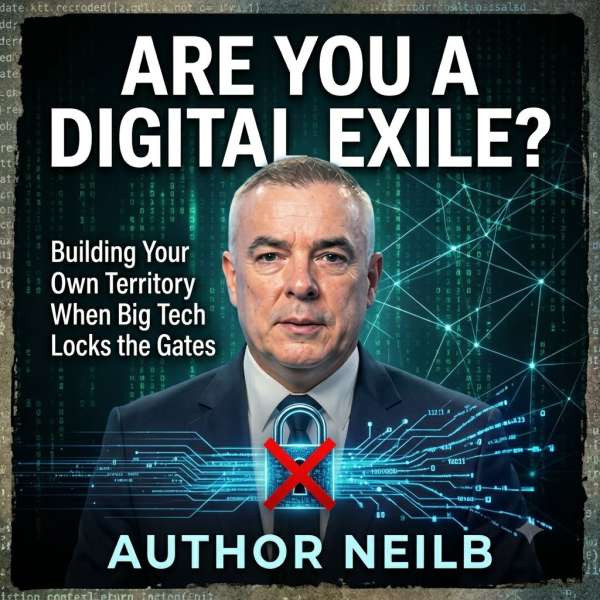


Are You a Digital Exile:
Building Your Own Territory When Big Tech Locks the Gates
Chapter 1: The Eviction Notice
It happens in an instant—a flicker of a screen and a dead-end notification [cite: 1]. You wake
up, reach for your phone, and the digital landscape you spent years cultivating is gone [cite:
1]. You aren't just logged out; you are erased [cite: 1]. For years, you poured your creativity,
your time, and your soul into building an audience on someone else’s property, believing in
the illusion of a partnership [cite: 1]. Now, you realize the painful, cold truth: you were
never a citizen of that platform; you were a tenant [cite: 1]. In the world of digital feudalism,
your content is merely fuel for their algorithms, and the landlord can change the locks
whenever the automated system flags your account [cite: 1]. There is no human to talk to,
no appeals process that works, and no transparency [cite: 1]. This chapter is about
acknowledging that sharp, biting sting of betrayal and realizing that your audience does not
truly belong to you—until you take the steps to own the ground they stand on
Building Your Own Territory When Big Tech Locks the Gates
Chapter 1: The Eviction Notice
It happens in an instant—a flicker of a screen and a dead-end notification [cite: 1]. You wake
up, reach for your phone, and the digital landscape you spent years cultivating is gone [cite:
1]. You aren't just logged out; you are erased [cite: 1]. For years, you poured your creativity,
your time, and your soul into building an audience on someone else’s property, believing in
the illusion of a partnership [cite: 1]. Now, you realize the painful, cold truth: you were
never a citizen of that platform; you were a tenant [cite: 1]. In the world of digital feudalism,
your content is merely fuel for their algorithms, and the landlord can change the locks
whenever the automated system flags your account [cite: 1]. There is no human to talk to,
no appeals process that works, and no transparency [cite: 1]. This chapter is about
acknowledging that sharp, biting sting of betrayal and realizing that your audience does not
truly belong to you—until you take the steps to own the ground they stand on
Building Your Own Territory When Big Tech Locks the Gates
Chapter 1: The Eviction Notice
It happens in an instant—a flicker of a screen and a dead-end notification [cite: 1]. You wake
up, reach for your phone, and the digital landscape you spent years cultivating is gone [cite:
1]. You aren't just logged out; you are erased [cite: 1]. For years, you poured your creativity,
your time, and your soul into building an audience on someone else’s property, believing in
the illusion of a partnership [cite: 1]. Now, you realize the painful, cold truth: you were
never a citizen of that platform; you were a tenant [cite: 1]. In the world of digital feudalism,
your content is merely fuel for their algorithms, and the landlord can change the locks
whenever the automated system flags your account [cite: 1]. There is no human to talk to,
no appeals process that works, and no transparency [cite: 1]. This chapter is about
acknowledging that sharp, biting sting of betrayal and realizing that your audience does not
truly belong to you—until you take the steps to own the ground they stand on [cite: 1].
Chapter 2: The Fallacy of the Free Platform
We have been sold a dangerous lie: that the biggest social media platforms are the best
places to build a legacy because they are 'free' [cite: 1]. But in the digital age, if you are not
paying, you are not the customer—you are the product being sold [cite: 1]. You are paying
for those services with your data, your autonomy, and your ability to control your own
destiny [cite: 1]. This 'rent-seeking' economy thrives entirely on your dependence [cite: 1].
The more you rely on them, the more leverage they have to silence you, bury your content,
or change their policies to prioritize their profits over your growth [cite: 1]. To become a
Digital Exile, you must first shatter the illusion that 'free' is synonymous with 'valuable'
[cite: 1]. It is time to stop renting space in a house that does not want you and start building
a foundation on land you control [cite: 1].
Chapter 3: At 72, I Refused to Bow
People frequently ask me, 'Neil, why don't you just retire? Why struggle with server logs,
PHP configurations, and code at 72?' [cite: 1]. The answer is simple: retirement is a societal
construct that assumes your productive life has an expiration date, and I refuse to accept
that premise [cite: 1]. While others in my age group were encouraged to fade into obscurity,
I chose to lean into the complexity of the digital world [cite: 1]. When the software giants
attempted to downgrade my 'lifetime' access, I didn't just walk away; I fought back [cite: 1].
This refusal to 'rest' became the fuel for my greatest projects [cite: 1]. I found that learning
new tools—whether it is Nginx, SQL databases, or AI—isn't just a hobby; it is a declaration
of vitality [cite: 1]. Your age is not a limitation on your ability to innovate; it is the
foundation of your persistence and the source of your resilience [cite: 1].
Chapter 4: Defining Your Digital Sovereignty
Sovereignty is the only antidote to the constant threat of exile [cite: 1]. To be a Digital
Sovereign is to stop being a passive user and start being an architect of your own online
environment [cite: 1]. It means owning your domain, keeping a local copy of your data, and
ensuring that no faceless corporation can flip a switch and end your work [cite: 1]. You do
not need to be a Silicon Valley titan to achieve this level of independence [cite: 1]. You
simply need to realize that every digital asset you create—your videos, your music, your
written word—deserves a home that you control completely, rather than a platform that
acts as a gatekeeper [cite: 1]. This shift in mindset is the first step toward true freedom [cite:
1].
Chapter 5: The Infrastructure Foundation: A Non-Technical Guide
Let’s demystify the 'scary' technical side of the web [cite: 1]. You do not need a massive
team of engineers or a computer science degree to own your corner of the internet [cite: 1].
Think of it like building a house: you simply need land, which is your domain name, and a
sturdy foundation, which is your own server hosting [cite: 1]. I have navigated the
complexities of server optimization, PHP-FPM, and database management, and I can tell you
that the barriers are lower than the industry wants you to believe [cite: 1]. This chapter
breaks down the essentials of how to secure your hosting, manage your own backend, and
why taking control of your technical infrastructure is the most liberating move you can
make for your digital career [cite: 1].
Chapter 6: Building Your Own Sanctuary
I didn't just write about independence; I built it with my own hands [cite: 1]. Whether it is
my platforms like TikTokbeans or my radio projects, the principle remains constant: create
a space that is resilient [cite: 1]. I built these platforms to provide a haven for creators who
are tired of being silenced by the 'Big Tech' algorithm [cite: 1]. This chapter outlines the
practical steps I took to create my own digital infrastructure and how you can apply those
exact principles to build your own sanctuary [cite: 1]. You are creating a space where your
content is safe, permanent, and entirely under your command—immune to the interference
of corporate gatekeepers [cite: 1].
Chapter 7: The 'Exile' Community Strategy
A platform is nothing without the people who engage with it [cite: 1]. The 'Exile' strategy is
not about isolating yourself; it is about gathering a loyal community of individuals who
value quality over the arbitrary whims of an algorithm [cite: 1]. When you build your own
site, you aren't fighting for 'viral' reach that lasts for an hour; you are building deep,
meaningful connections with the people who followed you from the ruins of the big
platforms [cite: 1]. This chapter explains how to nurture that community and turn those
who feel 'left behind' into the committed, loyal core of your new, sovereign audience [cite:
1].
Chapter 8: Fighting Back: Lessons from the Frontlines
When I took my dispute with the software industry to the UK Competition and Markets
Authority, I learned that corporate giants rely on you being too exhausted to fight [cite: 1].
They count on your silence, hoping you will just move on [cite: 1]. By filing reports and
demanding accountability, I learned that you have significantly more power than you think
[cite: 1]. You do not have to accept unfair, changing terms or retroactive alterations to your
rights [cite: 1]. This chapter shares the hard lessons from my legal and commercial battles,
proving that even a single individual can challenge the status quo if they are persistent,
organized, and refuse to be intimidated by corporate bullying [cite: 1].
Chapter 9: The Content Rebellion
The era of 'viral-bait' is quickly coming to an end [cite: 1]. Algorithms force creators to
produce shallow, disposable, and sensationalist content just to stay relevant for five fleeting
seconds [cite: 1]. When you are a Digital Exile, you are finally free to create for the long term
[cite: 1]. You can focus on depth, authenticity, and real value, knowing that your audience is
there for you, not for a trending topic [cite: 1]. This chapter offers specific strategies for
creating work that stands the test of time, ensuring that your audience stays engaged
because they genuinely value your unique perspective [cite: 1].
Chapter 10: The New Frontier
We are at a significant turning point [cite: 1]. The future of the internet will not be dictated
by a few massive, walled-garden corporations, but by individuals who choose to reclaim
their independence and build their own paths [cite: 1]. This project is more than a simple
hobby—it is a necessary movement for the survival of human creativity online [cite: 1]. By
building our own spaces, we are ensuring that the digital landscape remains open,
innovative, and human [cite: 1]. At 72, I am just getting started with this work [cite: 1]. If
you are reading this, you are part of the new frontier, and it is finally time to stop playing by
their rules and start building the future you want to see [cite: 1].
האזינו לאחרונה על ידי


לא נמצאו הערות
רצועות נוספות