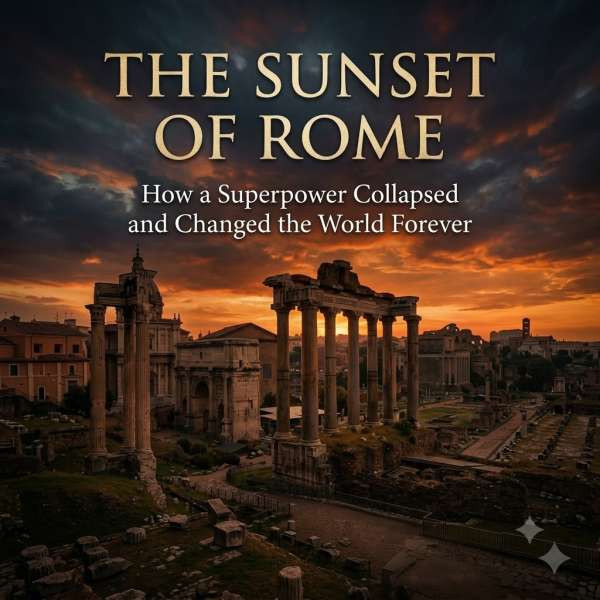


The Sunset of Rome: How a Superpower Collapsed and Changed the World Forever.
The story of Rome is more than a chronicle of marble columns, blood-stained arenas, and sweeping military conquests. It is the definitive human drama of power—a narrative that tracks the arc of a civilization from its humble origins to the heights of global dominance, and ultimately, to its inevitable dissolution. When we speak of the "fall" of Rome, we often imagine a sudden, violent rupture: the walls crumbling, the fires burning, and the end of an era marked by a single date on a calendar. Yet, as I have explored in the research for The Sunset of Rome: How a Superpower Collapsed and Changed the World Forever, the reality was far more complex, more gradual, and, in many ways, more hauntingly familiar.
The story of Rome is more than a chronicle of marble columns, blood-stained arenas, and sweeping military conquests. It is the definitive human drama of power—a narrative that tracks the arc of a civilization from its humble origins to the heights of global dominance, and ultimately, to its inevitable dissolution. When we speak of the "fall" of Rome, we often imagine a sudden, violent rupture: the walls crumbling, the fires burning, and the end of an era marked by a single date on a calendar. Yet, as I have explored in the research for The Sunset of Rome: How a Superpower Collapsed and Changed the World Forever, the reality was far more complex, more gradual, and, in many ways, more hauntingly familiar.
The story of Rome is more than a chronicle of marble columns, blood-stained arenas, and sweeping military conquests. It is the definitive human drama of power—a narrative that tracks the arc of a civilization from its humble origins to the heights of global dominance, and ultimately, to its inevitable dissolution. When we speak of the "fall" of Rome, we often imagine a sudden, violent rupture: the walls crumbling, the fires burning, and the end of an era marked by a single date on a calendar. Yet, as I have explored in the research for The Sunset of Rome: How a Superpower Collapsed and Changed the World Forever, the reality was far more complex, more gradual, and, in many ways, more hauntingly familiar.
I have written this book for the curious reader—the person who looks at the headlines of our modern world and senses echoes of the past. Whether you are a student of history, a traveler who has walked the ruins of the Forum, or simply someone fascinated by how great systems rise and eventually falter, this book is designed for you. My purpose is not to bury you in the dry, impenetrable jargon of academia, but to offer a clear, narrative-driven account that brings the men and women of antiquity to life. We will walk with the soldier on the frozen Rhine, sit in the councils of the emperors, and witness the shifting tides of faith and culture that redefined the Western world.
What inspired this work was a simple, nagging question: How does a superpower lose its grip? The Roman Empire was not destroyed by a single enemy or a solitary mistake. It was a victim of its own success, undone by the weight of its bureaucracy, the exhaustion of its economy, and the relentless pressure of a world that refused to remain static. By examining the structural cracks—from the economic stagnation of the third century to the environmental shifts and mass migrations that tested the frontiers—we gain a clearer perspective on the fragility of institutions we often take for granted.
In The Sunset of Rome, we move through fifteen chapters, tracing the path from the zenith of the Five Good Emperors to the final, quiet deposition of the last Western emperor. We will analyze the radical reforms of Diocletian, the transformative spiritual shift under Constantine, and the catastrophic turning points like the Battle of Adrianople. We will see how the empire fractured, how its heart was broken by the sack of its capital, and how it ultimately transformed into the successor kingdoms that would form the bedrock of medieval and modern Europe.
My aim throughout these pages is to remain objective and authoritative while keeping the human element at the forefront. History is made by individuals—by generals facing impossible choices, by common citizens struggling under the burden of taxes, and by migrants seeking a new life within the shadow of the eagle. By understanding their struggles, we can better understand our own.
You will find that the tone of this book is reflective and grounded. It is a cautionary tale, yes, but it is also a celebration of an enduring legacy. Even after the political structure of Rome collapsed, its influence remained woven into the fabric of our law, our governance, our languages, and our religious traditions. Rome did not truly vanish; it evolved, scattering its seeds across the continents to grow into the world we inhabit today.
As you read through these chapters, I invite you to look past the dates and names to the underlying mechanics of change. My hope is that this journey through the twilight of the Roman world provides you with both a deeper understanding of the past and a sharper lens through which to view the complexities of our present. The sunset of Rome was a long process, but it was not the end of the story—it was the beginning of everything that followed.
— NeilB
Introduction
The history of the Roman Empire is the ultimate human drama. It is a narrative of staggering ambition, monumental achievement, and a collapse so profound that it echoed through the centuries, shaping the very foundations of the world we inhabit today. For half a millennium, Rome stood as the undisputed master of the Mediterranean, a superpower whose reach extended from the rain-swept hills of northern Britain to the scorching deserts of the Levant. It was a civilization that gave us the blueprints for modern law, the architecture of our cities, the structure of our languages, and the roots of our religious traditions. Yet, for all its marble permanence and iron-fisted legions, Rome was not immune to the fundamental laws of history. It was, like all great powers, a prisoner of its own success.
The Sunset of Rome: How a Superpower Collapsed and Changed the World Forever is an exploration of that long, twilight struggle. It is the story of how an invincible titan, convinced of its own eternity, gradually succumbed to a complex web of internal decay and external pressure. This book does not look at the fall of Rome as a single, sudden event—a lightning strike that shattered the world in 476 AD. Instead, it frames the collapse as a slow-motion transformation, a centuries-long erosion of the structures that held the empire together.
The central theme of this narrative is the tension between the reach of a superpower and its capacity to sustain that reach. We will examine how the Roman state, once fueled by the spoils of conquest, became trapped by its own economic stagnation. We will look at how the reliance on slave labor discouraged innovation, how the burden of maintaining an overextended frontier drained the treasury, and how the rise of political corruption hollowed out the institutions of government from within.
But the story of Rome is not merely one of internal decay. It is also the story of a world in motion. We will trace the impact of mass migration, as displaced tribes—pushed by the environmental shifts of a changing climate and the relentless pressure of nomadic invaders like the Huns—pressed against the Roman frontiers. We will witness the profound cultural shift as a pagan empire, built on the worship of ancient gods, transformed into the cradle of Christendom. These forces did not simply destroy Rome; they reshaped it, forcing the empire to evolve, fracture, and eventually reinvent itself in the form of the Byzantine East and the successor kingdoms of the West.
This book is organized into fifteen chapters that follow this trajectory of decline and transition. We begin in Chapter 1, "The Zenith of Power and the Seeds of Decay," where we see the empire at its height, uncovering the subtle cracks that existed even in the golden age of the Five Good Emperors. We then move into the chaotic "Crisis of the Third Century" in Chapter 2, a period of plague, civil war, and economic hyperinflation that forced the state to fundamentally alter its relationship with the military.
In Chapters 3 and 4, we examine the desperate, radical reforms of Diocletian and the religious and geographic revolution ushered in by Constantine. These leaders bought the empire time, but their efforts to stabilize the state often increased the bureaucratic burden on the citizenry, setting the stage for the pressures discussed in Chapter 5, which focuses on the Great Migrations. The catastrophic defeat at the Battle of Adrianople in Chapter 6 serves as a pivotal turning point, shattering the myth of Roman invincibility and forcing the empire into a dangerous reliance on barbarian foederati.
The narrative then follows the inexorable fracturing of the state. We explore the permanent split between East and West in Chapter 7, the psychological trauma of the Sacking of Rome in Chapter 8, and the existential threats posed by the Huns and the Vandals in Chapters 9 and 10. As we reach the final act, Chapters 11 and 12 detail the era of the puppet emperors and the inevitable, quiet end of the Western imperial line in 476 AD.
However, the story does not end with the fall of a city or the deposition of a boy-emperor. Chapters 13 and 14 analyze the aftermath: the rise of the Germanic successor kingdoms and the survival of the East as the Byzantine Empire, which carried the Roman torch for another thousand years. Finally, in Chapter 15, we reflect on the enduring legacy of Rome in the modern world, addressing why the story of this ancient superpower remains a vital, cautionary tale for the present day.
The questions that drive this book are timeless: What happens when a society becomes so invested in its past that it loses the ability to adapt to the future? How does a government maintain its legitimacy when it can no longer protect its borders or feed its people? And perhaps most importantly, what is the cost of absolute power?
As you read these pages, I invite you to look beyond the dates and the names of emperors. Look for the patterns of human behavior, the systemic failures that occur when institutions grow too rigid, and the resilience of cultures as they navigate the chaos of collapse. History is not a closed book; it is a mirror. By understanding how the sunset of Rome came to pass, we gain a deeper, more nuanced understanding of the forces that shape our own era.
The decline of Rome was not a tragedy of fate, but a tragedy of choices—the choices of leaders who were blinded by tradition, of citizens who were detached from the state, and of a system that became too large to be saved by its own strength. It is a story of how a superpower collapsed, but also of how that collapse cleared the ground for the world we know today. Let us step back into the ancient world, to a time when the sun was beginning to set on the greatest empire the world had ever known, and witness the final, dramatic chapters of its long, enduring history.
Dedication
To those who seek to understand the cycles of history, and to the memory of the civilizations that shaped our world. May the lessons of the past serve as a light for our future.
Acknowledgments
Writing a history of the Roman Empire is an exercise in humility. To attempt to capture the vast, sweeping narrative of a civilization that defined the Western world for centuries is a daunting task, and one that would have been impossible without the guidance, support, and patience of many individuals.
I am deeply grateful to the historians and scholars whose lifetimes of research into the late Roman period provided the bedrock for this book. Their meticulous work in archaeology, epigraphy, and classical studies continues to illuminate the shadows of the ancient world. While this narrative is intended for a general audience, it rests entirely upon the rigorous academic foundations laid by those who have dedicated their careers to understanding the complexities of the Roman state.
I would like to thank the librarians and archival staff who assisted me in navigating the immense body of source material. Your expertise and dedication to preserving the records of our past remain an invaluable service to all who seek to learn.
To my friends and colleagues who engaged in countless conversations about the nature of power, the mechanics of collapse, and the enduring relevance of history: thank you. Your challenging questions and thoughtful insights sharpened my focus and helped me refine the core themes of this narrative. Whether in formal discussions or casual debates, your intellectual companionship was a constant source of inspiration.
On a more personal note, I am profoundly grateful to my family for their unwavering encouragement throughout this project. You supported me through the long hours of research and the challenges of the writing process with boundless patience and grace. Your belief in this work—and in me—kept me motivated when the scope of the project felt overwhelming.
Finally, to the readers who take the time to open these pages: thank you. It is my sincere hope that this journey through the sunset of Rome offers not just a look at the past, but a meaningful reflection on the world we inhabit today. This book belongs to all of you as much as it does to me.
Prologue
The Roman Empire did not fall in a day. It did not collapse like a thunderclap or vanish in a single, decisive stroke of misfortune. Instead, it suffered the slow, agonizing sunset of a titan—a process that spanned centuries, marked by the gradual erosion of institutions, the fraying of borders, and the quiet death of the ideals that had once made a city-state the master of the Mediterranean.
To look upon the ruins of the Forum today is to witness the final, silent witness to a tragedy of immense proportions. These broken columns and weather-worn stones were once the nerve center of a superpower that defined the parameters of Western civilization. Rome was more than an empire; it was a concept of order, law, and permanence. Yet, that very sense of permanence eventually became its greatest enemy. When a civilization believes itself to be eternal, it loses the capacity to change. When it loses the capacity to change, it begins the long walk toward its own twilight.
The story of Rome’s decline is often simplified into tales of barbarian hordes crashing through the gates, but the reality was far more nuanced and, in many ways, more haunting. The collapse was a confluence of forces: the crushing weight of an overextended military, the slow rot of internal political corruption, and the profound economic stagnation that turned a once-vibrant engine of growth into a hollow shell of taxation and bureaucracy. It was a failure of resilience. As the empire grew larger, it became more brittle, less capable of absorbing the shocks of a changing world.
We must also look to the skies and the soil. The empire did not exist in a vacuum; it was subject to the whims of a shifting climate and the invisible, devastating reach of plagues that thinned its populations and shattered its social cohesion. These environmental pressures acted as a catalyst, pushing nomadic peoples toward the Roman frontiers and forcing a desperate, often violent, encounter between the established order and the rising tide of the Great Migrations.
The transition from the ancient world to the medieval was not merely a change in leadership; it was a fundamental shift in the human experience. It was the era when the pagan gods of the old world receded into the shadows, replaced by the rising influence of Christianity, which would eventually bind the remnants of the Roman world into a new, distinct cultural identity. It was a time when the myth of the "Eternal City" was shattered by the swords of the Visigoths, forcing a traumatized citizenry to grapple with the unthinkable: that the center could not hold.
As we navigate the chapters of this history, we will follow the arc of this decline. We will see the empire transition from the zenith of the Five Good Emperors to the chaotic, soldier-controlled instability of the third century. We will witness the radical, desperate reforms of Diocletian and the transformative vision of Constantine. We will stand on the blood-soaked fields of Adrianople, where the myth of Roman invincibility was finally put to rest, and we will watch as the empire, once a unified whole, fractured into two—a wealthy, resilient East and a vulnerable, isolated West.
This book is a narrative journey through that long sunset. It is the story of how a superpower, having reached the absolute limits of its own ambition, found itself unable to sustain the weight of its own success. It is a story of puppet emperors and shadow generals, of the scourge of Attila and the loss of the North African breadbasket, and finally, of that quiet, inevitable moment in 476 AD when the last Western emperor was deposed, and the world realized that the Roman sun had truly set.
Yet, to focus only on the collapse is to miss the most important part of the story. The end of the Roman Empire was not the end of the Roman legacy. The laws, the language, the architecture, and the administrative structures that Rome perfected did not disappear with the fall of its last emperor. They were absorbed, repurposed, and transformed by the successor kingdoms that rose from the ashes. The Justinian Dream of a restored empire may have failed, but the ghost of Rome haunted the halls of every European monarch and every developing legal system for the next millennium.
In the modern age, we are still living in the long shadow of Rome. Its story serves as a mirror for our own times—a cautionary tale about the fragility of power, the necessity of institutional integrity, and the dangers of complacency. As a superpower, Rome faced the same fundamental questions that every great nation must answer: How do you manage a diverse and sprawling population? How do you maintain security without bankrupting your future? How do you adapt to a world that is shifting beneath your feet?
By examining the decline and fall of Rome, we are not merely studying the past; we are studying the mechanics of human society. We are looking at what happens when a system becomes so rigid that it can no longer survive the reality of a changing world. We are witnessing the end of an era, but also the birth of a world that would eventually become our own.
I am NeilB, and in the following pages, I invite you to step back into the world of the Caesars. We will walk the roads of the empire, stand on the ramparts of its frontiers, and witness the slow, dramatic, and ultimately transformative collapse of the greatest power the ancient world had ever known. We will explore how the sunset of Rome was not just a tragedy, but the necessary clearing of the stage for the modern world to begin.
Chapter 1: The Zenith of Power and the Seeds of Decay
In the second century AD, the Roman Empire was not merely a state; it was the world. To a citizen living in the year 120 AD, under the reign of the Emperor Hadrian, the Mediterranean was not a frontier, but a private lake. From the mist-shrouded moors of northern Britain to the sun-scorched sands of the Euphrates, the Pax Romana—the Roman Peace—held the known world in a grip of unprecedented stability.
Travelers could journey thousands of miles along paved, stone-lined roads, protected by the most disciplined military machine in history, without ever needing a passport or fearing a foreign army. The cities, adorned with marble forums, soaring aqueducts, and massive amphitheaters, served as symbols of a civilization that appeared to have solved the riddle of human governance. Rome was the apex of the ancient world, a superpower whose reach seemed infinite and whose longevity appeared guaranteed by the favor of the gods.
Yet, history is rarely as static as it appears from the marble pedestals of imperial statues. Beneath the surface of this golden age, the very foundations that supported Rome’s greatness were beginning to develop hairline fractures. The zenith of power was, in reality, the beginning of a long, slow transition—a period where the seeds of decay were sown, not by the swords of enemies, but by the weight of the empire’s own success.
The Illusion of Invincibility
The era of the "Five Good Emperors"—Nerva, Trajan, Hadrian, Antoninus Pius, and Marcus Aurelius—is frequently cited by historians as the pinnacle of Roman achievement. During this time, the empire reached its greatest territorial extent. Trajan, a soldier-emperor of unmatched ambition, pushed the borders deep into Mesopotamia and across the Danube into Dacia. The Roman eagle flew over lands that had never known the reach of the Senate.
For the Roman elite, this was a time of immense pride. The philosophy of Stoicism, which preached duty, self-control, and acceptance of one’s role in the cosmic order, permeated the upper echelons of society. There was a profound belief that Rome was the final, perfected form of human civilization. If the empire had problems, they were viewed as mere administrative hurdles, easily overcome by the rational application of Roman law and the sheer force of the legions.
However, the very size of the empire was its most dangerous liability. Managing a territory that stretched from the Atlantic Ocean to the Persian Gulf required a level of logistical mastery that was pushing the limits of the ancient world’s technology. Communication relied on the speed of a galloping horse or the favor of the winds for a ship. By the time an urgent report from a frontier province reached the imperial court in Rome, the situation on the ground had often changed entirely. The empire was becoming too large to be governed by a single center, yet its political culture was obsessively centralized.
The Economic Trap
While the grandeur of Rome was built on the backs of its legions, its economy was built on the backs of the enslaved. The Roman economy was not a modern, industrial engine driven by innovation and technological advancement; it was a system fueled by expansion.
For centuries, Rome had funded its lifestyle through the spoils of war. When a new territory was conquered, its gold was melted down, its resources were extracted, and, most importantly, its people were taken as slaves. This constant influx of cheap labor provided the manpower to work the vast agricultural estates, known as latifundia, which fed the sprawling population of the capital.
But expansion has a physical limit. As the empire reached its natural geographical boundaries—deserts to the south, vast forests to the north, and the rival Parthian Empire to the east—the wars of conquest slowed. With the end of rapid expansion came the end of the steady flow of war loot and cheap labor. The Roman economy began to stagnate.
Without the constant infusion of new wealth, the state became increasingly reliant on taxation. To maintain the massive bureaucracy and the legions stationed on the frontiers, the government squeezed its provinces. As taxes rose, the incentive for innovation plummeted. Why invest in new agricultural technology or manufacturing processes when you can simply force a slave to do the work? Rome had become a society that valued tradition and stability over growth and change. It was a comfortable trap, but a trap nonetheless.
The Borderlands: The Cost of Security
The Roman frontier, or limes, was the empire’s most visible demonstration of power. Massive walls, wooden palisades, and garrisoned forts stretched across thousands of miles. To the Romans, these barriers were meant to keep "barbarians"—a term they used for anyone outside the influence of Greco-Roman culture—at bay.
However, the frontier was never a static line. It was a permeable membrane. Over time, the people living just beyond the borders—Germanic tribes, nomadic steppe peoples, and desert nomads—became intimately familiar with the Roman way of life. They traded with the Romans, served in the Roman military, and began to adopt Roman customs.
By the second century, the Roman military had begun to rely heavily on these non-citizens to fill its ranks. These auxilia units, composed of tribal warriors, were essential for border security. While this policy was pragmatic, it created a long-term vulnerability. The empire was teaching potential adversaries how to fight like Romans. They were learning the tactics, the formations, and the military hierarchy that had made Rome invincible.
Furthermore, the sheer cost of maintaining these garrisons was a staggering drain on the imperial treasury. As the empire faced mounting pressure from restless tribes seeking better land or protection from their own internal conflicts, the legions were stretched thin. The "Good Emperors" spent much of their time rushing from one border crisis to another, a pattern that would eventually become the norm rather than the exception.
The Subtle Erosion of Institutions
Perhaps the most dangerous change during this period was the slow transformation of the Roman political soul. The early Republic had been defined by the active participation of its citizens. Even under the early Empire, there was a pretense of shared power between the Emperor and the Senate. But as the centuries passed, the distance between the ruler and the ruled grew.
The Roman state became increasingly bureaucratic. As the government grew more complex, it required more officials to manage it, more tax collectors to fund it, and more soldiers to enforce it. This created a class of administrators who were more interested in preserving their own positions and wealth than in the welfare of the empire. Corruption, once a localized issue, began to seep into the foundations of the provincial governments.
The average citizen, once a proud participant in the Roman experiment, became a passive observer. In the capital, the masses were placated with "bread and circuses"—subsidized grain and elaborate gladiatorial games. While these kept the peace, they also signaled a shift in the relationship between the people and the state. The citizen was no longer a stakeholder in the republic; he was a subject of the throne.
The Seeds of Decay
As the reign of Marcus Aurelius drew to a close in 180 AD, the cracks in the Roman system were still largely invisible to the common observer. The buildings were still grand, the legions were still feared, and the law was still supreme. But the underlying structures—the economy, the military, and the political system—were brittle.
The empire had reached a state of "mature exhaustion." It had perfected its form so completely that it had lost the ability to adapt. It was a giant, powerful and imposing, but one that was increasingly unable to respond to the changing world around it.
The environment, too, was beginning to shift. Evidence suggests that the climate in Europe and the Mediterranean began to cool slightly during this period, affecting crop yields and pushing migratory tribes toward the warmer, more fertile lands of the Roman Empire. These environmental pressures, combined with the structural weaknesses of the Roman state, would soon collide to create a perfect storm.
In retrospect, the zenith of the Roman Empire was not a destination, but a plateau. The Romans had built a magnificent house, but they had failed to maintain the foundation. They had assumed that the world would always accommodate their way of life, and that their power would always be enough to ensure their survival.
As we look at the transition from the golden age of the Antonines to the chaos that would follow, we see a crucial lesson in the history of superpowers. Power is not merely the possession of territory or the size of an army; it is the ability to evolve. When a society becomes so invested in its own past that it fears the future, it begins the slow, often unnoticed process of decline.
The seeds of decay were not planted by a single catastrophic event. They were sown in the soil of complacency, watered by the stagnation of the economy, and nurtured by the overextension of a system that had become too large to sustain itself. The sunset of Rome would not happen overnight; it would be a long, twilight struggle against the very forces the empire had helped to create.
In the chapters to follow, we will witness how these cracks widened into chasms, how the internal rot of corruption invited external ruin, and how a once-indomitable superpower began to lose its grip on the world it had shaped for centuries. The story of Rome is not just a tragedy of the past; it is a mirror held up to the present, reflecting the universal challenges of power, legacy, and the inevitable cycle of rise and fall.
Chapter 2: The Crisis of the Third Century
If the era of the Five Good Emperors represented the Roman Empire at its zenith—a polished marble facade of stability and prosperity—the third century was the moment the foundation began to fracture under the weight of its own ambition. Between 235 and 284 AD, the Roman world was plunged into a period of systemic collapse that nearly extinguished the imperial experiment entirely. Historians call this the "Crisis of the Third Century," a fifty-year whirlwind of civil war, hyperinflation, plague, and foreign invasion that fundamentally altered the relationship between the Roman state and its people.
By the time the dust settled, the Rome that emerged was a fundamentally different entity: more militarized, more bureaucratic, and significantly more fragile. To understand how a superpower nearly imploded, one must look at the convergence of three destructive forces: the breakdown of political succession, the failure of the economy, and the sudden, violent shifts in the natural world.
#### The Era of the Soldier-Emperors
The crisis began with a singular, bloody event: the assassination of Alexander Severus in 235 AD. Alexander was the last of the Severan dynasty, a young man who had attempted to rule with the counsel of the Senate, but who ultimately failed to command the respect of his own legions. His murder by his own soldiers on the Rhine frontier ignited a terrifying precedent. The army, once the servant of the state, had become its master.
For the next half-century, the imperial throne became a revolving door. Rome entered a period of "barracks emperors," where the purple robe was not bestowed by legal succession or senatorial consent, but by the raw, kinetic power of the military. If a legion in Gaul or the Danube felt underpaid or undervalued, they would proclaim their commander emperor, march on Rome, and overthrow the incumbent.
The consequences for stability were catastrophic. In those fifty years, Rome saw dozens of claimants to the throne, many reigning for only a few months before being murdered by the very troops who had elevated them. This constant turnover meant that no emperor had the time or the authority to address the systemic issues plaguing the state. Instead, they were perpetually focused on survival, bribing their soldiers to prevent the next mutiny and rushing to the frontiers to repel the constant flow of invaders who sensed the empire’s internal weakness.
#### The Economic Engine Stutters
While the political theater was playing out in the streets and military camps, the Roman economy was quietly suffering a death by a thousand cuts. The Roman Empire, despite its sophistication, was a low-growth agrarian society that relied heavily on plunder and stable tax revenue to function. The expansionist phase of the empire had essentially ended, meaning the flow of gold, slaves, and resources from new conquests had dried up.
To pay for the constant civil wars and the defense of overstretched borders, emperors turned to a desperate and destructive strategy: debasement. They began to reduce the silver content of the denarius, the primary currency of the Roman world. At the start of the second century, the denarius was almost pure silver. By the mid-third century, it had been diluted to a copper coin with a mere silver wash.
The psychological impact on the market was immediate and devastating. When the citizenry realized their money was worthless, inflation skyrocketed. Prices for basic goods like grain, oil, and clothing surged, creating a cost-of-living crisis that paralyzed trade. Merchants, fearing the currency would lose more value by the next day, withdrew from the marketplace. The interconnected Mediterranean economy—the great engine of Roman prosperity—began to fragment into isolated, local zones of trade. The state, meanwhile, could no longer pay its soldiers in meaningful currency, leading it to demand taxes in kind—grain, livestock, and clothing—rather than coin. This shift toward a command economy, while necessary for survival, crippled the private sector and forced millions of citizens into a subsistence existence.
#### A World in Flux: Plague and Climate
As if political chaos and economic collapse were not enough, the third century also saw the natural world turn against the Roman state. Around 249 AD, a devastating pandemic, known today as the Plague of Cyprian, swept through the Mediterranean. Named after the bishop of Carthage who documented the horror, the plague is believed to have been a viral hemorrhagic fever, perhaps smallpox or measles.
Unlike the earlier Antonine Plague, which had already thinned the population, this outbreak struck a society that was already reeling. It decimated the tax base, left fields unplowed, and thinned the ranks of the legions. In Rome, it was estimated that five thousand people died daily. The loss of life was not merely a humanitarian tragedy; it was a structural one. Fewer taxpayers meant less money for the army; fewer farmers meant less food for the cities; fewer soldiers meant weaker frontiers.
Compounding this was a subtle but profound shift in the climate. Tree-ring data and ice core samples suggest that the mid-third century marked the beginning of a period of cooling and erratic rainfall. For a society entirely dependent on agriculture, these fluctuations were ruinous. Harvests failed with greater frequency, leading to localized famines and mass migration. The Germanic tribes to the north—the Goths, Alamanni, and Franks—were also feeling the pressure of this climate shift. Their traditional lands were becoming less hospitable, forcing them to move southward in search of better resources. They did not necessarily arrive as conquerors seeking to destroy Rome, but as refugees and opportunistic warriors fleeing the harsh realities of a changing environment.
#### The Frontier Under Siege
The Roman frontier, which had been a relatively stable line of fortifications for two centuries, suddenly became porous. Because the Roman army was preoccupied with civil wars, the borders were often left under-defended. The Goths broke through the Danube, ravaging the Balkans and even killing an emperor—Decius—in battle in 251 AD. In the East, the rise of the Sassanid Empire, a resurgent Persian power, presented an existential threat that Rome had not faced since the days of the Parthians.
The empire, quite literally, began to tear itself apart. In the 260s, the Roman state splintered into three competing parts. In the west, the Gallic Empire claimed Gaul, Britain, and Spain. In the east, the Palmyrene Empire, led by the ambitious Queen Zenobia, seized control of the vital grain-producing regions of Egypt and the Levant. For a time, it seemed as though the center would not hold, and that the Roman world would dissolve into a series of smaller, competing regional kingdoms.
#### The Resilience of the State
How, then, did the empire survive? The answer lies in the sheer inertia of Roman institutions and the emergence of a series of "soldier-emperors" who were, for once, capable administrators. Leaders like Claudius Gothicus and Aurelian—the latter known as Restitutor Orbis, or "Restorer of the World"—began the painful process of stitching the map back together.
Aurelian, in particular, was a force of nature. In a reign of only five years, he defeated the Palmyrenes in the east, crushed the Gallic Empire in the west, and secured the frontiers. He understood that the empire could no longer function as it had under the Pax Romana. He began the construction of the massive Aurelian Walls around Rome, a stark admission that the capital itself was no longer safe from external threats.
By the time Diocletian seized power in 284 AD, the crisis was technically over, but the Rome he inherited was unrecognizable. The old idealism of the Republic—the idea of a Senate-led state—was dead. In its place was a hard, pragmatic, and highly militarized bureaucracy. The citizens of the empire had become subjects, and the emperor had transformed from the "First Citizen" into a remote, divinely-sanctioned autocrat.
#### The Lesson of the Third Century
The Crisis of the Third Century serves as a profound historical lesson on the fragility of systems. It demonstrates how a superpower can be brought to its knees not by a single cataclysmic event, but by the synergy of internal decay and external pressure. The plague, the inflation, and the civil wars were all interconnected; the plague weakened the army, which necessitated higher taxes, which fueled the inflation, which led to the civil wars.
Rome survived this period, but it did so by sacrificing the very qualities that had made its earlier success possible: the flexibility of its local governance, the stability of its currency, and the trust between the governed and the government. The empire had traded its soul for survival.
As we move forward into the fourth century, we see an empire that is more organized and perhaps more efficient, but also more rigid. The crises of the third century taught the Roman elite that they could no longer rely on the traditions of the past to survive the uncertainties of the future. The transformation of the Roman world was not a choice; it was a frantic, necessary adaptation to a world that had become significantly more dangerous. The stage was now set for the radical restructuring of the state under Diocletian, a man who would attempt to formalize this state of permanent emergency into a new, iron-clad system of control.
Chapter 3: Diocletian and the Radical Reshaping of the State
In the year 284 AD, the Roman Empire was a fractured mosaic of blood and desperation. For fifty years, the imperial throne had been a death trap, occupied by a revolving door of “barracks emperors” who were elevated by the sword and discarded by the dagger. The economy had withered under the weight of hyperinflation, and the frontiers—once iron-clad barriers—were porous, besieged by Germanic tribes in the north and the resurgent Sassanid Persians in the east. The Roman state was not merely failing; it was hemorrhaging its very essence.
Into this chaos stepped a man named Diocletian. A career soldier of humble origins from the province of Dalmatia, Diocletian was proclaimed emperor by his troops following the suspicious death of his predecessor. He was not a philosopher-king like Marcus Aurelius, nor a conqueror in the mold of Trajan. Instead, Diocletian was a pragmatist of the highest order. He recognized a fundamental truth that his predecessors had ignored: the Roman Empire had simply become too vast, too complex, and too dangerous for one man to govern from a single desk. To save Rome, he would have to dismantle its traditional structure and replace it with something radically new.
#### The Birth of the Tetrarchy
Diocletian’s most daring innovation was the Tetrarchy, or the “rule of four.” He understood that a centralized administration based in Rome could no longer react quickly enough to threats occurring simultaneously on the Rhine and the Euphrates. His solution was to divide the empire into two halves: the East and the West.
He took the title of Augustus for himself, taking charge of the wealthier East, and elevated a fellow soldier, Maximian, to the same rank to manage the West. But Diocletian went a step further. To ensure stability and provide for a clear line of succession, each Augustus appointed a junior colleague, known as a Caesar. These four men—two senior emperors and two junior deputies—would govern the empire as a unified, albeit decentralized, machine.
This system was designed to eliminate the civil wars that had defined the Third Century. By creating a pre-ordained succession plan, Diocletian hoped to remove the incentive for generals to rebel. The Caesars were effectively groomed to succeed the Augusti, theoretically ensuring a smooth transition of power. For a brief, shining moment, the madness ceased. The borders were stabilized, the usurpers were crushed, and the empire regained a sense of order that had been absent for generations.
#### The Price of Survival: A New Bureaucracy
While the Tetrarchy provided military stability, it came at a staggering administrative cost. Diocletian was a master of organization, and he believed that the solution to the empire’s woes was more government, not less. He shattered the old provincial system, carving the empire into smaller, more manageable districts. This allowed for tighter control and more efficient tax collection, but it also necessitated a massive expansion of the civil service.
Before Diocletian, the Roman government was relatively lean. A local governor might oversee a vast region with a small staff, relying on local elites to manage the details. Diocletian replaced this decentralized approach with a rigid, hierarchical bureaucracy. He created a thick layer of officials who reported up a vertical chain of command, all the way to the emperor.
This transformation turned the Roman state into a colossal machine of surveillance and taxation. To pay for the expanded military and the bloated civil service, Diocletian enacted sweeping economic reforms. He introduced a new system of taxation, the indictio, which assessed land and labor value on a regular cycle. He attempted to fix the prices of goods and wages through his famous Edict on Maximum Prices, a well-intentioned but ultimately disastrous attempt to curb inflation. By threatening the death penalty for merchants who exceeded these prices, he drove many goods into the black market, causing the very scarcity he sought to prevent.
The citizenry, once proud subjects of an expansive and relatively hands-off empire, found themselves increasingly trapped. To ensure the tax base remained stable, Diocletian began the process of binding workers to their jobs. Farmers were increasingly tied to their land, and certain trades became hereditary. This was the beginning of a social rigidity that would eventually evolve into the structures of the Middle Ages. The empire was no longer a collection of free citizens; it was a vast, state-run enterprise where individual liberty was sacrificed on the altar of imperial survival.
#### The Imperial Cult and the Transformation of Sovereignty
Diocletian’s reforms were not merely bureaucratic; they were psychological. He understood that the emperor needed to be elevated above the squalor of the barracks if he were to command lasting respect. He abandoned the pretense of the Princeps—the “first among equals”—which had been the thin veil of Republican tradition maintained since Augustus.
In its place, Diocletian adopted the trappings of an oriental autocrat. He introduced elaborate court ceremonies, requiring visitors to prostrate themselves before him. He wore robes of silk and gold, adorned with jewels, and surrounded himself with a complex hierarchy of eunuchs and officials. He styled himself as the earthly representative of the god Jupiter, demanding divine honors.
This move was calculated to provide a sense of sacred legitimacy to the imperial office. By wrapping the state in the mantle of divine right, Diocletian sought to make the emperor untouchable. However, this shift also alienated the traditional Roman aristocracy, who viewed this new, regal style as un-Roman and despotic. It created a profound cultural divide between the imperial court and the people it governed, a distance that would prove problematic for future emperors.
#### The Great Persecution
The final pillar of Diocletian’s effort to restore Roman unity was a return to traditional religious practice. He viewed the rise of Christianity as a threat to the pax deorum—the peace of the gods—which many Romans believed was the source of the empire’s strength. If the state was to be unified, it needed a single, shared identity, and for Diocletian, that identity was rooted in the ancient pagan rituals of the Roman pantheon.
In 303 AD, he initiated the “Great Persecution.” Churches were destroyed, scriptures were confiscated, and Christians were forced to sacrifice to the Roman gods or face torture and death. It was the most systematic attempt to eradicate Christianity in the history of the empire. Yet, it was a profound miscalculation. By the early fourth century, Christianity had woven itself into the fabric of urban life, particularly in the East. The persecution did not break the faith; it only hardened the resolve of the believers, creating a new class of martyrs and further dividing the populace at a time when unity was the stated goal of the state.
#### The Legacy of a Pragmatist
In 305 AD, in an act almost unprecedented in Roman history, Diocletian voluntarily abdicated the throne. He retired to his massive, fortress-like palace in Spalatum (modern-day Split, Croatia) to tend to his garden. He had succeeded in his primary goal: he had pulled the empire back from the brink of extinction. He had replaced the chaotic anarchy of the Third Century with a structured, albeit oppressive, system of governance.
However, the peace was fragile. The Tetrarchy, which relied heavily on the personal charisma and administrative genius of Diocletian, began to crumble almost immediately after his departure. His successors lacked his ability to manage the delicate balance of power, and the ambitions of the various Augusti and Caesars soon reignited the very civil wars he had sought to banish.
Diocletian’s legacy is a complex one. He is often credited with saving the empire, and in terms of longevity, he succeeded. He gave the Roman state another two centuries of life in the West and nearly a millennium in the East. Yet, the cost of that survival was high. He had turned Rome into a garrison state. The freedom and initiative that had characterized the early empire were replaced by a crushing tax burden, a stifling bureaucracy, and a society increasingly divided by rigid class structures and religious intolerance.
He had built a house that could withstand the storm, but in doing so, he had walled up the windows and locked the doors. The Roman state was now efficient and orderly, but it had lost the vibrant, expansionist spirit that had allowed it to conquer the Mediterranean. The empire was no longer a living, evolving organism; it was a museum piece, preserved by the sheer force of its own administrative machinery.
As we look toward the reign of Constantine in the next chapter, we must remember the world Diocletian left behind. It was a world that had traded its soul for security. The stage was set for a new kind of transformation, one that would move the center of power away from the old, crumbling city of Rome and toward a new destiny in the East. Diocletian had bought the empire time, but he could not buy it immortality. The cracks he had tried to seal with bureaucracy were, in reality, the fault lines of an era that was rapidly coming to an end.
Chapter 4: Constantine and the Christian Shift
The Roman Empire, by the dawn of the fourth century, was a fractured giant held together by the administrative rigor of Diocletian. The Tetrarchy—the rule of four—had succeeded in stabilizing the borders and curbing the chaos of the previous century, but it had also introduced a rigid, stifling bureaucracy. The state was a machine, efficient but brittle. Into this environment stepped a man who would fundamentally rewrite the Roman identity: Flavius Valerius Constantinus, known to history as Constantine the Great.
Constantine’s rise to power was not a foregone conclusion, but rather a violent byproduct of the very system Diocletian had designed to ensure order. When the Tetrarchy collapsed into civil war, Constantine emerged from the fray, eventually securing his dominance at the Battle of the Milvian Bridge in 312 AD. Legend dictates that before this decisive clash, Constantine looked to the heavens and witnessed a vision of a cross, accompanied by the promise: In hoc signo vinces—"In this sign, you shall conquer."
While the exact nature of his personal faith remains a subject of intense historical debate, the political consequences of his conversion were immediate and irreversible. Constantine did not merely change his own religion; he initiated a seismic shift in the relationship between the Roman state and the divine.
#### The End of the Pagan Consensus
For centuries, the Roman Empire had been built upon the pax deorum, or the "peace of the gods." Roman success was viewed as a contractual agreement: the state performed the proper rituals, and the gods, in turn, granted prosperity and victory. This system was inherently pluralistic. Rome was a voracious consumer of gods; it absorbed the deities of conquered peoples, integrating them into a sprawling, pantheistic hierarchy.
Christianity, by its very nature, was an outlier. It was monotheistic and exclusive. It did not ask for a seat at the Roman table; it demanded that all other tables be cleared. For the early Roman state, this was not just a religious difference; it was an act of political subversion. By refusing to offer sacrifice to the Emperor or the traditional gods, Christians were perceived as "atheists" who threatened the structural integrity of the empire. This tension had led to waves of state-sponsored persecution, most notably under Diocletian, who sought to purge the empire of this perceived rot.
Constantine’s decision to embrace Christianity effectively ended this long-standing antagonism. By issuing the Edict of Milan in 313 AD, he granted legal status to Christianity, ending the era of state persecution and allowing the Church to operate openly. Overnight, the social hierarchy of Rome was upended. The Christian clergy, once a clandestine network of persecuted dissidents, began to find themselves in the corridors of imperial power.
This was a masterful stroke of political consolidation. By aligning himself with a faith that emphasized a single, omnipotent God, Constantine mirrored the structure of the imperial throne. Just as there was one God in heaven, there was one Emperor on earth. The Church provided a unified administrative structure that the empire could utilize to bolster its own legitimacy. In return, the Church gained the resources, protection, and prestige of the Roman state. It was the beginning of a profound symbiosis that would define European history for the next millennium and beyond.
#### The Relocation of the Imperial Heart
While his religious policy redefined the spirit of the empire, Constantine’s decision to move the capital redefined its geography. In 330 AD, he inaugurated a new city on the site of the ancient Greek colony of Byzantium. He named it Nova Roma—New Rome—though it would eventually be known to the world as Constantinople.
This was not a decision made in haste. The administrative center of gravity had been drifting eastward for decades. The West—Italy, Gaul, and Spain—was increasingly plagued by economic stagnation, rural depopulation, and the constant threat of incursions across the Rhine and Danube rivers. Conversely, the East was wealthy, urbanized, and densely populated. It held the richest provinces of Egypt and Syria, and its trade routes connected the empire to the vast riches of the Silk Road.
Constantinople was strategically perfect. Situated on the Bosporus, it straddled the bridge between Europe and Asia. It was a fortress city, protected by water on three sides and, eventually, by the most sophisticated wall system in the ancient world. By moving the capital, Constantine was effectively abandoning the traditional heart of the empire to secure its future.
The move had a profound psychological impact. For centuries, Rome had been the physical manifestation of the empire’s soul. By creating a "New Rome," Constantine signaled that the empire was no longer defined by its past, but by its future. However, this shift also exacerbated the divide between the two halves of the state. The East, with its new capital and renewed focus, began to flourish, while the West was increasingly relegated to the role of a frontier buffer zone.
#### The Transformation of Roman Identity
The Christianization of the empire was not an instantaneous, uniform process. It was a slow, sometimes messy transition. Paganism did not disappear; it retreated, morphed, and often blended with the new faith. Many Roman aristocrats clung to the traditional rites of their ancestors, viewing Christianity as a vulgar superstition that lacked the intellectual sophistication of the classical traditions.
However, the institutional weight of the state was now firmly behind the Church. Constantine and his successors began to use the mechanisms of the empire to enforce orthodoxy. Councils were convened, such as the Council of Nicaea in 325 AD, to resolve theological disputes. These were not merely religious meetings; they were imperial initiatives designed to ensure that the Church remained a cohesive, stable institution that could support the state.
The transition also fundamentally changed how Romans viewed their own history. The classical tradition was rooted in the glorification of human achievement and civic virtue. The new Christian worldview placed the focus on the afterlife, divine providence, and the moral failings of man. This shift in perspective had a tangible impact on public life. Funds that might have been spent on civic infrastructure, like baths or theaters, were increasingly directed toward the construction of grand basilicas and the support of monasteries.
While this fostered a new sense of communal identity, it also created new sources of internal friction. Theological debates over the nature of Christ or the relationship between the Church and the state often spiraled into riots or civil unrest. The unity that Constantine had hoped to achieve through a single faith proved to be elusive. Instead, the empire found itself grappling with a new set of ideological divisions that would persist long after the political structure of the West had collapsed.
#### The Economic and Social Price of the Shift
It is important to recognize that these grand shifts—the embrace of Christianity and the move to the East—came at a significant cost to the average citizen. To maintain the military, the bureaucracy, and the new, grand infrastructure of the Christian empire, the state needed massive amounts of revenue.
The tax burden on the peasantry grew increasingly heavy. Under the later emperors, this system became almost predatory. Farmers were tied to their land by law, the precursors to medieval serfdom, to ensure that tax revenue remained stable. The middle class, the curiales or local town councilors, were made personally responsible for collecting these taxes. If they failed to meet the state’s quotas, they were expected to pay the difference out of their own pockets. This effectively destroyed the local civic life that had once been the bedrock of Roman stability.
As the state demanded more, the populace had less to give. The disparity between the wealthy, who could often lobby for tax exemptions, and the poor, who bore the full brunt of the state's demands, widened. In the West, this economic pressure created a sense of alienation. Many citizens began to see the imperial government not as a protector, but as an oppressor. When external threats eventually arrived, the motivation to defend the state had been significantly eroded.
#### The Legacy of a Changed Empire
By the time Constantine died in 337 AD, the Roman Empire was unrecognizable from the one that had existed under the Five Good Emperors. It was a more centralized, more bureaucratic, and more ideologically driven entity. It had traded its traditional religious pluralism for a state-sanctioned monotheism, and it had traded its Mediterranean-centric focus for a gateway to the East.
These changes were, in many ways, an attempt to adapt to a changing world. Constantine recognized that the old ways were no longer sufficient to hold a sprawling, stressed empire together. His reforms were a desperate, brilliant attempt to modernize the state and find a new source of unifying identity.
In the short term, these changes worked. They gave the empire a new lease on life, particularly in the East, where the Byzantine Empire would survive for another thousand years. But in the West, these changes may have inadvertently accelerated the decline. By shifting the focus and resources toward the East and creating a rigid, often oppressive state structure, the empire became less responsive to the specific, localized needs of its Western provinces.
The "Christian Shift" did more than just change the religion of the Roman people; it changed the very nature of what it meant to be Roman. It transformed a civilization that had been defined by its conquest and its civic duty into one defined by its faith and its endurance. As we move into the following chapters, we will see how this new, transformed Rome fared when it was tested by the massive waves of migration that were already beginning to gather on its frontiers.
The empire had survived the crisis of the third century, but the solutions found by Diocletian and Constantine had created a new, complex set of vulnerabilities. The sunset of Rome was not merely a loss of territory or power; it was a slow, complex metamorphosis. The state that would eventually fall in the West was, in many ways, a stranger to the one that had risen on the banks of the Tiber centuries before. Understanding this transition is essential to understanding why, when the end finally came, the world that followed looked so drastically different from the one that had preceded it.
Chapter 5: The Great Migrations and the Pressure on the Frontiers
For centuries, the Roman frontier—the limes—had functioned as a rigid membrane. It was a permeable barrier where Roman commerce, culture, and diplomacy met the "barbarian" world. To the Romans, this boundary represented the absolute limit of civilization; beyond it lay the terra incognita of the forests and steppes, inhabited by peoples whom the Romans viewed as chaotic, uncivilized, and dangerous. However, by the late fourth century, this membrane began to tear. The pressure exerted on Rome’s borders was no longer merely a series of localized raids or skirmishes; it was a mass displacement of entire populations, a human tide set in motion by forces far beyond the reach of Roman intelligence.
The Storm from the East
To understand the unraveling of the Roman frontier, one must look toward the Eurasian steppes. In the mid-fourth century, a mysterious and formidable nomadic confederation known as the Huns emerged from the depths of Central Asia. The Huns were master horsemen, possessing a mobility and a style of psychological warfare that was entirely alien to the disciplined, infantry-heavy legions of Rome.
As the Huns pushed westward, they acted like a wrecking ball, smashing into the Germanic tribes of the Goths, who occupied the lands north of the Danube. For the Goths, the choice was stark: submit to the brutal hegemony of the Huns or flee. They chose to flee, effectively creating a massive, panicked migration of humanity toward the Roman frontier.
This was not an invasion in the traditional sense, where an army seeks to conquer and occupy territory. It was a desperate quest for survival. In 376 AD, a large group of Goths, led by the chieftain Fritigern, arrived at the banks of the Danube. They stood before the Roman authorities not as a conquering force, but as supplicants, begging for asylum within the safety of the empire. They offered a trade: in exchange for land and protection, they would provide warriors to serve in the Roman military.
The Failure of Border Diplomacy
The Roman administration, already strained by the bureaucratic reforms of Diocletian and the religious shifts of Constantine, was woefully unprepared for this humanitarian crisis. The Roman approach to "barbarian" management had historically relied on a mix of force, bribery, and client-state relationships. Rome had often allowed small groups of migrants to settle on its lands, provided they were fragmented and integrated into the local economy.
However, the Goths arrived in numbers that the Roman state could not manage. Estimates suggest that tens of thousands of people—warriors, women, children, and the elderly—stood at the border. The local Roman commanders, burdened by corruption and incompetence, saw the situation not as a chance to bolster their legions, but as an opportunity for personal enrichment. They demanded exorbitant prices for food, forced the Goths to trade their children into slavery for dog meat, and treated the migrants with a callousness that turned desperation into rage.
The diplomatic failure was catastrophic. Rome had treated the Goths as a commodity to be exploited rather than a population to be integrated. When the Goths finally realized that the Roman promise of asylum was a trap designed to leave them starving and enslaved, they rebelled. They were no longer refugees; they were an army behind enemy lines, equipped with Roman-standard weapons and driven by the fury of the betrayed.
The Integration of Foreign Warriors
The presence of these Germanic warriors within the borders forced a fundamental shift in Roman military policy. Traditionally, the legions were composed of Roman citizens, men who fought for the glory of the state and the promise of land upon retirement. By the late fourth century, however, the economic stagnation of the empire made it increasingly difficult to recruit and pay for a native Roman army.
Faced with a shrinking tax base and a population that had largely lost interest in military service, the empire turned to the foederati—tribal units that fought under their own leaders but were paid by the Roman state. This was a double-edged sword. On one hand, it provided the empire with the manpower it desperately needed to guard the frontier. On the other, it hollowed out the Roman military identity.
The soldiers of the foederati did not fight for the survival of the Roman state; they fought for their own leaders and for the spoils of war. Their loyalty was to their own chieftains, not to the distant emperor in Constantinople or the increasingly weak administration in the West. As these units became more prominent, the distinction between the "Roman" army and the "barbarian" invader blurred. Rome was essentially outsourcing its national security to the very people it was trying to keep out.
The Transformation of the Frontier
The frontier, once a line on a map, became a zone of constant instability. The presence of the Goths and other tribes like the Vandals and the Suebi meant that the interior of the empire was no longer a safe haven. Roman cities, which had flourished during the Pax Romana without the need for defensive walls, now found themselves vulnerable. Life in the border provinces changed; wealth was hidden, and the agricultural cycle was frequently interrupted by the movement of armed bands.
This instability created a feedback loop. As the frontier provinces became more dangerous, they produced less tax revenue. As tax revenue declined, the state could pay its foederati even less regularly. When the pay stopped, the foederati would often turn to raiding the very provinces they were supposed to protect to sustain themselves. The empire was eating itself from the inside out.
The Human Element: Cultural Friction
Beyond the military and economic factors, there was a profound cultural tension. The Romans viewed the Goths, Vandals, and other Germanic tribes as "uncouth" and "barbaric," yet they were increasingly reliant on them for their survival. This created a deep sense of unease among the Roman aristocracy. Many senators and landowners viewed the presence of these "foreigners" as a stain on the glory of Rome, a sign that the empire had lost its moral and cultural integrity.
This cultural friction was exacerbated by religious differences. While many of the Germanic tribes had been converted to Arian Christianity—a branch of the faith that was considered heretical by the Catholic Church in Rome—the integration of these peoples brought new ideas and social structures into the heart of the empire. The Romans, who prided themselves on their laws and their orderly society, were forced to grapple with a world that was becoming increasingly decentralized and tribal.
A Precarious Balance
By the close of the fourth century, the Roman Empire had become a victim of its own success and its own rigidity. It had built a system that required constant growth and stability to function, yet it was now facing a world in flux. The migration of the Germanic tribes was not an accidental event; it was a symptom of a larger environmental and geopolitical
Đã nghe gần đây bởi


Không tìm thấy bình luận
Các bản nhạc khác