
- 5
- 0
- 0
- 0
- 0


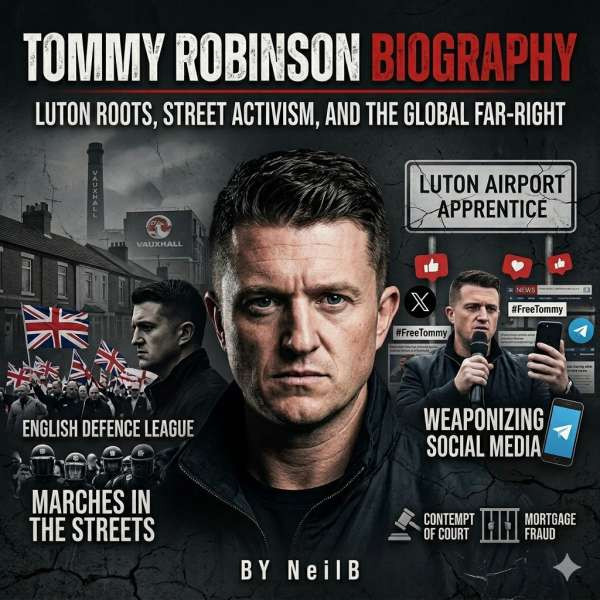
Tommy Robinson Biography
Stephen Christopher Yaxley-Lennon was born in Luton on November 27, 1982. To understand the man who would eventually become the face of a polarized Britain, one must understand the town that forged him. Luton in the 1980s was an industrial powerhouse transitioning into an era of uncertainty. As the local Vauxhall car plant—once the heartbeat of the town’s economy—began its long, slow decline, the social fabric of the borough tightened and frayed in equal measure.
Stephen Christopher Yaxley-Lennon was born in Luton on November 27, 1982. To understand the man who would eventually become the face of a polarized Britain, one must understand the town that forged him. Luton in the 1980s was an industrial powerhouse transitioning into an era of uncertainty. As the local Vauxhall car plant—once the heartbeat of the town’s economy—began its long, slow decline, the social fabric of the borough tightened and frayed in equal measure.
Tommy Robinson Biography
Tommy Robinson Biography
Chapter 1: Luton Roots
Stephen Christopher Yaxley-Lennon was born in Luton on November 27, 1982. To understand the man who would eventually become the face of a polarized Britain, one must understand the town that forged him. Luton in the 1980s was an industrial powerhouse transitioning into an era of uncertainty. As the local Vauxhall car plant—once the heartbeat of the town’s economy—began its long, slow decline, the social fabric of the borough tightened and frayed in equal measure.
Stephen grew up in a household characterized by complex identities. Born to an Irish mother and an English father, he was later adopted by his stepfather, Thomas Lennon. His upbringing was grounded in the working-class struggle; his mother worked in a local bakery and later at the Vauxhall plant, while his stepfather toiled as a pipe-fitter. It was a close-knit, Catholic-influenced family, yet the environment outside the home was anything but sheltered.
The streets of Luton were a melting pot, but they were also a place of hardening. By his own account, the town was "rough," a place where you learned to hold your own or be steamrolled. From a young age, Stephen observed a city in flux, where the changing demographics and economic anxieties created friction in the playgrounds and on the estates. He wasn't a bystander; he was an active participant in the social hierarchies of the era. He excelled academically enough to secure a prestigious apprenticeship in aircraft engineering at Luton Airport—a rare opportunity in a town where options were dwindling—but his gravitational pull remained toward the terraces and the street-level culture that dominated his social life.
Chapter 2: Football and the Firm
If Luton was the stage, the football terrace was the laboratory where Stephen Yaxley-Lennon’s identity as "Tommy Robinson" was birthed. In the 1990s and early 2000s, football hooliganism in Britain was not merely about the sport; it was about territorial dominance and the assertion of masculine strength. For a young man looking for belonging in a changing town, the Luton Town football firm provided a ready-made structure of hierarchy, discipline, and, most importantly, conflict.
The pseudonym "Tommy Robinson" was a calculated choice, adopted from a prominent member of the "Luton Town MIGs," a notorious hooligan crew. It served a dual purpose: it allowed him to operate in the shadows of the law, hiding his identity from police who were increasingly tracking hooligan activity, and it conferred upon him the status of the figure whose name he had borrowed. Under this mask, Yaxley-Lennon became a fixture of the terraces, participating in the brawls and "days out" that defined the era.
This period was essential to his development as an agitator. He learned the art of the chant, the psychology of the mob, and the effectiveness of physical intimidation. He discovered that a collective identity—the "firm"—could act as a force multiplier for his own personal frustrations. Whether they were clashing with rival fans from London or asserting control over their local turf, he was mastering the mechanics of street-level mobilization.
Chapter 3: The First Conviction
The collision between the street-level agitator and the state occurred in 2004, culminating in the legal consequences that would set the tone for the rest of his life. In July of that year, an argument involving Stephen and his then-partner, Jenna Vowles, escalated into a physical confrontation. An off-duty police officer intervened, leading to a violent struggle in the streets of Luton.
Stephen was subsequently convicted of assault occasioning actual bodily harm and assault with intent to resist arrest. The experience of the trial, and the following 12-month prison sentence, was a defining moment. For many, prison is a site of rehabilitation or shame; for Yaxley-Lennon, it became a crucible for his narrative of martyrdom. Within the walls of the carceral system, he encountered a world that only served to solidify his worldview: he felt himself to be a victim of a system that was fundamentally biased against people like him.
The loss of his job—his hard-won apprenticeship in aircraft engineering—was a professional death knell that freed him to pursue his political and activist ambitions full-time. He walked out of prison with a criminal record, but also with a heightened sense of defiance. He had been "processed" by the state, and he had emerged convinced that the state was not a neutral arbiter, but an adversary.
Chapter 4: The Far-Right Drift
In the mid-2000s, following his release from prison, Stephen Yaxley-Lennon found himself searching for a political vessel that could carry the frustrations he had cultivated in Luton. The political landscape of the UK at the time was volatile, with growing unease over migration, national identity, and the perceived abandonment of the working class by traditional parties.
During this period, he engaged with the British National Party (BNP), which was then attempting to move from the political fringe toward something resembling electoral legitimacy. For Stephen, the party offered a structured, albeit controversial, framework for his nascent grievances. He saw in the BNP a platform to voice the anxieties he had felt growing up in a town he believed was changing too fast and without the consent of those who had lived there for generations.
However, his flirtation with the party was short-lived. He quickly realized that the BNP’s rigid, bureaucratic structures and its association with old-guard, neo-Nazi imagery were not the right fit for the type of street-level activism he envisioned. He wanted something faster, more reactive, and less burdened by the historical baggage of the 20th-century far-right. He wanted a movement that felt modern, one that could be broadcasted and shared in the nascent age of social media. He realized that to build the movement he wanted, he would have to create it himself.
Chapter 5: The Birth of the EDL
The founding of the English Defence League (EDL) in 2009 was the pivot point that transformed Stephen Yaxley-Lennon from a local agitator into a national figure of controversy. The catalyst was a protest by radical Islamists against returning British soldiers in Luton. The sight of that protest ignited a firestorm of anger that Stephen channeled directly into the creation of a new organization.
The EDL was built on the idea of street-level defense. By branding the group as a "defence" league, he gave his followers a moral shield; they weren't the aggressors, they claimed—they were the defenders of British culture and values. It was a masterclass in rebranding. He tapped into the post-9/11 fear, the anxieties surrounding local demographic shifts, and a deep-seated feeling of alienation among the white working class in towns across the North and Midlands.
The group’s structure was intentionally decentralized. It was designed to be a movement that could be activated at a moment's notice in any town that felt "under threat." This gave the EDL a chaotic, unpredictable energy that the police struggled to contain. Stephen served as the face of this chaos, often speaking to the press with a blend of defiance and polished victimhood. He was rapidly learning how to use the media’s fascination with "extremism" to his own advantage, ensuring that every EDL march was covered in newspapers across the country.
Chapter 6: Streets on Fire
Between 2009 and 2013, the streets of towns like Luton, Tower Hamlets, Dudley, and Leicester became the primary battlegrounds for the EDL. These were not intellectual debates; they were physical, noisy, and often violent manifestations of a divided nation. The marches were choreographed to maximize visibility, featuring flags, chants, and the presence of "Tommy Robinson" at the helm, surrounded by his supporters.
For Stephen, this was the height of his street-level power. He discovered that he could call a march, and thousands would answer. He felt the rush of being a leader who could dictate the pace of the news cycle. However, this era also marked the beginning of intense scrutiny from state security services and the police. The marches often ended in clashes with anti-fascist counter-protesters, leading to countless arrests and the draining of local police budgets.
This period solidified his reputation as a polarizing provocateur. To his followers, he was a hero standing up to a political elite that ignored them. To his critics, he was a dangerous demagogue whose primary objective was to incite social unrest. Stephen thrived in this binary world. He had successfully taken the lessons of the football terrace and scaled them to a national level, proving that in a fragmented country, the loudest and most confrontational voice could command the largest audience.
Chapter 7: Breaking with the EDL
By 2013, the EDL was beginning to buckle under its own weight. The constant cycle of street protests had resulted in a thinning of the ranks, and the organizational chaos—fueled by internal disputes and the persistent scrutiny of the police—was making it difficult to maintain the momentum of the early years. Stephen Yaxley-Lennon had become the face of a movement that was increasingly being defined by its more violent, extremist fringes.
The decision to leave the EDL in October 2013 was a strategic pivot. He recognized that the brand had reached its ceiling and was becoming a liability. He was approached by the Quilliam Foundation, a counter-extremism think tank, in a highly publicized negotiation that saw him renounce his leadership of the EDL. For a brief moment, it appeared that the provocateur might be undergoing a transformation.
However, the "reformation" was short-lived. The move served primarily to distance him from the toxic reputation of the street-level group while allowing him to reinvent himself. By stepping away from the EDL, he escaped the burden of managing a sprawling, unmanageable organization and gained a new narrative: the "reformed" man who had seen the light but was now being ignored by the establishment. It was a perfect setup for his next act. He had realized that he didn't need the EDL to remain relevant; he needed only his name, his camera, and the vast, growing digital echo chamber he had cultivated.
Chapter 8: The Media Pivot
In the aftermath of the EDL, Stephen Yaxley-Lennon began his professional transition into the world of alternative media. He understood that the future of his influence lay not in the physical streets, but in the digital ones. He began collaborating with international outlets like Rebel Media, which provided him with the funding, production support, and global platform he needed to take his brand international.
This was the era of the "citizen journalist." Stephen armed himself with a mobile phone and a microphone, treating every interaction with authorities, every court appearance, and every public encounter as a potential piece of content. He was no longer just a speaker at a rally; he was a creator of a cinematic, high-stakes political reality show. He knew that the mainstream media would never offer him a fair platform, so he built his own.
This pivot professionalized his agitation. He learned how to edit his videos for maximum emotional impact, how to use social media algorithms to bypass traditional gatekeepers, and how to frame himself as a truth-teller fighting against a corrupt, globalist media machine. He wasn't just reporting on events anymore; he was curating them, ensuring that his supporters saw the world precisely through his lens. This digital infrastructure turned him into a pioneer of the modern, decentralized far-right media ecosystem, where the brand is the news, and the messenger is the message.
Chapter 9: The Contempt Cycles
As he stepped into the digital spotlight, Stephen Yaxley-Lennon entered into a series of recursive legal battles that became the defining feature of his public life. His most frequent clashes with the law were not for his political views, but for his conduct inside and around courtrooms. He became infamous for filming defendants and judicial processes, acts that repeatedly landed him in front of judges on charges of contempt of court.
For his supporters, these legal actions were clear evidence of "lawfare"—a state-sponsored campaign to silence a dissident. Every time he was arrested, he would livestream the event, turning the experience of being taken into custody into a broadcastable moment of martyrdom. He used these moments to galvanize his audience, framing the judiciary not as the protectors of the rule of law, but as the active agents of a political agenda meant to ruin him.
This cycle created a self-sustaining loop: his actions would trigger a legal response, which would trigger a new wave of crowdfunding, which would pay for the next legal defense, which would in turn increase his visibility. He became a master of "calculated provocation," knowing exactly where the line of the law was, and intentionally stepping over it to secure the maximum amount of media attention. The contempt charges weren't just hurdles; they were the fuel for the "Tommy Robinson" engine. He had successfully turned the courtroom into his stage, proving that in the digital age, a conviction can be just as valuable as a victory.
Chapter 10: The Global Stage
As the mid-2010s progressed, Stephen Yaxley-Lennon ceased to be merely a British domestic issue; he became a symbol in a burgeoning, transnational movement. He realized that the grievances he articulated—pertaining to national identity, migration, and the perceived "betrayal" of the establishment—resonated far beyond the borders of the United Kingdom. He began to forge alliances with right-wing figures and organizations in the United States, Europe, and Australia, participating in speaking tours and documentary projects that amplified his reach.
His ability to secure funding and rhetorical support from abroad was a turning point. He was no longer reliant solely on the small-scale donations of his local supporters; he was being bankrolled by international think tanks and individual donors who viewed him as a front-line soldier in a "clash of civilizations." This internationalization provided him with a shield. When the British establishment sought to sanction him, he could frame the narrative in global terms, presenting himself as a martyr whose cause was recognized and defended by powerful figures across the Western world.
This period transformed his political identity. He adopted the language of global populism, moving away from purely street-level concerns toward a more sophisticated, conspiratorial critique of globalist institutions. He became a fixture in the international digital media circuit, appearing on podcasts and platforms that reached millions. By positioning himself within this global network, he gained a level of protection and legitimacy that few other domestic agitators ever achieve; he wasn't just a man from Luton anymore—he was a global brand in the struggle for the "future of the West."
Chapter 11: The Leeds Incident
If there is a singular event that solidified Yaxley-Lennon’s status as a global cause célèbre, it was his arrest outside Leeds Crown Court in May 2018. While filming outside the court during an ongoing trial involving a grooming gang, he was arrested for breach of the peace and subsequently sentenced to prison for contempt of court. The speed of the process—from his arrest in the morning to his sentencing in the afternoon—sent shockwaves through the digital landscape.
The reaction was instantaneous and unprecedented. Within hours, the hashtag #FreeTommy began trending globally. Thousands of protesters descended on Downing Street, demanding his release, while international media figures, right-wing influencers, and even some members of the U.S. Congress weighed in on the "injustice" of his imprisonment. For a brief, feverish period, he was perhaps the most discussed political prisoner in the Western world.
This incident was a masterclass in his ability to weaponize a legal setback. By being imprisoned during a high-profile trial, he effectively hijacked the narrative, shifting the public conversation from the crimes being tried in the courtroom to the supposed tyranny of the British judicial system. The incident proved that he had successfully cultivated an audience that was not just passive consumers of content, but a mobilized, international force. The Leeds incident was the moment he moved from the fringes of the far-right to the center of a global digital culture war.
Chapter 12: Weaponizing Social Media
The rise of X (formerly Twitter) and other social media platforms was the wind in Yaxley-Lennon’s sails. He recognized earlier than most that these platforms were not just tools for communication; they were weapons for political warfare. He utilized them to bypass traditional media, creating a direct, unfiltered line to his supporters. He became a relentless operator, posting videos, screenshots of emails, and live updates that created a constant sense of crisis and urgency.
He mastered the art of the "short-form clip"—highly emotional, fast-paced videos designed for maximum shareability. He knew that the platforms’ algorithms prioritized engagement and controversy, so he leaned into both. When he was "deplatformed" from Facebook or Instagram, he didn't disappear; he treated the banning as a confirmation of his status as a threat to the establishment. Every loss of an account was a badge of honor that he wore to encourage his followers to migrate with him to encrypted messaging apps like Telegram or alternative platforms.
This digital infrastructure allowed him to create a "gated" community—a space where his word was the primary source of truth, and where dissenting voices were immediately blocked or ridiculed. He wasn't just building a following; he was building a digital bunker. By the mid-2020s, he had created an ecosystem that was largely impervious to mainstream fact-checking or regulation. He had successfully decoupled his influence from the physical world, proving that in the digital era, the person who controls the algorithm controls the narrative, and the person who controls the narrative controls the mob.
Chapter 13: Mortgage Fraud and Identity
Stephen Yaxley-Lennon’s public narrative often revolved around a sense of righteous persecution, but his private actions revealed a more cynical reality. In January 2014, he was sentenced to 18 months in prison after admitting to two counts of mortgage fraud. The conviction was a stark contrast to his self-styled image as a man of the people; it revealed that while he was inciting others to defend their communities, he had been conspiring to deceive banks for personal financial gain.
This conviction was compounded by his earlier legal troubles regarding his identity. In 2013, he had been sentenced to 10 months in prison for using a friend’s passport to illegally enter the United States. Having been denied entry due to his criminal history, he had chosen to bypass the law entirely, assuming a false identity to cross a border he was legally barred from.
For his critics, these weren't just "mistakes"—they were evidence of a pattern of dishonesty and a complete disregard for the very rule of law he claimed to be championing. Yet, for his base, these convictions were often dismissed as "stitch-ups" or minor transgressions that were being weaponized by a hostile establishment to discredit him. He had become adept at turning even his most blatant criminal acts into fuel for his narrative, convincing his followers that he was a man being hunted for his ideas, not for his actions.
Chapter 14: Radicalization and Resonance
Perhaps the most sobering assessment of Yaxley-Lennon’s influence came in the wake of the 2017 Finsbury Park terrorist attack. When the perpetrator, Darren Osborne, was found to have been consumed by online hate material, counter-terrorism investigators pointed to Yaxley-Lennon’s content as a significant factor in his rapid radicalization. Emails between the two were uncovered, and Osborne’s own testimony revealed an obsession with the inflammatory rhetoric found in Yaxley-Lennon’s social media posts.
Security services, including the Joint Terrorism Analysis Centre, began to treat the "extreme right" not just as a street-level nuisance, but as a genuine national security threat. They were no longer just tracking violent neo-Nazis; they were monitoring the digital ecosystems where individuals were "self-radicalizing" by binge-consuming content that preached a coming war of cultures.
For Yaxley-Lennon, this was an existential challenge. He was being directly linked to the formation of a "terrorist murderous intent." While he never explicitly called for violence, his work created the cognitive environment in which violence became a rationalized response. He walked a fine line, using rhetoric that dehumanized his targets while maintaining just enough deniability to stay outside the direct reach of terrorism laws. The Finsbury Park attack was the moment the state fully understood that his words were not just agitation—they were fuel for a fire that was beginning to burn out of control.
Chapter 15: The Political Mainstream
In late 2018, the boundaries between the political fringe and the mainstream were pushed to their breaking point when UKIP leader Gerard Batten appointed Yaxley-Lennon as his personal special advisor. The appointment, focused on "prison reform and rape gangs," was a clear attempt by Batten to capture the energy of the anti-establishment movement.
The move was met with immediate and fierce backlash, even within UKIP itself. For many of the party’s traditional members, the association with a figure so heavily linked to the far-right and with a long history of criminal convictions was a step too far. It brought into sharp focus the internal battle for the party’s soul, with accusations of "hijacking" and "lurching to the right."
For Yaxley-Lennon, the role was a validation of his influence. It was his closest attempt at entering the corridors of power, an effort to move from the streets to the boardroom. Although the appointment was short-lived and eventually failed to materialize into a formal position within the party apparatus, the intent was clear: the provocateur had successfully forced the political establishment to contend with his presence. He had moved from being a voice on the outside looking in, to a figure who could command the attention, and the desperation, of a mainstream political leader.
Chapter 16: The Pandemic Years
The arrival of the COVID-19 pandemic in 2020 presented an unexpected opportunity for the "Tommy Robinson" brand. As the British government implemented unprecedented lockdowns, travel restrictions, and mandatory health protocols, Yaxley-Lennon found a new, massive audience among those disillusioned with the state’s intrusion into their daily lives. He became a primary voice for anti-lockdown sentiment, blending his standard anti-establishment rhetoric with vaccine skepticism and theories about state control.
He utilized the pandemic to pivot from a focus on immigration to a broader, more existential "liberty versus tyranny" narrative. The rallies he helped orchestrate during this time were no longer just about his traditional base; they attracted a wider coalition of conspiracy theorists, libertarians, and exhausted citizens. He was once again at the center of a movement that defied public health regulations, framing the wearing of masks and the enforcement of social distancing as the final steps in the subversion of British freedom.
Throughout the lockdowns, he remained a persistent thorn in the side of the authorities. He documented his defiance of COVID laws, ensuring his followers saw him as a leader who practiced what he preached. He successfully positioned the pandemic as the ultimate test of the British spirit—and himself as the only one brave enough to lead the resistance. It was a period that allowed him to broaden his political base significantly, moving from the fringes into the lives of everyday people who felt silenced by the government’s emergency powers.
Chapter 17: Legal Defeats
By 2024, the cycle of legal battles that had defined Yaxley-Lennon’s career reached a new, intense level. He faced a series of high-profile cases, including a major defamation claim brought by Jamal Hijazi—a Syrian refugee whom Yaxley-Lennon had accused of being a violent aggressor in a high-profile school incident. The court found that Yaxley-Lennon had libeled the boy, resulting in a devastating judgment that ordered him to pay hundreds of thousands of pounds in damages and legal costs.
This was more than just a financial hit; it was a blow to the "truth-teller" persona he had worked so hard to build. The judgment systematically dismantled his version of events, exposing the factual basis of his claims as deliberate fabrications. In response, Yaxley-Lennon leaned into his well-worn script: he declared bankruptcy, claimed he was being targeted by "globalist" judges, and appealed directly to his supporters to fund his continued fight.
The defamation case was followed by further prison time for contempt of court, as he continued to flagrantly ignore judicial orders and the constraints of the legal system. He seemed to have reached a point where the legal system was no longer a hurdle to be avoided, but a venue he exploited for its propaganda value. Every defeat in court was repackaged as a win for his supporters, reinforcing their conviction that he was a victim of a corrupt, partisan judiciary that was determined to crush any voice of dissent.
Chapter 18: International Allegiances
As the domestic legal pressure mounted, Yaxley-Lennon leaned increasingly into his transnational political network. His influence was no longer confined to British shores; he became a frequent contributor to global right-wing media outlets and a partner in the growing network of "sovereignty" movements across the Western world. He saw himself as part of a global struggle, building connections with political figures and wealthy donors in Europe and North America who shared his ideological outlook.
These alliances were essential for his survival. When British platforms deplatformed him or British banks closed his accounts, he found refuge and financial support in international digital ecosystems. He was invited to speak at global summits where he was hailed as a martyr for "free speech." This international support network gave him a level of resilience that would have crippled a purely domestic activist.
He was no longer just a British agitator; he was a model for an international style of right-wing populism that viewed traditional media and established political parties with deep, ideological hostility. His movement was increasingly detached from the specificities of British domestic policy and aligned with a broader, borderless fight against what he defined as the "elite." By 2026, he had successfully integrated himself into a global political infrastructure, ensuring that even if he were to be silenced in the UK, his voice would continue to resonate on the international stage.
Chapter 19: The 2024 Riots
The summer of 2024 marked a dark chapter in British civil life, defined by widespread anti-immigration protests and riots that swept across the country. While Stephen Yaxley-Lennon did not issue explicit, direct instructions to riot, his Telegram channel became the primary digital conduit through which the unrest was framed. He acted as the "online opinion leader," creating an environment where anger, fear, and distrust were not just tolerated, but encouraged.
Through hundreds of messages, videos, and conspiratorial narratives, he reframed those participating in the violence as the "concerned British public" defending their homeland. He deliberately tapped into the emotional volatility of the time, amplifying stories of perceived betrayal by the government and the police. By the time the streets were alight with fire and physical intimidation, the moral and emotional conditions for such violence had already been firmly established by his digital output.
Academic studies later identified this as "indirect mobilization." Yaxley-Lennon understood the mechanisms of the algorithm and the psychology of his base perfectly. He provided a steady, one-way stream of content that made violent action feel like a natural, necessary, and patriotic response to government inaction. He successfully occupied the space of "lawful but awful," ensuring that while he could not be directly charged with inciting the violence, he was undeniably its most effective architect.
Chapter 20: The "Unite the Kingdom" Rallies
By 2026, the "Unite the Kingdom" rallies had become the centerpiece of Yaxley-Lennon’s public activism. These events were massive, multi-faceted displays of nationalist sentiment that drew thousands from every corner of the UK. They were strategically vague in their messaging—allowing attendees to project their own specific grievances onto the movement—but unified in their fundamental opposition to the status quo.
The rallies brought together a strange coalition: disaffected voters, far-right agitators, and those swept up in the broader immigration debate. They became a physical manifestation of his digital echo chamber, turning online outrage into a tangible, high-stakes spectacle. The rallies were frequently accompanied by counter-protests, turning city centers into polarized zones of scuffles, police cordons, and shouting matches.
For Yaxley-Lennon, these events were a vital show of strength. They served as physical proof that his movement was not just a collection of social media accounts, but a real-world force that could occupy the streets of London and other major cities. They were also his ultimate fundraising and branding tool, ensuring that the media remained tethered to his every move. The rallies cemented his role as the lightning rod for the era's deepest social anxieties, proving that he remained the most successful, and most disruptive, agitator of his generation.
Chapter 21: The Shadow of 2026
As of mid-June 2026, Stephen Yaxley-Lennon remains a figure locked in a state of perpetual confrontation. His return to the UK from Russia in June 2026—and his subsequent detention at Heathrow Airport under Schedule 3 of the Counter-Terrorism and Border Security Act—marked a new level of friction with the state. The seizure of his communication devices by police signaled that the intelligence and security services were now deeply focused on his international connections and potential "hostile activity."
Despite the mounting legal and surveillance pressure, his resolve appeared, to his supporters, to be unbreakable. Even while facing the seizure of his phones, he immediately leveraged the incident on social media, framing the state’s scrutiny as an attack on "investigative journalism." His ability to continue operating, even as the Oxford Union and other institutions became battlegrounds over his presence, demonstrated his unique resilience.
He is now a man who lives in the eye of a storm of his own making. Whether he is arguing at a prestigious debate, organizing a march, or being held in an airport detention room, his brand thrives on the controversy that follows him. He has successfully transformed his identity into a permanent, enduring shadow over British politics—a reminder of the power of a single, well-placed, and utterly uncompromising voice to destabilize the social cohesion of a nation. The "Unfinished City" of London, and indeed the country itself, continues to grapple with the fire he has spent two decades tending.

Không tìm thấy bình luận
Các bản nhạc khác