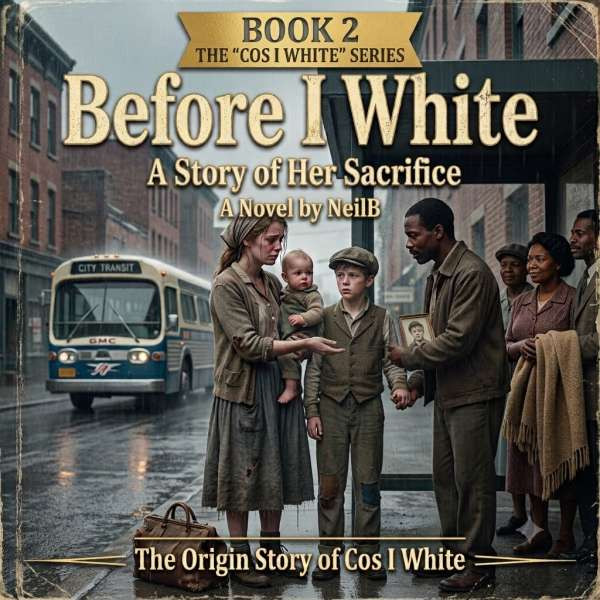


BEFORE I WHITE
Book 2 of the "Cos I White" Series
Book 2 of the "Cos I White" Series
BEFORE I WHITE
Book 2 of the "Cos I White" Series
PART ONE: THE WEIGHT OF BLOOD
CHAPTER ONE: THE HOUSE ON THE HILL.
The house on the hill was a monument to everything Ruth Harrison had been taught to despise, even as she had called it home for the first eighteen years of her life. It sat atop the highest ridge in Harrison County, Mississippi, a sprawling white colonial with columned porches and tall windows that caught the morning sun like mirrors and reflected it back into the world as a warning to anyone who dared approach. The grounds were immaculate—rolling lawns of emerald grass that had been trimmed by the hands of men who had never owned a single blade of it, ancient oaks draped in Spanish moss that swayed like ghostly curtains in the summer breeze, gardens that bloomed with azaleas and camellias and roses in their proper seasons, each flower planted precisely where it belonged, each petal a testament to the order that the Harrison family had imposed upon the world around them.
It was the kind of house that appeared on postcards, the kind of house that people pointed to with pride when they spoke of the old families, the ones who had built this part of the South with their own hands and their own money and their own unshakeable belief in their own superiority. It was the kind of house that whispered secrets, that held memories, that bore witness to the rise and fall of generations. And it was the kind of house that Ruth had fled in the dead of night, never to return.
She had grown up in that house, had run through its halls as a child, her bare feet slapping against the polished hardwood floors, her laughter echoing off the high ceilings. She had sat at the long mahogany dining table, learning which fork to use for which course, learning how to speak to the help, learning how to be a proper Southern lady. She had attended the finest schools, worn the finest clothes, and been promised a future that would be just as fine as her past.
But all of that had ended the day she told her father she was pregnant.
The memory of that day was burned into her mind like a brand, a moment of such searing pain that she had never been able to fully escape it. She had stood in her father s study, her hands clasped together to keep them from trembling, her eyes fixed on the Persian rug beneath her feet, the intricate patterns blurring as tears filled her eyes. Her father, William Harrison III, had sat behind his massive oak desk, his face a mask of cold fury, his eyes hard as flint, his jaw set in the rigid line that she had learned to fear as a child. His mother, Eleanor, had stood by the window, her back turned, her shoulders rigid with disapproval, her silhouette a perfect portrait of aristocratic disdain.
"You ve disgraced this family," her father had said, his voice low and dangerous, each word cutting into her like a blade. "You ve thrown away everything we ve given you. Everything we ve worked for. For what? For some... some nobody from the other side of the tracks?"
Ruth had wanted to defend herself, to explain that the man she loved was not a nobody, that he was kind and gentle and had promised to marry her, that he had a soul as deep and true as any man her father had ever met. But the words had died in her throat. She had seen the look in her father s eyes, and she had known that nothing she could say would make a difference. She had known that he had already judged her, already condemned her, already erased her from the family tree.
"Who is he?" her mother had asked, finally turning from the window. Her voice was cold, dismissive, the voice of a woman who had long ago stopped believing that her daughter was capable of anything worthwhile. "Who is the father of this child?"
Ruth had shaken her head. "I can t tell you."
"Can t, or won t?" her father had demanded, his voice rising, his face flushing with anger.
"Both," she had whispered.
The truth was that she had promised to protect him. He was a good man, a decent man, but he was also a man with secrets, a man who had trusted her with those secrets and asked her to keep them safe. She had loved him, and she had kept her promise. She had loved him the way she had never loved anyone before, with a fierceness that frightened her, a devotion that defied all reason. And she had believed, with all her heart, that he would come back for her, that he would find a way to be with her, that their love would conquer everything.
But her father had not been moved by love. He had been moved by rage, by pride, by the cold calculation of a man who had built his life on appearances and was not about to let his daughter destroy it all.
Her father had given her an ultimatum. Either she would name the father, or she would leave the house and never return. She had refused, and he had made good on his threat. Within hours, she had been packed and turned out, her belongings thrown into a single suitcase, her future erased as if it had never existed.
She had stood on the steps of the house that had been her home, clutching her suitcase, watching the door close behind her. She had heard the click of the lock, the finality of it, and she had known that she was truly alone. Her mother had not come to say goodbye. Her father had not looked back. She had been cast out like a stranger, a stranger who had once been their daughter.
The years that followed had been hard, harder than she could have ever imagined. Ruth had found work where she could, cleaning houses and waiting tables and doing whatever was necessary to survive. She had moved from town to town, always one step ahead of the shame that seemed to follow her like a shadow, always looking over her shoulder, always waiting for the other shoe to drop.
She had given birth to her son, William, in a small hospital in a town she barely remembered, a place called Hattiesburg, where the nurses had been kind and the doctors had been indifferent. She had held him in her arms, this tiny creature with his pale hair and his winter blue eyes, and she had promised herself that she would give him a better life than she had had. She had promised herself that he would never know the pain of rejection, the sting of shame, the cold emptiness of being cast out by those who were supposed to love him.
She had named him William after her father, not because she loved her father—she didn t, not anymore—but because she wanted her son to have a name that meant something, a name that carried weight, a name that would open doors rather than close them. She had hoped, naively, that the name would protect him, that it would give him a chance at the life she had never been able to have.
But promises, she had learned, were easier made than kept.
Now, eight years later, she stood at the edge of a different town, a small place called Willow Creek, holding her son s hand and wondering if she was about to make the biggest mistake of her life. The Greyhound bus that had brought them here had long since disappeared, its diesel fumes dissipating into the cold winter air, its rattle and hum fading into the distance. The sun was beginning its slow descent toward the horizon, painting the sky in shades of orange and gold, casting long shadows across the frozen ground.
"Where are we going, Mama?" William asked, his voice small and tired, his small hand clutching hers so tightly that his knuckles were white.
Ruth looked down at her son, at his pale hair and his winter blue eyes, at the face that was so much like his father s. She felt a surge of love so powerful it almost brought her to her knees, a love that was fierce and protective and all consuming. This boy was her whole world, her reason for living, her only source of hope in a world that had given her nothing but pain.
"Just a little further, baby," she said, squeezing his hand. "Just a little further."
She had heard about this town from a woman she had met on the bus, a kind old woman with a face like wrinkled parchment and eyes that sparkled with knowing. The woman had told her that Willow Creek was a place where people could start over, a place where the past didn t follow you, a place where you could be whoever you wanted to be. The woman had said it with a knowing look, as if she understood that Ruth was running from something, that Ruth was carrying secrets of her own. Ruth had been too tired, too scared, to ask what the woman meant. She had simply nodded and thanked her and hoped that the woman was right.
Now, as she walked through the streets of Willow Creek, she wasn t sure if the woman had been right at all. The town was small, smaller than she had expected, a cluster of buildings that seemed to have been forgotten by time. There was a grocery store with a faded sign, a diner with a flickering neon sign that promised "Good Eats," a barber shop with a red and white pole that hadn t been painted in years, and a church with a white clapboard steeple that rose above the treetops like a silent prayer. It was the kind of place where everyone knew everyone else, where secrets were hard to keep, where a woman with a child and no husband would be noticed.
She had been running for so long that she had forgotten what it felt like to stop.
She led William to the edge of town, where the paved road gave way to a dirt track that wound into the dense pine forest. The trees loomed dark and forbidding, their branches reaching out like skeletal fingers, their shadows stretching across the path like warnings. She knew what she had to do, had known it for weeks, had been planning it and dreading it in equal measure. It was the only way, the only chance she could give her son.
"William," she said, kneeling down in front of him, her hands gripping his thin shoulders with a ferocity that surprised them both. "I need you to listen to me."
He looked at her, his eyes wide with trust, his small face pale and frightened. He was so small, so fragile, so utterly dependent on her. And she was about to break his heart.
"I have to go away for a while," she said, forcing the words out, each one a knife in her chest. "I have to go away, and you need to stay here."
His face crumpled, his lower lip trembling, tears welling in his beautiful blue eyes. "No, Mama. Don t leave me. Please don t leave me."
She pulled him into a fierce embrace, her body shaking with silent sobs, her tears soaking into his thin coat. "I have no choice," she whispered into his hair. "I have to protect you. They re looking for us. They ll take you away from me if they find us. This is the only way. You stay here, and someone will find you. Someone will take care of you. You re a good boy, William. A good, brave boy. Remember that. Remember me."
She pressed a kiss to his forehead, her lips cold and chapped, her heart breaking into a thousand pieces. Then, before she could lose her nerve, she stood up and ran. She ran into the forest, her thin coat flapping behind her like the wings of a wounded bird, her breath coming in ragged gasps, her legs pumping beneath her as if she could outrun the pain. She did not look back. She couldn t. If she looked back, she would lose her nerve, and she needed to be brave. For him.
She ran until her lungs burned and her legs gave out, and then she collapsed against the trunk of a pine tree and wept. She wept for the life she had lost, for the child she had left behind, for the future she would never have. She wept for the mother she had been and the mother she could not be. She wept until there were no tears left, until her body was empty and hollow, until all that remained was a profound, aching silence.
And when the tears were gone, she stood up, wiped her face, and began to walk. She had no idea where she was going, no idea what she would do next. All she knew was that she had done the only thing she could do.
She had given her son a chance.
CHAPTER TWO: A MOTHER S LOVE
Ruth Harrison had been born on a Tuesday in late September, the only daughter of William Harrison III and Eleanor Harrison. She had arrived in the world with a full head of dark hair and a set of lungs that announced her presence to everyone in the hospital. Her father had held her in his arms and declared her perfect, and from that moment on, she had been the center of his world.
Her early years had been idyllic, a blur of sunshine and laughter and the kind of privileged existence that few people could imagine. She had wanted for nothing. There had been toys and clothes, tutors and ponies, parties and holidays. She had been surrounded by love and attention, and she had grown up believing that the world was a place of limitless possibility, that the future was hers for the taking.
Her mother had been a distant figure, more concerned with appearances than with affection, a woman who seemed to view her daughter as a project rather than a person. Eleanor Harrison had been raised to believe that a woman s value lay in her beauty, her poise, her ability to attract a suitable husband. She had passed these beliefs on to her daughter, not through words, but through the weight of her expectations, the coldness of her gaze, the constant, unspoken demand that Ruth be perfect.
But her father had more than made up for it. He had been her champion, her protector, her biggest cheerleader. He had taught her to ride a bike, to read, to stand up for herself. He had told her that she could be anything she wanted to be, that the world was hers for the taking. He had believed in her, truly believed in her, and his belief had given her the confidence to dream.
But as she grew older, the world began to narrow. She learned that there were limits, expectations, rules that she was expected to follow. She learned that being a Harrison meant something, that she had a reputation to uphold, a legacy to protect. She learned that there were certain things she could do and certain things she could not, and that deviating from the path that had been laid out for her would have consequences.
She had tried to be good. She had tried to be the daughter her parents wanted. She had gone to the right schools, made the right friends, said the right things. She had smiled when she was supposed to smile and been quiet when she was supposed to be quiet. She had been the perfect Southern lady, the belle of every ball.
But she had also been lonely. Beneath the surface of her perfect life, there had been a deep, abiding loneliness, a sense that something was missing. She had felt like an actress playing a role, always performing, never being herself. She had felt like a stranger in her own life, watching it unfold from a distance, never quite able to step into it.
And then she had met him.
He was a stranger to Harrison County, a man who had arrived in town with nothing but a suitcase and a smile. He had been hired to work on the railroad, a temporary job that had brought him through the area. He was handsome in a rugged, unpolished way, with dark hair that fell across his forehead and blue eyes that seemed to see right through her, that seemed to understand her in a way no one else ever had.
They had met at the general store, where she had gone to buy some ribbon for her mother. He had been standing in line behind her, and he had helped her pick up the package she had dropped. Their hands had touched, and she had felt a spark, a connection that had taken her breath away. It had been like lightning, sudden and electric, a jolt of recognition that had left her stunned.
He had introduced himself as James, and they had started talking. They had talked for hours, standing in the middle of the store, oblivious to the world around them. He had made her laugh, really laugh, for the first time in years. He had made her feel seen, understood, alive. He had looked at her as if she were the most fascinating person in the world, as if everything she said was worth listening to.
They had started seeing each other in secret. She knew it was wrong, knew that her parents would never approve, but she couldn t help herself. He was the first person who had ever made her feel like herself, the first person who had ever loved her for who she really was. With him, she could let down her guard, drop the mask, be the person she had always been beneath the surface.
She had fallen in love with him, deeply and completely. She had believed that he felt the same way, that they would find a way to be together, that love would conquer all. She had believed that they were meant to be, that fate had brought them together, that nothing could tear them apart.
But love, she learned, was not always enough.
He had told her the truth one night, sitting on the banks of the creek where they had first kissed. The moon had been full, casting silver light across the water, and the air had been thick with the sound of crickets and the scent of honeysuckle. He had been quiet for a long time, staring at the water, his face pale and troubled, and she had known that something was wrong.
"I have to leave," he had said finally, his voice barely above a whisper. "I have to leave, and I can t take you with me."
She had felt her world shatter. "Why? What s wrong?"
He had looked at her then, his blue eyes filled with pain. "There are things about me that I haven t told you," he had said. "Things that would put you in danger. I can t stay here. I can t put you at risk."
She had begged him to explain, but he had refused. He had told her that he loved her, that leaving was the hardest thing he had ever had to do, but that it was the only way to keep her safe. He had told her that he would always love her, that he would never forget her, that she had changed his life in ways she couldn t imagine.
"When you love someone," he had said, "you have to be willing to let them go."
She hadn t understood then. She had been too angry, too hurt, too desperate. She had screamed at him, cried, begged him to stay. She had told him that she didn t care about the danger, that she would rather be with him than be safe, that love was worth the risk.
But he had been adamant. He had held her tightly, kissed her forehead, and walked away into the darkness. She had watched him go, her heart breaking into a thousand pieces, and she had never seen him again.
She had told him she was pregnant before he left. He had held her tightly, his body shaking with silent sobs. He had begged her to forgive him, to understand, to take care of herself and their child. He had promised that he would find her, that he would come back for her, that they would be together again.
She had believed him. She had believed that he would come back, that they would be together, that everything would work out in the end. She had clung to that belief like a lifeline, a beacon of hope in the darkness.
But he never came back.
CHAPTER THREE: THE MAN WHO LEFT
James had been a mystery to Ruth from the very beginning, a man who seemed to carry secrets as naturally as other men carried wallets. He had never spoken about his past, never mentioned his family, never given any indication of where he had come from or what he had left behind. He had been a ghost, a figure who had appeared in her life and disappeared just as quickly.
In the weeks after his departure, Ruth had tried to find him. She had asked questions, followed leads, searched through records. She had called every number he had ever given her, written to every address, visited every place he had ever mentioned. But she had found nothing. It was as if he had never existed, as if he had been a figment of her imagination.
She had begun to wonder if she had imagined him, if the love she had felt had been a fantasy. But the child growing inside her was proof that he had been real, that the love had been real, that the loss was real.
She had written him letters, dozens of them, pouring out her heart on paper. She had told him about the baby, about her fears and hopes, about the future she had dreamed for them. She had told him that she loved him, that she missed him, that she would wait for him forever if she had to. She had sent the letters to the last address she had for him, but they had been returned, unopened.
She had kept his photograph, a worn and faded picture of a man with kind eyes and a gentle smile. It was the only thing she had of him, the only proof that he had existed, and she had clung to it like a lifeline. She had looked at it every night, tracing the lines of his face with her finger, trying to remember the sound of his voice, the warmth of his touch.
She had named her son after him, in a way. William had been her father s name, but she had given it to her son as a tribute to the man she had loved, the man who had given her the greatest gift of her life.
The warning had come in the form of a letter, slipped under her door in the middle of the night. She had found it the next morning, a plain white envelope with no return address, no postmark, nothing to indicate where it had come from. Inside, there had been a single sheet of paper, covered in typewritten words.
You need to leave. They re coming for you. They ll take the child. Run and don t look back.
Ruth had read the letter over and over, her heart pounding with fear. She had no idea who had sent it or why. She had no idea what it meant, who "they" were, why they would want to take her child. But she had also had no doubt that the warning was real. She had seen the look in James s eyes when he had told her he had to leave, the fear that had lurked beneath the surface. She had sensed that he was running from something, that his secrets had put him in danger.
And now, it seemed, that danger had found her.
She had packed her bags that very night, taking only what she could carry. She had grabbed William from his bed, wrapping him in a blanket, and fled into the darkness. She had no idea where she was going, no idea what she would do next. All she knew was that she had to run, had to protect her son, had to keep him safe.
The years that followed were a blur of motel rooms and bus stations, of stolen moments and constant fear. Ruth had moved from town to town, never staying in one place for more than a few weeks, always looking over her shoulder, always waiting for the other shoe to drop. She had worked odd jobs, taken whatever she could find, done whatever was necessary to survive. She had been a waitress, a maid, a factory worker, a seamstress. She had done things she was not proud of, taken risks she would never have taken if she had had any other choice.
And all the while, she had been haunted by the fear that they would find her, that they would take her son, that everything she had sacrificed would be for nothing.
It was in a small diner in a town she didn t remember that she had met the stranger. He was an old man, his face lined with years of hard living, his eyes sharp and knowing. He had sat down across from her, uninvited, and looked at her with an intensity that had made her blood run cold.
"You re the one they re looking for," he had said, his voice low and gravelly. "The one with the boy."
She had tried to deny it, to brush him off, to pretend she didn t know what he was talking about. But he had just shaken his head, a sad smile on his lips.
"I m not here to hurt you," he had said. "I m here to warn you. They re getting closer. They know you re heading south. You need to find a place to hide, a place where no one will find you."
He had told her about Willow Creek, a small town in Mississippi where people minded their own business and strangers were welcome. He had told her that the town was mostly black, that she would be an outsider, but that she would be safe. He had told her that there was a church there, a good church, run by a good man who would help her.
She had listened to him, her heart pounding with fear and hope. She had wanted to believe him, wanted to believe that there was a place where she could finally stop running, where she and her son could find peace.
"Thank you," she had whispered. "Thank you for telling me."
He had nodded, his eyes filled with a strange, sad understanding. "You re a good mother," he had said. "You re doing the right thing. Don t ever doubt that."
He had stood up and walked away, disappearing into the night, and she had never seen him again.
The journey to Willow Creek had been long and hard. Ruth had spent her last few dollars on a bus ticket, cramming herself and William into the back of the Greyhound, holding him close as they rattled through the night. She had not slept, not really, too consumed by fear and exhaustion to find rest.
William had been a trooper, as he always was. He had not complained, not once, even though she knew he was tired and hungry and scared. He had just curled up against her, his small body warm against hers, his trust in her absolute.
She had looked down at him, at his pale hair and his winter blue eyes, at the face that was so much like his father s. She had felt a surge of love so powerful it had almost broken her, a love that was fierce and protective and all consuming. This boy was her whole world, her reason for living, her only source of hope in a world that had given her nothing but pain.
"Don t worry, baby," she had whispered. "I m going to find us a home. I m going to take care of you. I promise."
The bus had pulled into Willow Creek in the early morning, the sky still dark, the air cold and biting. Ruth had stepped off the bus, William s hand in hers, and looked around at the town that would become her son s home.
It was small, smaller than she had expected, a cluster of buildings that seemed to have been forgotten by time. There was a grocery store with a faded sign, a diner with a flickering neon sign that promised "Good Eats," a barber shop with a red and white pole that hadn t been painted in years, and a church with a white clapboard steeple that rose above the treetops like a silent prayer.
It was the kind of place where everyone knew everyone else, where secrets were hard to keep, where a woman with a child and no husband would be noticed. But it was also the kind of place where people could start over, where the past didn t follow you, where you could be whoever you wanted to be.
She had walked through the streets, William s hand in hers, her heart pounding with fear and hope. She had seen the people, the black men and women going about their business, the children playing in the streets. She had seen the way they looked at her, a white woman with a white child, an anomaly, an outsider.
She had known, in that moment, that she could not stay. She could not bring her son here, could not expose him to the prejudice and discrimination that she knew he would face. She could not force him to live in a world that would hate him simply because of the color of his skin.
She had made her choice. She would leave him here, in this town, with these people. She would trust that they would take care of him, that they would give him the chance she could never give him.
She had led him to the edge of the forest, to the place where the trees loomed dark and forbidding, and she had told him what she had to do.
And then she had run.
CHAPTER FOUR: THE GRANDPARENTS SHAME
The news of Ruth s pregnancy had spread through Harrison County like wildfire, carried on the tongues of gossips and the whispers of servants. Within days, everyone knew that the Harrison girl had disgraced herself, that she had fallen from grace, that she was carrying a child whose father no one knew.
The shame had been unbearable. The Harrison family, once the pride of the county, had become an object of pity and scorn. The invitations had stopped coming. The phone had stopped ringing. The friends who had once filled their house had disappeared, not wanting to be associated with a family that had fallen so far.
Her father had retreated into a cold silence, speaking to her only when necessary, his eyes filled with a contempt that cut deeper than any words. Her mother had retreated into her own world, burying herself in her garden, refusing to acknowledge her daughter s existence. The house that had once been filled with laughter had become a tomb, silent and cold.
Ruth had tried to make amends. She had apologized, begged for forgiveness, offered to do whatever was necessary to restore the family s honor. But it had been no use. The damage had been done, and her parents had made it clear that there was no coming back from it.
The confrontation had come on a Sunday afternoon, after church. Her father had called her into his study, his face a mask of cold fury. Her mother had stood by the window, her back turned, her shoulders rigid with disapproval.
"You ve disgraced this family," her father had said, his voice low and dangerous. "You ve thrown away everything we ve given you. Everything we ve worked for. For what? For some... some nobody from the other side of the tracks?"
Ruth had wanted to defend herself, to explain that the man she loved was not a nobody, that he was kind and gentle and had promised to marry her. But the words had died in her throat. She had seen the look in her father s eyes, and she had known that nothing she could say would make a difference.
"Who is he?" her mother had asked, finally turning from the window. Her voice was cold, dismissive, the voice of a woman who had long ago stopped believing that her daughter was capable of anything worthwhile.
"I can t tell you," Ruth had whispered.
"Can t, or won t?" her father had demanded.
"Both."
The truth was that she had promised to protect him. He was a good man, a decent man, but he was also a man with secrets, a man who had trusted her with those secrets and asked her to keep them safe. She had loved him, and she had kept her promise.
But her father had not been moved by love. He had been moved by rage, by pride, by the cold calculation of a man who had built his life on appearances and was not about to let his daughter destroy it all.
"Either you name the father," her father had said, "or you leave this house and never return."
She had refused, and he had made good on his threat.
The days after her expulsion had been a blur of tears and pain. Ruth had wandered the streets, her suitcase in hand, her heart heavy with grief. She had no place to go, no one to turn to, no hope for the future.
She had ended up in a small boarding house on the edge of town, a place where the rooms were cheap and the neighbors were indifferent. She had spent her last few dollars on a room, a tiny space with a bed and a chair and nothing else. She had sat on the bed, her hands empty, her heart broken, and wept.
She had thought about her parents, about the life she had lost, about the future she would never have. She had thought about the child growing inside her, the child who would never know his grandparents, the child who would grow up without a family.
And she had felt a rage rise up inside her, a rage that was fierce and hot and all consuming. She had been cast out, discarded, abandoned. She had been treated as if she were nothing, as if her life meant nothing, as if her existence was a crime.
But she would not let that rage consume her. She would not let the anger win. She had a child to think about, a child who needed her, a child who deserved a better life than she could give him.
William was born on a cold December night, in a small hospital in Hattiesburg. Ruth had been alone, terrified, her body wracked with pain. But when she had held her son in her arms, all the pain had melted away. She had looked at his tiny face, at his pale hair and his winter blue eyes, and she had known that she would do anything, absolutely anything, to protect him.
She had named him William, after her father. It was a name that carried weight, a name that meant something. She wanted her son to have a chance, to have opportunities, to have a life that was better than hers.
She had looked down at him, her heart overflowing with love. "I m going to take care of you," she had whispered. "I m going to give you everything I never had. I promise."
CHAPTER FIVE: THE ROAD BEGINS
The years that followed were a blur of motel rooms and bus stations, of stolen moments and constant fear. Ruth had moved from town to town, never staying in one place for more than a few weeks, always looking over her shoulder, always waiting for the other shoe to drop.
She had worked odd jobs, taken whatever she could find, done whatever was necessary to survive. She had been a waitress, a maid, a factory worker, a seamstress. She had done things she was not proud of, taken risks she would never have taken if she had had any other choice.
But through it all, she had kept William safe. She had fed him, clothed him, loved him. She had taught him to read, to write, to dream. She had given him everything she could, even when she had nothing to give.
William had grown up on the road, a child with no home, no roots, no sense of belonging. He had learned to adapt, to be quiet, to stay out of sight. He had learned to read people, to know when to trust, to know when to run.
But he had also learned to dream. He had dreamed of a home, of a family, of a place where he belonged. He had dreamed of a future where he could be someone, where he could make a difference, where he could be proud of who he was.
Ruth had seen that fire in his eyes, that determination, that hunger for something more. And she had known that she had to give him a chance, a real chance, to escape the life that had been forced upon them.
The decision to leave William in Willow Creek had been the hardest choice Ruth had ever made. She had agonized over it, prayed over it, cried over it. She had weighed the options, considered the alternatives, tried to find another way.
But in the end, she had known that it was the only way. She was running out of money, running out of time, running out of hope. She could not keep William safe forever, could not protect him from the world that was closing in around them.
She had to give him a chance. A real chance. A chance to be someone, to do something, to make a difference.
She had led him to the edge of the forest, to the place where the trees loomed dark and forbidding, and she had told him what she had to do.
And then she had run.
PART TWO: THE RUNNING
CHAPTER SIX: MOTEL ROOMS AND STRANGERS
The years on the road had taught Ruth that there were two kinds of motel rooms in the world: the ones that smelled like bleach and the ones that smelled like despair. The ones that smelled like bleach were the good ones, the ones where the sheets were clean and the water was hot and you could almost pretend that you were a normal person, living a normal life. The ones that smelled like despair were the others, the ones where the sheets were stained and the water was cold and the walls were thin enough to hear the man in the next room crying.
Ruth and William had stayed in more motel rooms than she could count, more than she wanted to remember. They had stayed in bright, cheerful ones with swimming pools and vending machines, where the neon signs flickered with promises of comfort and the parking lots were filled with families on vacation. They had stayed in dark, dreary ones with flickering lights and the faint smell of cigarette smoke, where the carpets were stained and the bedspreads were threadbare and the only sounds were the hum of the air conditioner and the distant wail of a train whistle. They had stayed in ones where the doors didn t lock and the windows didn t close and the only thing between them and the outside world was a flimsy curtain and a prayer.
But no matter where they stayed, Ruth had always made sure to keep William close. She had slept with him in the same bed, her body curled around his, her arms wrapped around him like a shield. She had kept the photograph of James close, the only thing that reminded her that she had once known love, that she had once been happy, that there had been a time before the running.
The photograph was worn and faded now, the edges soft from years of handling. She had looked at it so many times that she could trace every line of his face with her eyes closed—the gentle curve of his smile, the kindness in his eyes, the way his hair fell across his forehead. She had memorized every detail, every shadow, every nuance. It was the only thing she had of him, the only proof that he had existed, that the love had been real.
She often wondered where he was, whether he was safe, whether he ever thought about her. She wondered if he was still running, still hiding, still fighting whatever battle had forced him to leave. She wondered if he had found peace, if he had found happiness, if he had found someone else to love.
And she wondered if he ever thought about the son he had never known.
The motel at the edge of town had been the worst one yet. It was a dirty, dilapidated place, the paint peeling off the walls in long, curling strips, the neon sign flickering in the darkness like a dying heartbeat. The parking lot was filled with potholes and broken glass, and the only light came from a single bulb above the office door, buzzing with the desperate energy of a trapped insect.
The man at the front desk had been surly, suspicious, his eyes lingering on William in a way that made Ruth s skin crawl. He was a large man, with a thick neck and a permanent scowl, and he had looked at them as if they were something unpleasant that had tracked mud onto his floor.
"One night," he had said, his voice flat and unfriendly. "That s all I can give you."
Ruth had paid with the last of her money, her hands trembling, her heart pounding. She had taken William s hand and led him to their room, a small, cramped space with a single bed and a window that looked out onto a parking lot. The sheets were stained, the carpet was threadbare, and the air was thick with the smell of stale cigarette smoke and cheap perfume.
But it was a roof over their heads, a place to sleep, a moment of respite from the constant running.
"This is nice, Mama," William had said, his voice small and tired. "I like it here."
Ruth had felt a surge of love so powerful it almost broke her. He was so young, so innocent, so eager to please. He didn t know that they were running, that they were hiding, that their lives were a constant game of survival. He didn t know that the last of her money was gone, that she had no idea where their next meal was coming from, that the men in black cars were getting closer every day.
"Go to sleep, baby," she had whispered. "I ll be right here."
She had tucked him into bed, smoothing the covers over him, kissing his forehead. She had sat on the edge of the bed, watching him sleep, her heart aching with a grief she couldn t name. She had looked at his pale hair, his winter blue eyes, his small, trusting face, and she had made a silent promise to herself.
She would protect him. She would keep him safe. She would find a way to give him the life he deserved.
No matter what it cost her.
The knock had come in the middle of the night, a sharp, insistent sound that had jolted Ruth awake. She had sat up, her heart pounding, her eyes scanning the darkness. The knock had come again, louder this time, more urgent.
"Who is it?" she had called out, her voice trembling.
"Open the door, Ruth," a voice had answered. "We know you re in there."
It was a man s voice, cold and smooth, a voice that sent a chill down her spine. She didn t know who he was, didn t recognize the voice, but she knew in her bones that he was dangerous. She had heard that voice before, in her nightmares, in her fears, in the constant dread that had followed her for years.
"William," she had whispered, shaking him awake. "William, get up. We have to go."
He had woken up, disoriented, confused. "Mama, what s wrong?"
"Shh," she had said, pressing a finger to her lips. "Don t make a sound. We have to be quiet."
She had grabbed his hand and led him to the window, pushing it open, climbing out into the night. The ground had been hard and cold beneath her feet, but she hadn t felt it, hadn t felt anything but the terror that drove her forward.
They had run into the darkness, the motel disappearing behind them, the man s voice fading into the distance. Ruth had run until her lungs burned and her legs gave out, and then she had collapsed against a tree, her body shaking with exhaustion and fear.
"Mama, I m scared," William had whispered, his voice small and trembling.
Ruth had pulled him close, her arms wrapped around him, her heart aching with love and fear. "I know, baby," she had said. "I know you re scared. But we re going to be okay. We re going to find a place where they can t hurt us. I promise."
She had made that promise so many times, to him and to herself. She had promised that they would be safe, that they would find a home, that the running would end. And she had believed it, had clung to that belief like a lifeline.
But as she sat there in the darkness, her son in her arms, her heart pounding with fear, she had begun to wonder if the promise was empty. She had begun to wonder if there was any hope left, any future, any chance of peace.
She had pushed the doubts aside, forced herself to stand up, forced herself to keep moving. She had taken William s hand and led him deeper into the darkness, and she had kept walking.
It was the only thing she knew how to do.
CHAPTER SEVEN: THE KINDNESS OF STRANGERS
The years on the road had taught Ruth many things, but perhaps the most important lesson was the kindness of strangers. She had met people who had seen her and William and had chosen to help, who had given them food and shelter and hope when they had nothing else.
There was the woman at the diner who had given her a job and a bed, who had looked at her with knowing eyes and asked no questions. She was a stout, cheerful woman named Betty, with a laugh that filled the room and a heart that was even bigger. She had taken Ruth in when she had nowhere else to go, had given her a place to sleep and a hot meal and a chance to earn a little money.
"You look like you could use a friend," Betty had said, her eyes twinkling with understanding. "And I could use some help in the kitchen. What do you say?"
Ruth had said yes, had worked in that diner for three months, had saved enough money to move on. She had never forgotten Betty s kindness, the way she had asked no questions, the way she had trusted Ruth without reservation.
There was the old man on the bus who had given her his seat and his smile and his blessing. He was a frail, stooped man with a white beard and eyes that sparkled with mischief. He had seen Ruth struggling with William, had seen the exhaustion in her eyes, and he had insisted that she take his seat.
"A pretty young woman like you shouldn t be standing," he had said, his voice warm and gentle. "And a young man like this deserves a comfortable ride."
He had told her stories during the long journey, stories of his youth, of his travels, of the people he had met along the way. He had made her laugh, had made her forget her troubles for a little while. And when they had parted ways, he had pressed a crumpled dollar bill into her hand.
"Buy yourself something nice," he had said. "And remember, there s always kindness in the world. You just have to look for it."
There was the family who had taken them in for a week, feeding them and clothing them and treating them like their own. They were a large, boisterous family, with seven children and a house that was always overflowing with noise and laughter. They had found Ruth and William sleeping in a bus station, had invited them home, had given them a warm bed and a hot meal and a sense of belonging.
"You re part of the family now," the mother had said, her arms wrapped around Ruth in a warm embrace. "As long as you need us, we re here for you."
Ruth had wept that night, silent tears streaming down her face. She had been so alone for so long, had carried so much on her own, had forgotten what it felt like to be supported. The kindness of that family had reminded her that she was not alone, that there was still goodness in the world, that there were still people who cared.
These moments of kindness had kept Ruth going, had reminded her that there was still goodness in the world, that there were still people who cared. They had given her hope when hope was hard to find, and she had clung to them like a lifeline.
But the kindness of strangers was not always enough. It could not stop the men in black cars, could not erase the past, could not give her the future she dreamed of. It was a temporary respite, a moment of peace in a life that was defined by chaos and fear.
And Ruth had learned to take what she could get.
It was on a Greyhound bus, somewhere between Alabama and Mississippi, that Ruth had met the woman who would change everything. She was an old woman, her face lined with years of hard living, her eyes sharp and knowing. She had sat down next to Ruth and William, her bags stuffed into the overhead compartment, and she had smiled at them with a warmth that had taken Ruth by surprise.
"Where are you headed?" the woman had asked, her voice gentle and kind.
"Nowhere, really," Ruth had said, her voice cautious. "We re just... traveling."
The woman had nodded, her eyes filled with understanding. "I see," she had said. "I ve been there myself. Traveling, running, trying to find a place where the past doesn t follow you."
Ruth had felt a chill run down her spine. The woman knew. She could see it in her eyes, the knowing, the understanding. She had been there herself, had been running from something, had been hiding from something. She had seen the same desperation in Ruth s eyes that she had once seen in her own.
"I ve heard about a place," the woman had said, her voice low and conspiratorial. "A small town in Mississippi called Willow Creek. It s a place where people can start over, where the past doesn t follow you, where you can be whoever you want to be."
Ruth had listened, her heart pounding with hope. She had wanted to believe, wanted to trust, wanted to find a place where she could finally stop running. She had heard so many promises before, so many false hopes, so many roads that had led nowhere.
But there was something different about this woman. Something in her eyes, in her voice, in the way she spoke. She was not selling a dream; she was sharing a truth.
"Willow Creek," Ruth had repeated, the name tasting like hope on her tongue.
"Willow Creek," the woman had confirmed. "Look for the church. The one with the white steeple. Tell them I sent you."
Ruth had watched the woman leave the bus, her heart heavy with gratitude. She had no idea who the woman was, no idea why she had been so kind, no idea if she could trust her advice. But she had known, in her bones, that she had to try.
She had looked down at William, at his pale hair and his winter blue eyes, at the face that was so much like his father s. She had felt a surge of love so powerful it almost broke her. This boy was her whole world, her reason for living, her only source of hope in a world that had given her nothing but pain.
"We re going to Willow Creek," she had whispered. "We re going to find a home."
The bus had rumbled on, carrying them toward an uncertain future. Ruth had held William close, her eyes fixed on the window, watching the landscape change. The familiar scenery of Alabama had given way to the rolling hills of Mississippi, the pine forests giving way to cotton fields, the small towns giving way to smaller towns.
She had no idea what she would find in Willow Creek, no idea if the woman s advice was trustworthy, no idea if there was any hope left. But she had to believe. She had to hope. She had to keep moving forward.
It was the only thing she knew how to do.
CHAPTER EIGHT: THE HUNGER
The hunger was a constant companion, a low, gnawing ache that never quite went away. Ruth had learned to ignore it, to push it down, to pretend that she wasn t hungry when her stomach was growling and her head was spinning. She had learned to survive on coffee and cigarettes, to stretch a single meal across an entire day, to make a little food go a long way.
But William was young, too young to understand, too young to ignore the pangs of hunger that plagued him. And Ruth had made sure that he never went to bed with an empty stomach.
She had gone without food so that he could eat. She had given him the last of the bread, the last of the milk, the last of everything. She had watched him eat, her heart aching with love and guilt, and she had told herself that it was worth it.
Because it was. It was worth every moment of hunger, every night of sleeplessness, every day of exhaustion. He was her son, her reason for living, her only source of hope. And she would do anything, absolutely anything, to protect him.
The diner was a small, rundown place on the edge of town, the kind of place where the coffee was weak and the food was greasy and the only customers were truck drivers and drifters. Ruth had been working there for three weeks, washing dishes and waiting tables, earning just enough to pay for the motel room and the groceries.
The owner, a gruff, tired man named Frank, had been kind to her. He had given her the job without asking questions, had paid her in cash, had turned a blind eye to her absences and her lies. He had known that she was running, that she was hiding, and he had never pushed her for the truth.
"Ruth," he had said one evening, his voice low and serious. "I need to talk to you."
She had felt a chill run down her spine. "What is it, Frank?"
"There s a man asking questions," he had said. "He s been asking about you, about a woman with a child. He doesn t look like a cop, but he looks dangerous. I think you should leave."
Ruth had felt her blood run cold. The men in black cars had found her. They were closing in, and there was nowhere left to run.
"Thank you, Frank," she had said, her voice trembling. "Thank you for everything."
She had packed her bags that very night, taken William from his bed, and fled into the darkness. She had no idea who the man was, no idea why he was looking for her, but she had known that she had to run.
They had walked for hours, until her legs were burning and her feet were bleeding, until they had reached the edge of town and the road stretched out before them. She had looked down at William, at his tired face and his trusting eyes, and she had felt a surge of love that almost broke her.
"Don t worry, baby," she had whispered. "We re going to find a home. I promise."
The hunger had been worse than ever in those days. Ruth had barely enough money for a bus ticket, let alone food. She had gone days without eating, surviving on water and sheer determination. She had watched William eat scraps, had given him the last of everything, had told herself that it was worth it.
But there were moments when the hunger was almost too much to bear, when her body was wracked with pain and her mind was clouded with exhaustion. There were moments when she wondered if she could go on, if she had the strength to keep fighting, if there was any hope left.
In those moments, she had looked at William, at his pale hair and his winter blue eyes, and she had found the strength to keep going. She had found the will to survive, the determination to protect him, the love that had carried her through every hardship.
She had made a promise to herself, a promise that she would never give up, that she would never stop fighting, that she would find a way to give her son the life he deserved. It was a promise that had sustained her through the darkest nights, the hardest days, the moments when hope seemed lost.
And it was a promise she intended to keep.
CHAPTER NINE: THE PHOTOGRAPH
The photograph was Ruth s most precious possession, a worn and faded picture of a man with kind eyes and a gentle smile. It was the only thing she had of James, the only proof that he had existed, that the love had been real.
She had carried it with her everywhere, tucked into her pocket, pressed against her heart. She had looked at it every night, tracing the lines of his face with her finger, trying to remember the sound of his voice, the warmth of his touch. She had closed her eyes and imagined him there with her, imagined his arms wrapped around her, imagined the life they could have had.
William had asked about the photograph once, his curious eyes studying the face of the man he would never know. They had been sitting in a bus station, waiting for a ride, and William had noticed the photograph in her hand.
"Who is that, Mama?" he had asked, his voice small and curious.
Ruth had felt a surge of grief, a pain so sharp it took her breath away. She had looked at the photograph, at the face of the man she had loved, and she had felt the weight of all the years that had passed, all the dreams that had died, all the hopes that had been dashed.
"That s your father," she had said, her voice soft and trembling. "He was a good man. A kind man. He loved us very much."
"Where is he now?" William had asked.
Ruth had shaken her head, her eyes filled with tears. "I don t know, baby. I don t know where he is. But I know that he loved us, and that he would have stayed if he could."
She had looked at William, at his pale hair and his winter blue eyes, at the face that was so much like his father s. She had felt a surge of love so powerful it almost broke her. This boy was the legacy of their love, the proof that it had been real, the hope that carried her through the darkest days.
"Will I ever meet him?" William had asked.
Ruth had hesitated, not knowing what to say. She wanted to tell him yes, wanted to promise that one day they would be together again, that James would come back and they would be a family. But she couldn t make that promise, couldn t give him false hope, couldn t set him up for disappointment.
"I don t know, baby," she had said finally. "But I know that he loves you. And I know that he would be proud of the boy you re becoming."
Ruth had made a promise to herself that night, a promise that she would never forget James, that she would never stop loving him, that she would make sure that William knew his father s memory.
She had looked at the photograph, at the face of the man she had loved, and she had whispered, "I ll keep him safe, James. I ll keep our son safe. I promise."
The photograph had become a talisman, a symbol of everything she had lost and everything she still had. It had given her strength when she was weak, hope when she was despairing, love when she was alone.
And it had reminded her that she was not alone, that she had been loved, that she was worthy of love.
CHAPTER TEN: THE PREACHER S WARNING
The preacher was a tall, dignified man with kind eyes and a gentle voice. He had found Ruth on the steps of his church, her body shivering with cold, her eyes hollow with exhaustion. She had been sitting there for hours, unable to move, unable to think, unable to do anything but wait.
He had taken her in, fed her, clothed her, listened to her story. He had asked no questions, offered no judgment, given nothing but compassion. He had seen the fear in her eyes, the desperation in her voice, and he had responded with kindness.
"Tell me what happened," he had said, his voice filled with compassion.
Ruth had told him everything—the pregnancy, the exile, the running, the fear. She had told him about the men who were looking for her, the men who wanted to take her son. She had told him about her love for James, her faith in his return, her hope that one day they would be together again.
The preacher had listened, his eyes filled with understanding. "You are a brave woman, Ruth," he had said. "You have given your son a great gift—the gift of love, of sacrifice, of hope."
He had given her a warning, a warning that would change everything.
"There are men looking for you," he had said. "They are powerful, dangerous. They will not stop until they find you and the boy. You need to leave, Ruth. You need to find a place where they cannot reach you."
Ruth had felt her heart sink. She had known that the men were close, had felt their presence in the shadows, in the whispers, in the constant dread that followed her. But hearing it spoken aloud, hearing it confirmed, had made it real in a way that it hadn t been before.
"Where can I go?" she had asked, her voice trembling. "Where can I hide from them?"
The preacher had thought for a long moment, his brow furrowed with concentration. "There s a town," he had said finally. "A small town called Willow Creek. It s a place where people go to start over, where the past doesn t follow them. The people there are good people, kind people. They will help you."
Ruth had felt a glimmer of hope, a flicker of light in the darkness. Willow Creek. The name had echoed in her mind, a promise of safety, of peace, of a new beginning.
"Willow Creek," she had repeated. "How do I get there?"
The preacher had given her directions, had written down the name of a church, had told her to ask for the Reverend Thomas. He had given her money for a bus ticket, had packed her a bag of food, had sent her on her way with a blessing.
"Go with God, Ruth," he had said. "And may He keep you safe."
The letter had arrived the next day, slipped under the door of the preacher s rectory. It was a plain white envelope with no return address, no postmark, nothing to indicate where it had come from.
Inside, there was a single sheet of paper, covered in typewritten words:
We know you re in Willow Creek. We re coming. Leave now, or we ll take the boy.
Ruth had read the letter over and over, her heart pounding with fear. She had no idea who had sent it, no idea how they had found her. But she had known that she had to run.
She had packed her bags, taken William s hand, and fled into the night.
PART THREE: THE HUNT
CHAPTER ELEVEN: THE MEN IN BLACK CARS
Ruth had seen them for the first time on a Tuesday, three days after the preacher s warning. She had been walking back to the motel from the diner where she worked, William s small hand clasped tightly in hers, her mind churning with the terror of the letter that had been slipped under the preacher s door. The sun was sinking low on the horizon, painting the sky in shades of bruised purple and blood orange, casting long shadows that stretched across the cracked pavement like the fingers of reaching hands. The air was thick with the smell of dust and diesel and the faint, sickly sweetness of decaying magnolia blossoms that had fallen from the trees and rotted in the gutters.
She had noticed the car first because it was so out of place. Willow Creek was a town of rusted pickups and dented sedans, of vehicles held together with baling wire and prayer, of trucks that had seen better decades and cars that had been patched and repatched so many times that their original color was a distant memory. The car that was parked across the street from the motel was none of those things. It was a sleek black sedan, so shiny that it seemed to glow in the fading light, its surface reflecting the sky like a mirror, its chrome trim gleaming with an almost obscene perfection. Its engine was idling, a low, throaty purr that seemed to vibrate through the ground beneath her feet, a sound so smooth and powerful that it seemed to belong to a different world entirely. Its windows were tinted so dark that she couldn t see inside, couldn t see who was watching her from behind that impenetrable glass, couldn t see the faces of the men who had been hunting her for so long.
She had felt a chill run down her spine, a primal fear that made her blood run cold and her heart stutter in her chest. She had stopped walking, her body frozen, her mind racing with the knowledge that she was being hunted, that they had found her, that there was nowhere left to run. The photograph of James seemed to burn in her pocket, a reminder of the danger that had followed her for years, the danger that had finally caught up with her.
"William," she had whispered, her voice tight with panic. "Don t look back. Just keep walking."
He had looked up at her, his pale blue eyes wide with confusion, his small face pinched with worry. He was so perceptive, so attuned to her moods, so quick to sense when something was wrong. He had learned to read her fear, to recognize the signs of danger, to trust her instincts without question.
"Mama, what s wrong?" he had asked, his voice small and trembling. "Why are you scared? Is it the bad men again?"
"Nothing, baby," she had said, forcing a smile that didn t reach her eyes. "Everything s fine. We just need to walk a little faster, that s all."
She had quickened her pace, pulling him along, her heart pounding so loudly that she was certain the men in the car could hear it. She had not looked back, had not dared to look back, but she had felt the weight of their gaze, the pressure of their attention, the certainty that they were watching her every move. She had felt their eyes on her back, cold and calculating, like predators sizing up their prey.
She had reached the motel room, her hands trembling so badly that she could barely fit the key into the lock. She had pushed William inside, slammed the door shut, and turned the deadbolt with a click that sounded deafeningly loud in the silence. She had drawn the curtains,
اخیراً توسط


نظری یافت نشد
آهنگ های بیشتر