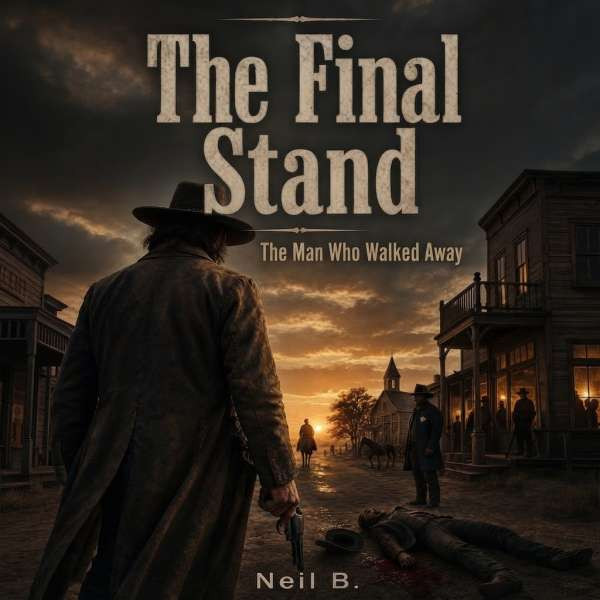



The Last Honest Gun
### The Man Who Walked Away
The desert did not care for names. It did not care for the legends etched into the tavern walls of a dozen frontier towns, nor did it hold reverence for the man who had authored those legends in lead and smoke. To the desert, Jack Mercer was merely a collection of bones and breath, a temporary shadow cast against the relentless, shimmering heat of the basin.
Jack stood at the edge of a dry wash, the air shimmering with a heat that tasted of copper and dust. In his hands, he held the weight of his life. It was a heavy, cold burden, forged in iron and polished by years of desperate necessity. These two revolvers were not merely tools; they were the architects of his identity. Every notch on the grips represented a moment where Jack had chosen death over life, or perhaps more accurately, where he had been forced to facilitate the finality of someone else’s journey.
### The Man Who Walked Away
The desert did not care for names. It did not care for the legends etched into the tavern walls of a dozen frontier towns, nor did it hold reverence for the man who had authored those legends in lead and smoke. To the desert, Jack Mercer was merely a collection of bones and breath, a temporary shadow cast against the relentless, shimmering heat of the basin.
Jack stood at the edge of a dry wash, the air shimmering with a heat that tasted of copper and dust. In his hands, he held the weight of his life. It was a heavy, cold burden, forged in iron and polished by years of desperate necessity. These two revolvers were not merely tools; they were the architects of his identity. Every notch on the grips represented a moment where Jack had chosen death over life, or perhaps more accurately, where he had been forced to facilitate the finality of someone else’s journey.
# The Last Honest Gun
### The Man Who Walked Away
*Copyright © 2026 Neil B.. All rights reserved.*
*Published by Neil Branson.*
---
## Chapter 1: The Weight of Steel
The desert did not care for names. It did not care for the legends etched into the tavern walls of a dozen frontier towns, nor did it hold reverence for the man who had authored those legends in lead and smoke. To the desert, Jack Mercer was merely a collection of bones and breath, a temporary shadow cast against the relentless, shimmering heat of the basin.
Jack stood at the edge of a dry wash, the air shimmering with a heat that tasted of copper and dust. In his hands, he held the weight of his life. It was a heavy, cold burden, forged in iron and polished by years of desperate necessity. These two revolvers were not merely tools; they were the architects of his identity. Every notch on the grips represented a moment where Jack had chosen death over life, or perhaps more accurately, where he had been forced to facilitate the finality of someone else’s journey.
He looked down at the weapons. They were beautiful in their lethal simplicity. The steel caught the harsh midday sun, casting a blinding reflection that danced across the scrub brush. For years, he had been the man who stood between order and chaos, the man who brought peace through the barrel of a gun. But the peace he fostered was always stained with the iron tang of blood. He had grown tired of the stain. He had grown weary of the way the world looked at him, not as a man, but as a weapon to be pointed at problems.
Jack knelt in the sand. The grit pressed into his knees, sharp and unforgiving. He began to dig. He did not use a shovel, for he wanted the earth to claim these items in a way that felt deliberate. He used his bare hands, clawing at the loose, sun-baked soil until he had carved a hollow deep enough to hide his past.
As he worked, his mind drifted to the faces of those who had fallen by his hand. They were not all villains, though the stories told in the saloons often painted them as such. Some were desperate men, some were misguided youths, and some were simply men standing on the wrong side of a line he had been paid to defend. The weight of those faces was heavier than the steel in his hands. It was a weight that pulled at his shoulders, hunching his posture, making him feel older than his thirty-five years.
He placed the revolvers into the earth. They looked small against the vast, indifferent landscape. He felt a sudden, sharp pang of vulnerability, a sensation so foreign to him that it almost made him recoil. Without the steel at his hip, he was just a man. He was susceptible to the elements, to the whims of fate, and to the cruelty of others. Yet, in that vulnerability, he felt the first flicker of something he had not known in a decade. He felt the possibility of silence.
He covered the weapons, patting the sand down until the surface looked as undisturbed as the rest of the basin. He smoothed the ground with his palms, erasing the evidence of his labor. When he stood up, he felt a strange imbalance, a phantom weight still tugging at his right side. He reached down, his fingers brushing the empty leather holster that he had long ago discarded, and let out a long, slow breath that seemed to carry the last of his old life away into the wind.
Jack turned his back on the spot. He began to walk. His destination was Oakhaven, a town he had heard of only in passing, a place described as quiet, unremarkable, and, most importantly, unaware of his reputation. He carried nothing but a bedroll, a canteen, and the clothes on his back. He had no plan other than to exist without a legacy.
As he trekked across the flat expanse, the sun began to dip toward the horizon, painting the sky in violent shades of violet and bruised orange. He thought about the nature of change. People often believed that moving forward required a grand gesture, a loud proclamation of intent, or a sudden shift in circumstance. But as Jack watched the long shadows of the cacti stretch across the sand, he realized that true change was often quiet. It was the decision to lay down a burden, even when the muscles of one’s soul had grown accustomed to the ache.
He knew that the past was not something that could be easily discarded. It was like the desert itself, shifting and moving under the surface, capable of being unearthed by the slightest change in the wind. He could bury the guns, but the habits of the gunslinger were etched into his reflexes. He could walk away from his name, but his eyes would always scan the room for exits. He could trade his notoriety for anonymity, but he would always be a man who understood the language of violence better than the language of peace.
Yet, he felt a spark of inspiration, a quiet, growing resolve. If he could survive the violence of his past, perhaps he could learn to survive the stillness of his future. He wanted to understand what it felt like to plant a seed instead of a bullet. He wanted to know the rhythm of the seasons, the slow, steady progress of a life governed by the sun rather than the trigger.
He reached the crest of a hill and saw the faint lights of Oakhaven flickering in the distance. It looked small and fragile, a cluster of wooden structures clinging to the edge of the wilderness. It was a place that needed protection, perhaps, but it was also a place that needed to be left alone. He hoped he could be the latter.
As he walked toward the town, Jack felt the tension in his jaw begin to loosen. The path ahead was uncertain, and he knew that the shadows of his life would likely follow him until his dying day. But for this night, under the vast, unblinking gaze of the stars, he was simply a traveler. He was a man who had chosen to stop being a ghost, even if he had to become a stranger to do it.
He thought of the phrase he had heard a preacher mutter once in a crowded station, something about how the burden of the past is only as heavy as the hand that refuses to let go. He had let go. His hands were empty, raw from the sand, and trembling slightly with the exertion of his choice. He looked at them and saw, for the first time in years, the potential for creation. He could build, he could mend, and he could nurture.
The wind picked up, cool and smelling of pine from the distant mountains. It was a clean scent, free of the sulfur and burnt powder that had defined his existence for so long. He adjusted his pack, feeling the simple, honest weight of it against his spine. It was a burden he could manage. It was a weight he had chosen.
He stepped onto the dirt road that led into Oakhaven. The crunch of his boots on the gravel sounded like a fresh start. He did not know what tomorrow would bring, or if the town would accept a man with nothing to offer but his labor and his silence. He did not know if the shadows of his past would find him here, or if he would be forced to reclaim the steel he had left in the sand. But as he walked into the outskirts of the town, he felt a strange, profound sense of peace.
The Last Honest Gun was gone, buried beneath the dunes. In his place was a man named Jack, who walked with a measured, careful gait, eyes forward, heart beating with the rhythm of a life yet to be written. He was not looking for a fight. He was not looking for glory. He was looking for the horizon, and for the first time, he felt that he might actually reach it.
The town of Oakhaven lay ahead, peaceful and unsuspecting. It was a place of simple homes, dusty streets, and the promise of a life that did not depend on the speed of a draw. Jack took a deep breath, filling his lungs with the crisp night air, and continued his walk. He was a man who had walked away from everything he knew, and in doing so, he had stepped into the only life that truly mattered: the one he was building for himself, one quiet step at a time.
He passed the first few houses, noticing the dark windows and the stillness of the porches. There was a comfort in the anonymity, a liberation in the fact that no one here knew the history he carried. He was no longer a legend, no longer a nightmare to be whispered about in the dark. He was a neighbor, a worker, a human being.
As he reached the center of town, he paused by a hitching post. He rested his hand on the weathered wood, feeling the grain beneath his fingertips. It was solid, real, and indifferent to his past. He smiled, a small, weary expression that didn't quite reach his eyes, but it was a start.
The journey had been long, and the cost had been high, but as he stood there, watching the moon rise over the rooftops of Oakhaven, he knew that he had made the right choice. He had buried his past, but he had kept his soul. And as long as he had that, he could face whatever the future held. He was the man who walked away, and for the first time in his life, he was walking toward himself.
The night was quiet, save for the distant howl of a coyote and the soft rustle of the wind through the trees. Oakhaven was asleep, wrapped in the protective blanket of its own obscurity. Jack Mercer stood in the shadows of the street, a man without a gun, a man without a past, a man who was finally, truly, free. He took one more breath, steady and deep, and moved forward into the darkness, ready to begin the work of living.
The weight of steel was gone, replaced by the weight of hope, and it was a burden he was more than happy to carry. He walked past the saloon, the livery, and the general store, his footsteps muffled by the dust of the road. He was a ghost no longer, but a man of flesh and blood, seeking nothing more than a place to belong. And in the quiet heart of Oakhaven, he felt that he had finally found his home.
He found a spot near the edge of town, a small, abandoned shed that smelled of dry hay and earth. It was not much, but it was a shelter, a place where he could rest his head and dream of a life that did not involve the barrel of a revolver. He laid out his bedroll, feeling the hardness of the floor beneath him, and closed his eyes.
The desert was far away now, and with it, the weapons that had defined his existence. He had left them there, deep in the sand, a testament to the man he had been and the man he refused to be any longer. He was ready for the morning, for the work, and for the slow, steady process of becoming someone new. He was the man who walked away, and he would never look back.
The silence of the night was his companion, and for the first time, he did not fear it. He embraced it, letting it wrap around him like a cloak, shielding him from the memories of the past and the uncertainty of the future. He was, at long last, at peace.
And as the first light of dawn began to touch the horizon, painting the sky in soft shades of gold and rose, Jack Mercer opened his eyes. He stood up, stretched his limbs, and looked out at the world before him. It was a new day, a new beginning, and he was ready to embrace it with everything he had. He was a man who had walked away, and he was never going to stop.
He walked out into the morning, the air fresh and cool against his face. The town was beginning to stir, the sounds of life echoing through the streets. He felt a sense of anticipation, a hunger for the work that lay ahead. He was no longer a gunslinger; he was a man who worked the land, a man who built, a man who lived.
He walked toward the center of town, his head held high, his heart open to the possibilities of the day. He was a stranger in a new land, a traveler on a new path, and he was ready for whatever the world had to offer. He was the man who walked away, and he was finally, truly, home.
The journey had been difficult, and the road had been long, but he had arrived. He was in Oakhaven, and he was ready to begin his life. He took a deep breath, savored the moment, and moved forward, one step, then another, into the light of the new day. He was a man of his word, and he had promised himself a life of peace. And as he walked into the morning, he knew that he would keep that promise, no matter what it took.
The past was behind him, the future was ahead, and he was right where he belonged. He was a man who walked away, and he was finally free. The weight of steel was gone, and in its place was the weight of a life well-lived, a life of purpose, and a life of peace. He was the last honest gun, and he had finally found the one thing he had been searching for all along: himself.
He walked on, his shadow stretching out before him, a symbol of the man he was and the man he would become. He was a man of the frontier, a man of the desert, and a man of the earth. He was a man who walked away, and he would never be the same again.
The sun climbed higher in the sky, illuminating the town of Oakhaven and the life that Jack was about to lead. He was ready, he was willing, and he was able. He was a man who walked away, and he was finally home.
The story was just beginning, and he was the author of his own fate. He would write it in the sweat of his brow, the strength of his hands, and the kindness of his heart. He was a man who walked away, and he was finally free.
The journey of a thousand miles begins with a single step, and he had taken that step. He was walking away from the life of violence, and toward the life of peace. He was a man who walked away, and he was finally home.
The weight of steel was gone, but the strength of his spirit remained. He was a man who walked away, and he was finally free. The future was bright, and he was ready for it. He was a man who walked away, and he was finally home.
He walked on, the sun warming his back, the wind whispering through the trees. He was a man who walked away, and he was finally free. He was the last honest gun, and he had finally found the peace he had been searching for. He was a man who walked away, and he was finally home.
The story of Jack Mercer was just beginning, and it was a story of hope, of renewal, and of the power of the human spirit to overcome even the darkest of pasts. He was a man who walked away, and he was finally free.
He walked into the heart of Oakhaven, a man of his word, a man of his own making, and a man who was finally, truly, at peace. He was the man who walked away, and he had found the life he had always dreamed of. He was home.
---
## Chapter 2: A Quiet Life in Oakhaven
The sunrise in Oakhaven did not announce itself with the harsh, unforgiving glare of the desert. Here, the light filtered through the thick canopy of oak trees, casting soft, dappled shadows across the valley floor. For Jack Mercer, the morning air felt thin and unfamiliar. It lacked the metallic scent of gunpowder and the dry, stinging grit of the badlands. Instead, it smelled of damp earth, pine needles, and the waking life of a valley that had never known the sound of a six-shooter.
He stood by the edge of the corral, his hands resting on the rough, weathered wood of the fence. His palms were calloused, though they were accustomed to the leather grip of a pistol rather than the rough hemp of a lead rope. Today, his hands were stained with the honest dirt of the ranch, a stark contrast to the blood he had washed from them only weeks ago.
Clara stood on the porch of the main house, watching him. She was a woman of few words, her face etched with the quiet resilience of someone who had buried a husband and kept the land running through sheer force of will. She did not ask questions about where he came from or why a man with such steady, watchful eyes would choose to labor for a meager wage. She simply pointed to the chores, and Jack obeyed.
"The south fence needs mending, Jack," she called out, her voice carrying easily in the stillness. "The cattle have been pushing against the perimeter. If they get into the timber, they will be gone by sundown."
Jack nodded, tipping his hat. "I will have it finished before noon, Clara."
He walked toward the shed to gather his tools. The rhythm of his life had changed entirely. In his old life, the passage of time was measured in heartbeats and the ticking clock of a potential draw. Here, time was measured in the steady pulse of the seasons and the physical demands of the earth. It was a mundane existence, and yet, it was the first time in his life that he felt a semblance of peace.
As he worked on the fence, he found his mind wandering. The muscle memory of his past remained sharp. Every time he hammered a nail, his wrist flicked with the same precision he once used to **** a hammer. Every time a bird took flight from the brush, his hand twitched toward his hip, seeking a weight that was no longer there. He had buried the steel in the sand, but he had not yet buried the man who knew how to use it.
The challenge of this new life was not the labor. He could swing an axe or mend a fence with the best of them. The challenge was the silence. In the quiet moments of the afternoon, the memories returned with a persistent, gnawing hunger. He remembered the faces of men whose lives had ended by his hand. He remembered the cold, hollow stare of the frontier and the way reputations were built upon the ruins of others.
He paused to wipe sweat from his brow, looking out over the verdant hills of Oakhaven. A group of riders passed along the distant ridge, their silhouettes dark against the horizon. For a brief second, his heart hammered against his ribs. He crouched low, his eyes tracking their movement with a predatory instinct he despised. He waited for the flash of a gun, the crack of a rifle, the inevitable confrontation.
But the riders were only neighbors, moving a small herd of calves toward the market. They laughed as they rode, their voices drifting down to him on the breeze. They were not hunters. They were men of the soil, concerned only with the price of beef and the arrival of the rains.
Jack let out a long, shaky breath and forced his shoulders to relax. He was not a target here. He was just a man with a hammer and a stack of cedar posts.
"You are thinking too hard," a voice said.
Jack turned to find Clara walking toward him, carrying a canteen of water. She stood close enough that he could smell the faint scent of lavender soap. She did not look at him with suspicion, but with a guarded curiosity that made him feel both seen and protected.
"I am just doing the work," Jack replied, taking the canteen.
"You do the work as if you are trying to outrun a ghost," she said gently. She gestured to the fence. "You have mended this section three times this morning. It is sturdy enough to hold a bull, let alone a stray calf."
Jack looked at the fence. She was right. He had been so focused on perfection, on ensuring that nothing could break through, that he had become obsessive. He had been trying to build a wall around his life, both physical and metaphorical, to keep the past at bay.
"Old habits," he muttered, looking down at his boots.
"We all have a past, Jack," Clara said, her tone softening. "Some of us come to Oakhaven because we have nowhere else to go. Others come because they are looking for a place where the past does not matter. Whatever you are running from, you have arrived. The land here does not judge a man by what he did yesterday. It only asks that you respect it today."
Her words hit him with the force of a physical blow. She was offering him a grace he did not believe he deserved. In the world he had left behind, there was no redemption. There was only the cycle of violence, where a man was defined by his last kill and his next potential one. But here, in this pocket of green silence, perhaps there was a chance to be something else.
"I want to believe that," Jack said, his voice barely a whisper.
"Then start by putting down the hammer," she suggested with a faint smile. "The work is done for the day. Come inside. I have fresh bread cooling, and the coffee is hot."
He watched her walk back toward the house. She moved with a grace that suggested she, too, had known her share of hardship. She did not demand his history, and she did not mock his silence. She simply invited him to be part of the living world again.
That evening, as the sun dipped below the trees, the town of Oakhaven began to stir. Jack walked into the small village center to pick up supplies. The streets were narrow and lined with modest storefronts. People moved with a leisurely pace, nodding to him as he passed.
"Evening, Jack," the baker said, wiping flour from his apron. "Fine day for the harvest."
"It was a good day," Jack replied.
He felt a strange, jarring sensation as he walked. He was a ghost walking among the living. He knew that if these people saw the man he had been, they would not see the ranch hand who fixed their fences. They would see the legend, the man whose name was whispered in saloons across the territory as a warning. They would see the violence he had tried to bury.
He stopped at the mercantile to buy a bag of flour and a few sundries. The shopkeeper, an elderly man named Elias, peered over his spectacles.
"You are settling in well, I hear," Elias said, counting out the change. "Clara says you are the best hand she has hired in years. Most men find the quiet of Oakhaven too loud after a while."
"The quiet is fine by me," Jack said.
"It is a strange thing," Elias continued, tapping a newspaper on the counter. "People think the frontier is a wild place, but it is the people who make it wild. We have had our share of trouble, even here. But we look out for one another. That is the secret to a quiet life. We don't bring the outside world in with us."
Jack looked at the newspaper. The headline spoke of a land dispute in the next territory over, a violent affair involving hired guns and broken promises. He looked away, focusing on the simple, orderly shelves of the shop.
"I have no interest in the outside world," Jack said.
"That is good to hear," Elias replied. "We like our peace. It is a rare thing, and we guard it fiercely."
As Jack walked back to the ranch under the blanket of a star-filled sky, he felt the weight of his decision. He had traded the roar of gunfire for the song of crickets. He had traded the adrenaline of the duel for the exhaustion of honest labor. He was trying to build a foundation on shifting sand, hoping that if he stood still enough, the past would eventually forget him.
He reached the ranch and sat on the porch, looking out over the dark, rolling hills. The air was cool, and the world felt vast and indifferent to his struggle. He thought of his revolvers buried deep in the desert. He wondered if they were still there, or if the wind and the shifting dunes had uncovered them, exposing the metal to the sun.
He realized then that he could not simply walk away from who he was. The identity he had forged with blood and steel was not something he could leave behind in a hole in the ground. It was part of him, an echo that followed him into every room and every quiet moment. The question was not whether he could escape his past, but whether he could live in spite of it.
He closed his eyes and listened to the sounds of the night. A coyote howled in the distance, a lonely, mournful sound. He did not reach for a weapon. He did not tense his muscles. He simply breathed, letting the rhythm of the valley settle into his bones.
He was Jack Mercer, the man who had walked away. And for tonight, that was enough. He would wake up tomorrow, mend the fences, and continue to build a life that was his own, one day at a time. The past was a shadow, and shadows only existed when there was light. As long as he stayed in the light of Oakhaven, perhaps he could find a way to make the shadow disappear entirely.
But even as he drifted toward sleep, a part of him remained vigilant. He knew that the world had a way of finding those who tried to hide. He knew that peace was not a destination, but a choice that had to be made every single morning. And as he lay there, listening to the wind rustle through the oak trees, he made that choice again. He would be the man who walked away, until the day he could no longer afford to run.
The next morning, the sun rose with the same gentle warmth. Jack stepped out onto the porch, ready for the day. He saw Clara in the garden, her hands deep in the soil, tending to the vegetables. She looked up and smiled, a gesture so simple and so kind that it felt like an anchor.
"Morning, Jack," she said. "The south field needs clearing. There are rocks that have surfaced after the rain."
"I will get to it," he said.
He picked up the tools, feeling the weight of the iron in his hands. It was heavy, but it was a different kind of weight than the one he had carried for so long. It was the weight of creation, not destruction. He walked toward the field, his boots crunching on the gravel path.
He stopped for a moment at the edge of the property, looking out toward the mountains that bordered the valley. They were distant and blue, hiding the vast, lawless territory where he had spent his youth. He took a deep breath of the fresh morning air, letting it fill his lungs.
He was not the man he used to be. He was a man in transition, a man searching for a way to exist in a world that did not require him to be a ghost. He was building a life, one fence post and one rock at a time. And for the first time in his life, he felt that he might actually succeed.
The road ahead was uncertain, and he knew that his history would always be a part of him. But he also knew that he was no longer alone. He had the land, he had the work, and he had the quiet dignity of a life lived for something other than survival.
He began to clear the rocks, his movements steady and purposeful. Each rock he moved was a step away from the past, a piece of his history cast aside to make room for the future. He worked through the morning, his mind focused on the task at hand. He did not look over his shoulder. He did not listen for the sound of approaching horses. He simply lived, in the present moment, in the beautiful, quiet life he had chosen for himself in Oakhaven.
It was a small life, perhaps, but it was his. And in the vast, unforgiving expanse of the frontier, that was a victory worth fighting for. As the sun reached its zenith, he paused to look at the cleared field. It was ready for the planting, a blank canvas upon which he could write a new story. He wiped the dirt from his hands, stood tall, and looked toward the horizon. The past was behind him, and the future was waiting. He was ready to meet it, one honest day at a time.
---
## Chapter 3: The First Echo
The morning air in Oakhaven usually smelled of damp earth and the sweet, resinous scent of pine needles. It was a clean, uncomplicated fragrance that had anchored Jack Mercer to his new life. For three months, he had existed in the rhythm of the rising and setting sun. He had learned the language of the land, the way the soil turned dark when thirsty, and the subtle shift in the wind that signaled a coming storm. His calloused hands, once stained by the metallic tang of gunpowder, were now perpetually dusted with the honest grit of the ranch. He was no longer the man who lived by the speed of his draw. He was simply Jack, the man who mended fences and kept the horses fed.
The transition had not been easy, but it had been rewarding. Every day spent in silence was a victory against the ghosts that had haunted his youth. He found a strange, quiet joy in the mundanity of his labor. The physical exhaustion of a long day’s work provided a sanctuary for his mind, silencing the inner monologue that once whispered of death and retribution. He had traded the weight of steel for the weight of a hammer, and in that trade, he had found a version of himself he could finally respect.
The peace broke on a Tuesday.
It was a day like any other, until the town bell began to toll with a frantic, irregular cadence. Jack was in the barn, smoothing a rough piece of cedar for a new gate, when the sound reached him. He set his chisel down, his instincts sharpening with a sudden, unwanted clarity. The rhythm of the bell was not for a fire; it was the sharp, panicked ringing that signaled a crisis of human making. He wiped his hands on his trousers and walked out into the bright, unforgiving light of the Oakhaven street.
A crowd had gathered near the mercantile store. The atmosphere was thick with a heavy, suffocating dread. As Jack pushed through the periphery of the gathering, he saw Sheriff Miller standing over a figure huddled against the storefront. The merchant, a man named Silas who had sold Jack his first bag of oats upon his arrival, lay on the boardwalk. He was motionless.
Jack moved closer, his heart thumping a slow, steady beat against his ribs. He had seen death before; he had seen it in every conceivable form, from the battlefield to the lonely back alleys of border towns. But there was a quality to this stillness that made his blood run cold. It was the absolute, deliberate precision of the scene.
The Sheriff looked up, his face pale and etched with a weary sort of confusion. "He didn't stand a chance, Jack. Whoever did this, they didn't even give him time to speak."
Jack knelt beside the body, ignoring the sharp intake of breath from the onlookers. He focused on the wounds. There were two, placed with terrifying accuracy. One was centered perfectly in the chest, and the other had found its mark just above the heart. It was a pattern, a signature written in lead.
His stomach dropped. The world seemed to tilt on its axis. He recognized the placement of the wounds with the same familiarity he felt for his own reflection in the mirror. It was his signature. It was the way he had been taught to shoot during the long, brutal years of the frontier, a method designed to guarantee an immediate end to any threat. It was a technique he had not used for years, yet here it was, staring back at him from the lifeless chest of a local merchant.
He looked at the ground, searching for the spent casings. He found them tucked near the edge of the boardwalk, polished and gleaming in the morning sun. He reached out, his fingers trembling slightly, and picked one up. The firing pin mark was deep and distinct. He knew that mark. He had practiced it for hours on end, years ago, until the movement was as natural as breathing.
"Do you recognize the caliber, Jack?" the Sheriff asked, his voice low and suspicious.
Jack stood up slowly, tucking the casing into his pocket. He forced his face into a mask of stoic indifference, though his mind was racing with a thousand terrifying possibilities. "It’s a standard load, Sheriff. Many men carry this weight."
"But few shoot like this," Miller replied, stepping closer. "This isn't the work of a drunkard or a thief. This was a statement."
Jack looked around the circle of faces. He saw fear. He saw the fragile veneer of their quiet, law-abiding existence beginning to crack. For a brief, agonizing moment, he considered telling them the truth. He could confess who he was, explain the burden he carried, and perhaps warn them that he was the reason this shadow had fallen over their homes. But he saw the way they looked at him, not as a savior, but as a man who belonged to the same world as the murderer. If he spoke, he would lose the only home he had ever truly known.
"I’m just a ranch hand, Sheriff," Jack said, his voice steady despite the turmoil inside. "I wouldn't know anything about the habits of killers."
He turned away, walking back toward the outskirts of town. He needed space to think. He needed to reconcile the fact that his past had not stayed buried in the sand. It had crawled out, draped in the clothes of a killer, and it had followed him to the one place he had hoped to find sanctuary.
As he walked, he reflected on the nature of his own legacy. He had spent years trying to wash the blood from his hands, believing that if he walked away from the violence, the violence would eventually forget him. He had been naive. He realized now that he had been living in a dream, a temporary reprieve from the reality of his own actions. Every choice he had made, every life he had taken, had left a ripple in the fabric of the frontier. Now, those ripples were converging into a tidal wave, and they were threatening to drown the very people he had grown to care for.
He reached the edge of the ranch, the sight of the rolling hills offering no comfort today. The landscape looked different, stripped of its peaceful veneer. The wind, which had once felt like a gentle companion, now sounded like a warning. He sat on the porch of the small cabin he called his own, watching the sun begin its descent toward the horizon.
He thought of the young men who had once looked up to him, the ones who had seen his reputation as something to be coveted rather than feared. He had always tried to warn them that the path of the gun led only to an early grave or a hollow life. They never listened. They saw the glory of the quick draw, the fame of the name, but they never saw the nights spent staring at the ceiling, wondering if the next knock on the door would be the last.
Someone was trying to frame him. Or perhaps, someone was trying to become him.
The thought sent a shiver down his spine. If the killer was using his signature, they weren't just committing a crime; they were engaged in a ritual of mimicry. They were attempting to inhabit his skin, to claim the power that came with his name. It was an insult to the life he had tried to build, and a direct threat to his identity.
He stood up and paced the length of the porch. He could leave. He could pack his few belongings, saddle his horse, and ride away before the sun rose the next morning. He could be a ghost again, a man without a name, drifting through the shadows of the frontier. But the image of Silas on the boardwalk kept playing over in his mind. The merchant had been a kind man, a man who had shared his stories of the town’s history with a stranger who had no right to be there. Silas had died because someone wanted to get Jack’s attention.
If he left, would they follow? Or would they simply find another target, another innocent victim to bait the hook?
He looked toward the barn where his tools were kept. The hammer and the chisel were there, symbols of his attempt at honest work. He walked into the barn, the darkness swallowing him whole. He moved to the back corner, where he had buried his life beneath a pile of old, rotted hay. He didn't need to dig them up yet, but he needed to know they were there. He reached down, his fingers brushing against the cold, familiar iron of the holsters he had hidden months ago.
The metal felt like ice against his skin. It was a heavy, cold weight, a reminder of the man he had been. He hadn't touched them since he arrived, and he had hoped he never would again. But as he sat in the dark, he realized that he could not simply walk away from this. The violence was no longer a ghost of the past; it was a living, breathing reality that had arrived on his doorstep.
He had to protect this town. Not because he was a hero, or because he wanted to reclaim his status, but because he owed it to the people who had allowed him to exist in peace for a few short months. He owed it to himself to prove that he was more than a weapon.
The evening turned to night, and the stars began to pin themselves to the velvet sky. Jack sat in the barn, the cold iron of his past resting beside him. He realized that the first echo had arrived, a harbinger of the storm to come. The silence of Oakhaven had been shattered, and there was no turning back.
He began to formulate a plan. He wouldn't fight as the man they expected. He wouldn't be the legend they were trying to frame. He would use his knowledge of the past to outthink the present. He would become the shadow that stalked the hunter.
He stood up, his resolve hardening like cooling steel. He had spent his life being defined by the expectations of others, by the myths they built around his name. Now, he would define the outcome. He would walk the line between the pacifist he had become and the gunslinger he had been, and he would find a way to end the cycle before it destroyed everything he had worked so hard to build.
He stepped out of the barn and looked toward the town. The lights of the saloon were dim, and the streets were empty. The silence was back, but it was a fragile, brittle thing, ready to snap at the slightest touch. He knew that somewhere out there, the person who had killed Silas was watching, waiting for a reaction. They wanted him to emerge, to show himself, to play the role they had scripted.
Jack smiled, a grim, humorless expression. He would play the role, but not in the way they expected. He would be the ghost they were looking for, but he would be a ghost that carried a purpose. He would protect the innocent, even if it meant returning to the fire he had tried so hard to escape.
As he walked back to his cabin, he felt the weight of his decision settle upon his shoulders. It was a heavy burden, but it was his to carry. He had walked away from his past, but he had finally realized that one cannot simply walk away from their own soul. He was Jack Mercer, and he was the last honest gun in a world that had forgotten the meaning of the word.
He lay down on his cot, listening to the crickets chirping in the tall grass. The night was peaceful, but he knew it was a temporary reprieve. Tomorrow would bring new challenges, new questions, and new shadows. But for tonight, he would rest. He would gather his strength, center his thoughts, and prepare for the conflict that was inevitably coming.
He had spent his life fighting for survival, but this was different. This was a fight for his identity, for the integrity of the life he had chosen to lead. And for the first time in his life, he wasn't fighting for a reputation or a paycheck. He was fighting for the right to be a man of peace, even if he had to use violence to secure it.
The irony was not lost on him. To preserve the life of a man who had buried his guns, he might have to dig them up again. It was a paradox that threatened to consume him, but he accepted it. He would do what was necessary, and he would do it with the precision that had made him a legend. But this time, the echo of his actions would be his own.
He closed his eyes, the image of the mercantile store fading into the darkness. He felt the cold iron of the holsters in his mind, a constant, grounding presence. He was ready. Whatever the next few days brought, he would face them with the clarity of a man who had nothing left to lose and everything to protect.
The first echo had sounded, and the world had changed. Oakhaven was no longer the sanctuary he had found; it was the battlefield he had tried to leave behind. But he would not run. He would stand, he would watch, and he would act when the time was right. The man who walked away had returned, but he was not the same man who had left. He was stronger, wiser, and more dangerous than he had ever been. And he was ready.
As the moon climbed higher, casting long, skeletal shadows across the landscape, Jack drifted into a shallow, restless sleep. He dreamed of sand and steel, of faces he had forgotten and voices he had silenced. But through it all, there was a sense of purpose. He was the protector of this town, the silent guardian of their peace. And he would see this through to the end, no matter what it cost him.
The morning would bring the light, and with it, the truth. He would be ready for it. He would be waiting in the shadows, a ghost in the machine, a man who understood the language of violence better than anyone else. And when the killer made their next move, Jack would be there to ensure it was their last. The cycle would end with him, and the legacy of the gun would finally, truly, be laid to rest.
---
## Chapter 4: Shadows in the Saloon
The air inside the Dusty Spur Saloon was thick with the scent of stale tobacco, cheap whiskey, and the metallic tang of fear. Jack Mercer pushed through the swinging doors, his hat pulled low to shield his eyes from the flickering oil lamps. He did not look for trouble; he looked for the truth. The silence that greeted him was not the peaceful quiet of a library, but the heavy, expectant hush that descends upon a room when a stranger brings a cold draft in from the night.
Jack moved toward the far end of the bar. He kept his shoulders slumped, mimicking the posture of a man worn down by hard labor and little sleep. He ordered a glass of whiskey, feeling the familiar burn as it slid down his throat. It was a drink he had grown accustomed to in his past life, yet here, in the dim light of Oakhaven, it tasted like ashes.
He leaned against the scarred wood of the counter, his ears tuned to the low murmurs drifting from the tables scattered across the room. The murder of the local merchant had changed the texture of the town. People were no longer just talking about the weather or the price of cattle. They were speaking in hushed, jagged tones about the return of a ghost.
"They say it was a professional," a man whispered at the table nearest to Jack. He was a middle-aged rancher with calloused hands and a nervous twitch in his left eye. "Two shots, center mass, exactly four inches apart. Who does that? That is not a robbery gone wrong. That is an execution."
His companion, a gaunt man with a thick beard, leaned in closer. "I heard tell of a man who used to ride these territories years back. They called him the Silver Ghost. They say he could put a bullet through a coin tossed in the air from fifty paces. They say he never missed, and he never left a witness behind."
Jack tightened his grip on his glass. The name felt like a physical weight pressing against his chest. He had spent months burying that identity beneath the soil of the desert and the simple rhythm of ranch work. He had walked away from the steel and the smoke, convinced that a man could rewrite his own story if he only had the courage to put down the gun. Now, the shadows of his past were reaching out to claim him.
"You think he is back?" the rancher asked, his voice trembling.
"I think the devil has a way of returning to the scene of his sins," the bearded man replied. "If he is back, then Oakhaven is no longer a home. It is a graveyard in the making."
Jack turned his head slightly, his gaze fixed on the reflection in the mirror behind the bar. He saw his own face, weathered by the sun and etched with the lines of hard decisions. He did not look like the monster they described, yet he knew the truth of his own hands. He knew the weight of the hammer and the finality of the trigger.
He realized then that the danger was not just the physical threat of a killer, but the psychological unraveling of the town. Fear was a contagion. It turned neighbors into suspects and transformed a quiet sanctuary into a place of suspicion. If the people believed the legend of the gunslinger had returned, they would soon begin to see him in every shadow and every stranger.
Jack finished his drink and stepped away from the bar. He needed to move, to keep his mind sharp, but his legs felt heavy. He walked toward the exit, his boots clicking softly on the floorboards. As he passed a group of card players, he overheard a younger man speaking with a tone of strange, misplaced admiration.
"If he is back, he is not the enemy," the young man said, shuffling a deck of cards with practiced ease. "He is the ultimate authority. Think of the power, being able to walk into any room and command absolute silence just by showing your face. That is not a curse. That is a legacy."
Jack paused, his hand hovering over the doorframe. He felt a sudden, sharp pang of pity for the boy. The youth saw only the glamour of the gun, the hollow prestige of the reputation, and none of the blood that stained the path. He did not see the nights spent shivering in the cold, the faces of those who had fallen, or the agonizing loneliness of a man who can never truly belong anywhere.
He pushed the door open and stepped out into the cool night air. The moon hung low over the horizon, casting long, distorted shadows across the dirt street. Oakhaven looked peaceful, but Jack knew better. The peace was fragile, a thin veneer stretched over a foundation of anxiety.
He walked toward the stables where he had been sleeping, his mind churning with the implications of what he had heard. Someone was using his methods. Someone was walking in his footprints. By mimicking his style, this person was not just committing crimes; they were actively trying to resurrect a legend that Jack had spent his life trying to kill.
He stopped in the middle of the street, looking up at the vast expanse of the night sky. He thought about the buried revolvers, the iron-willed resolution he had formed to leave the violence behind. He had believed that his past was his own to abandon. He had been wrong. The past is never truly dead. It stays with us, a silent companion that waits for the moment of our greatest weakness to remind us of who we were.
But as he stood there, a strange sense of clarity began to wash over him. He had come to Oakhaven to find peace, but peace was not something to be found in the absence of conflict. It was something to be forged in the presence of it. If he wanted to protect this town, if he wanted to ensure that the innocent did not fall victim to the shadow of his own reputation, he would have to confront the truth head-on.
He could not remain a ghost. He could not hide in the corners of saloons and listen to whispers of his own demise. If he was to save Oakhaven, he would have to become more than the man they feared. He would have to become the man they needed.
He looked toward the horizon, his jaw set in a line of quiet determination. The path ahead was dark, and the choices he would soon have to make would likely cost him everything he had built. He knew that the cycle of violence was a trap, designed to lure men back into the fray until nothing remained of their humanity. Yet, he also knew that he could not stand by while the legacy he had discarded was used as a weapon against the innocent.
He turned back toward the edge of town, his stride steady and purposeful. The shadows in the saloon were only the beginning. The real battle would not be fought with bullets alone, but with the strength of his own character. He had walked away from his past, but now he realized that he had to own it, to reconcile the man he was with the man he had become, if he was ever to find true redemption.
The wind picked up, swirling the dust around his feet. Jack Mercer looked once more at the quiet houses of Oakhaven, feeling a profound sense of responsibility for the people who slept within them. He was not a savior, and he was certainly no hero. He was a man with a heavy past, a man who had made mistakes, but he was also a man who refused to let his history define the future of others.
He reached the barn and stepped inside, the familiar smell of hay and old wood grounding him. He stood in the darkness for a long moment, listening to the rhythmic breathing of the horses. He was tired, more tired than he had ever been in his life, but the exhaustion was no longer a burden. It was a catalyst.
He knew now that he could not run from the ghost of the gunslinger. He had to meet it. He had to show the world, and perhaps show himself, that the identity he had forged in Oakhaven was stronger than the reputation he had left in the desert.
The night was quiet, but it was a quiet that held the promise of an approaching storm. Jack sat down on a stack of hay, closing his eyes. He did not know how the coming days would unfold, or if he would survive the confrontation that was clearly barreling toward him. But for the first time since arriving in Oakhaven, he felt a sense of purpose. He was no longer running away. He was waiting.
He realized that the most powerful thing a man can do is to choose his own path, even when the road is paved with the consequences of his own history. He had traded his guns for a life of anonymity, but he had found something far more valuable in the process. He had found his conscience. And as long as he held onto that, he could never be the monster the shadows wanted him to be.
He drifted into a light, uneasy sleep, his dreams filled with the echo of gunshots and the image of a young man with a cold, desperate look in his eyes. He knew the imposter was out there, watching, waiting, and learning. The game had begun, and the stakes were higher than any prize of gold or land. The prize was the soul of the man who had once been the last honest gun, and the future of a town that deserved better than the ghosts of the past.
When he woke, the first light of dawn was beginning to bleed into the sky, painting the clouds in shades of bruised purple and gold. Jack stood up, stretched his stiff muscles, and stepped out into the morning. The town was beginning to stir. Somewhere, a dog barked. A door creaked open. The cycle of the day was beginning anew, but for Jack, nothing would ever be the same.
He walked toward the ranch house, his mind clear. He had work to do. He had a life to protect. And he had a legacy to confront, one final time. He understood now that his past was not a weight to be buried, but a lesson to be learned. And he was finally ready to teach it.
---
## Chapter 5: The Sheriff’s Suspicion
The morning air in Oakhaven held a crisp, biting quality that usually promised a productive day of labor. For Jack Mercer, however, the sunrise brought only a tightening in his chest. He stood near the edge of Clara’s barn, the rough wood grain pressing against his calloused palms as he watched the dust kick up from the main road. The town was waking up, but the usual rhythm of commerce and gossip felt strained. The recent murder of the merchant had cast a pall over the streets, a shadow that seemed to stretch longer with every passing hour.
Jack kept his head down, his hat pulled low to shield his eyes from the rising sun. He had spent the last few weeks trying to disappear into the scenery, to become nothing more than a man who moved bales of hay and mended fences. He wanted to be a man without a story, a person whose past was as silent as the desert night. Yet, he could feel eyes on him. It was a ****le at the back of his neck, a sensation he had learned to trust back when his life depended on reading the intentions of strangers.
He turned toward the sound of approaching hoofbeats. Sheriff Miller was riding toward the ranch, his posture stiff and his gaze fixed directly on Jack. The lawman was a man of few words, known for his relentless pursuit of order in a land that often seemed determined to embrace chaos. As Miller pulled his horse to a halt, the animal snorted and shifted, sensing the tension radiating from its rider.
Miller dismounted with a slow, deliberate grace. He walked toward Jack, his boots clicking rhythmically against the hard-packed earth. He did not offer a greeting, nor did he look toward the house to acknowledge Clara. His attention was reserved entirely for the man standing before him.
Jack wiped his hands on his trousers and waited. He knew the look of a man who was hunting for the truth, even if he did not yet know what that truth looked like.
You are a hard man to pin down, Mercer, Miller said, his voice low and gravelly. He stopped a few feet away, his hand resting casually, perhaps by accident, near the butt of his sidearm. You arrived here with nothing but a pair of sturdy boots and a habit of staying out of the way. Most men in this territory have a history that precedes them. They have neighbors who can vouch for their kin, or at least a story about where they spent the last decade. You have provided neither.
Jack kept his expression neutral, his posture relaxed but ready. I prefer to let my work speak for itself, Sheriff. I came here to find a quiet life, not to recount my life story to every man who happens to pass by.
Miller chuckled, though there was no warmth in the sound. Quiet is a commodity that is becoming increasingly rare in Oakhaven. We have a dead man in the street, a killer who possesses a level of skill that does not belong in a town this size, and a stranger who arrived just in time to see the peace unravel. You will forgive me if my curiosity is piqued.
The Sheriff stepped closer, his eyes scanning Jack’s face with clinical precision. He was looking for a flicker of recognition or a sign of guilt. Jack met his gaze, allowing himself to project only the weariness of a man who had seen too much of the world.
I am a ranch hand, Sheriff, Jack said, his voice steady. I know nothing of your dead merchant or the nature of his demise. If you are looking for a suspect, I suggest you look for someone who has a reason to be involved in the affairs of this town. I am merely a man who wants to be left alone.
Miller shook his head, his eyes narrowing. You have a way of carrying yourself that belies your humble occupation. You hold your shoulders like a man who has spent a lifetime behind a rifle, not a plow. You watch the perimeter of this property every time a rider approaches. It is not the behavior of a man who is simply looking for a quiet life. It is the behavior of a man who is waiting for a fight.
The accusation hung in the air, heavy and undeniable. Jack felt the weight of his own history pressing down on him. He had tried to shed his identity, to bury it in the desert sand alongside his revolvers, but he was learning that a man’s past is not a coat he can simply take off at the door. It was woven into his character, into the way he stood, the way he breathed, and the way he perceived the world.
Sheriff, I have lived a life that taught me the value of being prepared, Jack said, choosing his words with care. That does not make me a killer. It makes me a man who understands that safety is an illusion. If you want to keep this town safe, I suggest you look for the person who is actually committing these crimes, rather than harassing a man who has done nothing but work to support himself.
Miller studied him for a long moment. The silence between them was thick, filled with the unspoken questions of a lawman who sensed a ghost in his presence. You are hiding something, Mercer. I can see it in the way you avoid talking about your origins. I do not know if you are a villain or a victim, but I do know that you are not what you claim to be. If this town suffers another tragedy, I will not be satisfied with your silence. I will pull the truth out of you, one way or another.
The Sheriff turned back to his horse and mounted with a fluid, practiced motion. He looked down at Jack one last time, his face etched with a mix of suspicion and grim determination. Keep your head down, Mercer. If you are truly here for peace, you will find no trouble from me. But if you are the reason the shadow has fallen over Oakhaven, I will ensure that you do not leave this valley alive.
Jack watched as Miller rode away, his silhouette growing smaller against the backdrop of the rolling hills. The threat was clear, and it was entirely justified. Miller was a good man, a man who cared for his town, and he was doing exactly what he had sworn to do. He was protecting his people from an unknown threat.
Jack felt a surge of frustration, not at the Sheriff, but at his own predicament. He had come here to find peace, yet he had only brought the potential for more violence. He had sought to escape the consequences of his past, but the past had a way of finding him, echoing through the empty streets and the eyes of those who sensed the steel in his soul.
He walked toward the barn, his thoughts racing. He had to be more careful. He had to find a way to navigate this situation without drawing more attention to himself, yet he knew the killer was still out there, using his own methods, his own signature, to stain his reputation even further. The imposter was not just killing; he was creating a narrative, a story that pointed directly at Jack Mercer.
As he reached the barn door, Clara stepped out, her expression concerned. She had been watching the exchange from the shadows of the porch.
What did he want, Jack? she asked, her voice soft but filled with apprehension.
He is just doing his job, Clara, Jack replied, trying to keep his voice light. He is worried about the town, and he thinks I am a stranger who does not belong.
Clara walked toward him, her gaze searching his face. You do not belong to the violence that has come to Oakhaven, she said firmly. I have watched you work. I have seen how you treat the animals and how you respect the land. You are a good man, Jack. Do not let the Sheriff’s suspicion make you doubt that.
Her words were a balm to his weary spirit. It was rare for someone to see past the armor he wore, to recognize the man beneath the legend. He looked at her, and for a moment, he allowed himself to believe that redemption was possible. Perhaps he could still save this town. Perhaps he could stop the killer and finally put his past to rest, not by running from it, but by standing against the darkness it had birthed.
I am not the man I was, Clara, Jack said, his voice barely a whisper. But I am the man who is here now. And I will not let anything happen to this place.
He turned back to his chores, his movements deliberate and focused. The work was simple, the labor honest, and for the first time in a long time, he felt a sense of purpose that did not involve blood. He would deal with the Sheriff’s suspicion, and he would deal with the imposter who was trying to steal his legacy. He would face whatever came his way, because for the first time, he was not just fighting for his own survival. He was fighting for the only thing that had ever mattered: the chance to be something other than a weapon.
The afternoon sun climbed higher, casting long, stark shadows across the ranch. Jack worked through the heat, his mind turning over the pieces of the puzzle. He thought about the execution-style murder, the precision of the shot, and the way the killer had left no trail. It was a professional job, a cold-blooded act that required a steady hand and a calm heart. It was a reflection of the man he used to be, a mirror held up to his own history.
He realized then that the imposter was not just a fan of his reputation; he was a student of his life. The killer knew how he thought, how he moved, and how he struck. This was not a random act of violence. It was a calculated attempt to drag him back into the light, to force him to acknowledge the man he had tried to leave behind.
Jack stopped his work for a moment and leaned against a post, looking out toward the distant horizon. The desert was vast, indifferent to the struggles of the men who lived upon it. It had been his home, his sanctuary, and his prison. He had walked away from it once, and he would walk away again, but first, he had to finish what had begun in the streets of Oakhaven.
He would not be a ghost in this town. He would be a shield. He would earn the trust of the people, even the Sheriff, by proving that the man they feared was the only one capable of saving them. It was a dangerous path, one that would likely lead to more blood, but it was the only path that offered a sliver of hope.
As the sun began to dip toward the western hills, painting the sky in shades of gold and violet, Jack felt a strange sense of clarity. The fear that had gripped him since the first murder began to recede, replaced by a cold, hard resolve. He was no longer running. He was standing his ground, waiting for the moment when the truth would finally be revealed.
He looked toward the Sheriff’s office in the distance, a small, unassuming structure that represented the order he had once fought against. He would talk to Miller again. He would find a way to earn his trust without revealing the full extent of his past, a compromise that would be difficult but necessary. He would be the honest gun, the man who used his skills for the right reasons, even if those reasons were born from a history he could never truly escape.
The evening breeze picked up, rustling the dry grass and carrying the scent of sagebrush and woodsmoke. It was a peaceful sound, a reminder of the life he was fighting to preserve. Jack took a deep breath, letting the cool air fill his lungs. He was ready. Whatever the imposter had planned, whatever the future held, he would face it with the steady hand and the quiet heart of a man who had finally found something worth protecting.
He walked back into the barn, the dim light casting long shadows across the floor. He felt the weight of his own existence, not as a burden, but as a foundation. He was Jack Mercer, the man who had walked away, and he was the only one who could stop the ghost that had come to haunt his new home. He would not fail, not this time. He would ensure that the last honest gun would be used to bring peace, and then, he would finally find the quiet life he had sought for so long.
The night deepened, the stars emerging in the vast, velvet sky. Oakhaven was quiet, but it was a silence that felt different now. It was the silence of a town holding its breath, waiting for the next move in a game that was far larger than any of them could have imagined. Jack sat in the doorway of the barn, watching the stars and waiting for the dawn. He knew that the struggle had only just begun, but for the first time, he felt he was no longer alone in the dark. He had a purpose, he had a home, and he had the strength to stand against the past. And that, he realized, was enough.
The Sheriff’s suspicion had been a catalyst, a spark that had set his resolve aflame. He would no longer be the man who hid in the shadows. He would be the man who stepped into the light, who confronted the darkness, and who stood as a beacon for those who sought safety. He would be the last honest gun, the man who walked away, but who was always ready to return when the innocent needed him most. And as he watched the stars, he knew that the journey ahead would be difficult, but he was prepared to walk it, one step at a time, until the truth was laid bare and the peace of Oakhaven was restored.
The night air grew colder, but Jack did not retreat. He stayed in the doorway, a sentinel in the dark, watching over the town that had become his sanctuary. He thought about the life he had lived, the choices he had made, and the man he was becoming. He was not the legend the world thought he was, and he was not the villain his imposter wanted him to be. He was simply Jack, a man who had walked away, and who was now ready to face whatever the future held with courage and grace.
The wind sighed through the trees, a gentle, mournful sound that seemed to carry the secrets of the frontier. Jack closed his eyes, listening to the rhythm of the night. He was at peace, not because the danger had passed, but because he finally understood his place in the world. He was a man of the frontier, a man of the land, and a man

لم يتم العثور على تعليقات
المزيد من المسارات