
- 0
- 0
- 0
- 0
- 0


The story of Abraham Lincoln begins not in the marble halls of Washington, but in the damp, unforgiving shadows of the Kentucky woods. On February 12, 1809, in a one-room log cabin on Sinking Spring Farm near Hodgenville, Lincoln was born into a life of profound obscurity. His father, Thomas, was a man of the frontier—a carpenter and farmer who navigated life with the restless, wandering spirit of a pioneer. His mother, Nancy Hanks, provided a quiet, stoic grace to their existence, a contrast to the rugged, often volatile environment of the early American backcountry.
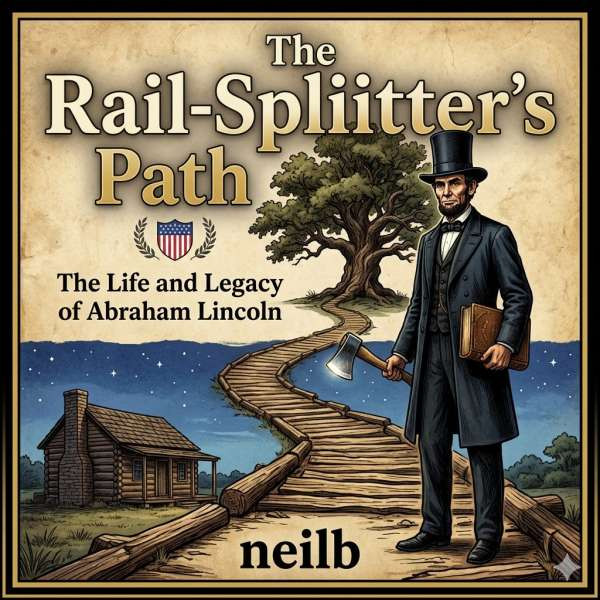
The Life and Legacy of Abraham Lincoln
Chapter 1: The Kentucky Frontier
The story of Abraham Lincoln begins not in the marble halls of Washington, but in the damp, unforgiving shadows of the Kentucky woods. On February 12, 1809, in a one-room log cabin on Sinking Spring Farm near Hodgenville, Lincoln was born into a life of profound obscurity. His father, Thomas, was a man of the frontier—a carpenter and farmer who navigated life with the restless, wandering spirit of a pioneer. His mother, Nancy Hanks, provided a quiet, stoic grace to their existence, a contrast to the rugged, often volatile environment of the early American backcountry.
This environment was more than a backdrop; it was a character in his development. Sinking Spring Farm was defined by rocky soil and the persistent, biting threat of the elements. Young Lincoln grew up in a world where survival was the only currency. He learned the rhythm of the seasons, the harshness of winter, and the absolute necessity of self-reliance. This was an America of superstition, where tales of ghosts and forest spirits were as common as the morning dew. These early years forged in him a bedrock of empathy for the "common man." He was born of that soil, he bled that blood, and he understood the silent, heavy labor that defined the life of the early American settler. He was a child of the wilderness, and the wilderness, in turn, imprinted its vastness upon his soul.
Chapter 2: The Indiana Wilderness
In 1816, when Abraham was seven, the family trekked north into the Indiana wilderness, settling on a claim at Little Pigeon Creek. This was the "back-country" in every sense—an untamed, heavily forested land where the trees had to be cleared by hand before a single crop could be sown. It was here, in the autumn of 1818, that the young boy faced his first great crucible: the "milk sickness," a mysterious and terrifying ailment that claimed his mother, Nancy.
The death of his mother left a void in the cabin that was both physical and spiritual. Thomas Lincoln’s eventual remarriage to Sarah Bush Johnston brought a new, nurturing influence into Abraham’s life; she was a woman who recognized the boy's towering intellect and encouraged the very thing that Thomas viewed with suspicion: reading. In the dim, flickering light of the cabin, with a copy of Aesop’s Fables or a borrowed Bible, Abraham began to drift away from the axe and toward the word. It was in these Indiana years that the "rail-splitter" identity was born—a man who could swing an axe with the best of them, but who, when the work was done, would retreat into the depths of a book, forever seeking a wider horizon than the trees allowed.
Chapter 3: New Salem Beginnings
By the time Lincoln reached New Salem, Illinois, in 1831, he had shed the skin of the Indiana boy and began to search for his place in the burgeoning state of Illinois. New Salem was a village of dreams and mud—a place where ambitious men gathered to discuss politics, theology, and the future of the West. Lincoln arrived as a flatboat man, having navigated the Mississippi to New Orleans, a trip that exposed him for the first time to the grotesque, haunting reality of the slave markets.
In New Salem, he reinvented himself a dozen times over: store clerk, soldier in the Black Hawk War, postmaster, and surveyor. It was a social laboratory. He learned the art of the stump speech, not by reciting academic treatises, but by telling stories that made his neighbors laugh, think, and eventually, trust him. He became the village arbiter, a man whose honesty was so pronounced it earned him the moniker "Honest Abe." He was not yet a statesman; he was a representative of the people—a man who stood in the village square and translated the complexities of law and politics into the plain, accessible language of his peers.
Chapter 4: The Law and the Legislature
Lincoln’s transition from the local politician of New Salem to the sophisticated attorney of Springfield marked his true intellectual maturation. Law was his gateway to the wider world. He did not attend a university; he devoured Blackstone’s Commentaries and taught himself the rigorous, logical structures of the courtroom. As a circuit-riding attorney on the Eighth Judicial Circuit, he spent months away from home, traveling from county seat to county seat, often sleeping on floors in crowded inns.
This was the era that defined the "Prairie Lawyer." He defended the railroad companies, the poor farmer whose horse had been stolen, and everyone in between. He developed a style that was deceptively simple—he would often concede the trivial points of an argument to his opponent, only to pivot with devastating, razor-sharp logic to the central, unassailable truth of the case. During these years, his political life in the Illinois General Assembly deepened, as he began to grapple with the Whig ideology and the growing, cancerous issue of slavery that threatened to tear the republic into fragments. He was learning how to lead.
Chapter 5: Courtship and Marriage
Springfield introduced Lincoln to the social and political elite, most notably Mary Todd, a woman of high education and sharp, piercing political instincts. Their courtship was, in the words of historians, a "tumultuous dance." It was filled with broken engagements, social anxiety, and deep bouts of the "melancholy" that seemed to cling to Lincoln like a shroud.
Their marriage in 1842 was a union of opposites—the refined daughter of a Kentucky slave-owning family and the rough-hewn, self-taught politician from the frontier. Yet, it was in this domestic arena that Lincoln found his most steadfast, if complicated, ally. Mary was his primary political strategist; she believed in his destiny long before he did. Through the birth of their sons, the joys of fatherhood, and the later, devastating tragedies that would test their sanity, Mary remained the anchor of his private life, even as the national storm clouds began to gather, signaling that his life of local law and domesticity was rapidly coming to an end.
The Rail-Splitter’s Path: The Life and Legacy of Abraham Lincoln (Part 2)
Chapter 6: The Congressman from Illinois
In 1847, Lincoln arrived in Washington D.C. as a freshman Congressman. The capital was a city of immense political theatre and deep-seated regional animosity. Lincoln’s tenure here was marked by his fierce, albeit unpopular, opposition to the Mexican-American War. He believed the conflict was an exercise in imperial land-grabbing, and he famously challenged President James K. Polk with his "Spot Resolutions," demanding to know the exact spot where American blood had been shed on American soil.
While his stance earned him little favor at home, it showcased a man who refused to abandon his moral compass for political convenience. During this time, he also witnessed the dehumanizing spectacle of the slave pens in the shadows of the Capitol. This experience seared itself into his consciousness. He saw how the legal system—the very profession he revered—was being contorted to justify the ownership of human beings. His single term taught him that the national legislature was not yet ready to face the truth, and he returned to Springfield with a deepened resolve, believing that a national reckoning was not just possible, but inevitable.
Chapter 7: The Sleeping Giant Awakes
For a few years, Lincoln returned to the law, seemingly content in the quietude of the Illinois courts. But the passage of the Kansas-Nebraska Act in 1854 shattered that tranquility. By repealing the Missouri Compromise and allowing the question of slavery in the territories to be decided by "popular sovereignty," the act reopened a wound that the nation had been desperately trying to patch over.
Lincoln, the moderate, was suddenly radicalized. He emerged from his political hibernation, not with fire, but with cold, hard logic. He recognized that if slavery were allowed to expand, it would eventually engulf the entire nation. His speeches during this time, most notably at Peoria, displayed a new, matured oratorical power. He stripped away the flowery rhetoric of his contemporaries and spoke in the plain, ringing tones of liberty. He was no longer just a local lawyer; he was the voice of a growing movement that feared the death of the American dream. The sleeping giant of the American conscience was awake, and Lincoln was its most articulate champion.
Chapter 8: The Birth of the Republican Party
The mid-1850s were a time of political wreckage. The once-mighty Whig Party had crumbled, and the Democratic Party was fracturing along sectional lines. From the ashes of these old alignments rose the Republican Party, a fragile, untested coalition bonded by a single, urgent purpose: the prevention of the expansion of slavery. Lincoln was a key architect of this new organization in Illinois.
He had to bridge the gap between radical abolitionists, who wanted slavery destroyed everywhere, and conservative Republicans, who simply wanted it contained in the South. This required a delicate, masterful touch. At the 1856 Bloomington Convention, Lincoln delivered a speech so powerful that reporters were said to have forgotten to take notes, simply sitting in thrall to his words. It was the "Lost Speech," and it cemented his position as the leader of the Illinois Republicans. He had proven that he could hold a coalition together through the sheer force of his integrity and his ability to define the moral stakes of the debate.
Chapter 9: The Lincoln-Douglas Debates
The 1858 Senate race against the "Little Giant," Stephen A. Douglas, stands as the most intellectually significant campaign in American history. Douglas was the incumbent, a master of populist rhetoric and a national celebrity. Lincoln was an underdog. Through seven legendary debates across Illinois, they transformed a local election into a national referendum on the future of humanity.
Lincoln insisted on a formal structure, moving beyond the casual stump speech to a rigorous back-and-forth that forced Douglas into a corner. Douglas argued for popular sovereignty—the right of territories to choose for themselves—while Lincoln exposed the flaw in that argument: it ignored the fundamental, universal right of every human being to be free. The crowds numbered in the thousands, standing in rain and mud, listening to hours of complex legal and moral argument. Although Lincoln ultimately lost the Senate seat, he won the war of ideas. He had presented the case for human equality in a way that resonated far beyond the borders of Illinois, positioning himself as the only man capable of taking on the Democrats in 1860.
Chapter 10: The House Divided
In June 1858, accepting the Republican nomination for the Senate, Lincoln delivered a speech that would define his historical legacy. "A house divided against itself cannot stand," he declared, pulling from the Gospels to illustrate the precarious state of the Union. He argued that the American experiment could not endure permanently half-slave and half-free.
This was a daring, almost reckless declaration. Many of his advisors warned him that it was too inflammatory, that it would alienate moderate voters. Lincoln ignored them. He understood that the time for equivocation had passed. He was not calling for an immediate, violent revolution, but he was setting the stage for an inevitable choice. His words transformed the political landscape, shifting the focus from the technicalities of law to the moral necessity of justice. He was no longer just a politician; he was a prophet of the American future, articulating the fundamental truth that the nation would eventually become all one thing, or all the other.
Chapter 11: The Election of 1860
The 1860 Republican National Convention in Chicago was a testament to the power of political organization and timing. Lincoln was not the presumptive frontrunner; men like William Seward were better known and better funded. Yet, as the convention progressed, the sheer determination of Lincoln’s friends and the clarity of his platform began to tip the scales. When he secured the nomination on the third ballot, it sent a shockwave through the country. The subsequent election was a four-way race, a fractured contest that reflected the splintering soul of the nation. Lincoln captured the North and the electoral majority without carrying a single state in the South. When the news of his victory reached the telegraph offices, it was not merely an announcement of a new president; it was the final trigger for a secession movement that had been simmering for decades. The mandate was clear, but the price of that mandate was the shattering of the Union.
Chapter 12: A Nation Unraveling
The period between November 1860 and March 1861—the "Secession Winter"—was perhaps the most agonizing experience of Lincoln’s life. As South Carolina and then others formally withdrew from the United States, Lincoln maintained a strategic, often misunderstood, silence from his home in Springfield. He refused to compromise on the central pillar of his platform: the prohibition of slavery's expansion. In the South, he was portrayed as a radical, a tyrant who would trample their way of life. In the North, he was a man under immense pressure to either negotiate or strike back. During these months, he aged visibly. The physical toll of the crisis was etched into the lines of his face. He watched, helpless, as the maps in his office grew smaller, the federal government losing authority over vast swathes of its territory, all while he prepared for a presidency that might well be the final one of the United States.
Chapter 13: The Fire Opens
The bombardment of Fort Sumter on April 12, 1861, shattered the illusion that a peaceful resolution was still possible. When the news reached Washington, Lincoln moved with a precision that silenced his doubters. He immediately issued a call for 75,000 volunteers to suppress the rebellion. This was not the act of a man who desired war, but of a man who understood that a government that could not enforce its own laws was, in effect, no government at all. The shock of the attack forced a unification of the North that few expected. It marked the definitive end of the "political" phase of the conflict and the beginning of a total war. Lincoln realized that the scale of the conflict would dwarf anything in the nation’s history. He was no longer a civilian administrator; he was now the Commander-in-Chief of a broken nation, tasked with stitching it back together with iron and blood.
Chapter 14: The Burden of Command
The early years of the Civil War were defined by Lincoln’s desperate search for leadership. The Union military was plagued by indecision, vanity, and caution. General after general—McClellan, Burnside, Hooker—failed to grasp the necessity of aggressive, coordinated action. Lincoln spent his nights in the telegraph office, reading reports of disaster, agonizing over casualty lists, and personally drafting orders for generals who were often more interested in politics than victory. This chapter explores his growth as a wartime leader. He had to learn the craft of military strategy through trial and error, reading textbooks on warfare at night while managing a cabinet filled with rivals who often thought they were more capable than the President himself. He became the master of the "war cabinet," balancing strong egos and navigating the treacherous waters of wartime diplomacy to keep the borders of the North secure and the international community at bay.

لم يتم العثور على تعليقات
المزيد من المسارات